




























Views
Downloads
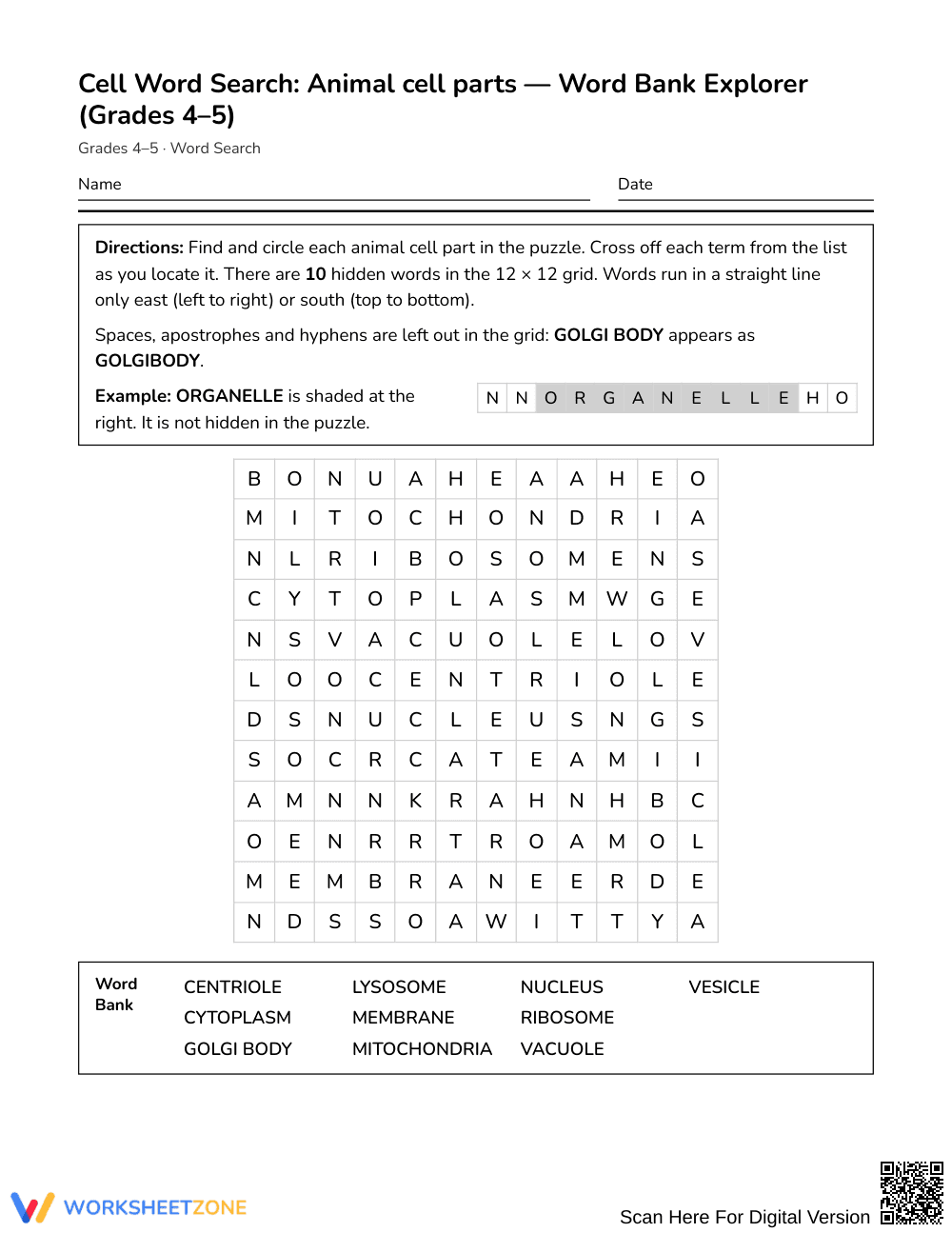

Ready Animal Cell Parts Word Search | Grades 4–5 Science

Paste this activity's link or code into your existing LMS (Google Classroom, Canvas, Teams, Schoology, Moodle, etc.).
Students can open and work on the activity right away, with no student login required.
You'll still be able to track student progress and results from your teacher account.
This animal cell word search reinforces foundational biology vocabulary for upper elementary learners by engaging them in identifying essential organelle terms. Students locate ten key cell structures while connecting scientific terminology to biological functions, building visual recognition and retention before complex cellular biology units.
At a Glance
- Grade: Grades 4–5 · Subject: Science
- Standard: Not standards-assessed — vocabulary enrichment building foundational life science terms
- Skill Focus: Identifying key animal cell parts and organelle recognition
- Format: 1 page · 10 words · Answer key included · PDF
- Best For: Independent vocabulary review, emergency sub plans, and early finishers
- Time: 15–20 minutes
What's Inside
This printable science resource contains a single-page puzzle sheet accompanied by a comprehensive three-page answer key. Students scan the letter arrangement to locate 10 fundamental biological structures, referencing an alphabetized word bank that lists terms ranging from the nucleus to the mitochondrion. The complete three-page answer key clearly highlights each hidden term, making verification fast and accurate for teachers or self-checking students.
Puzzle Structure and Mechanics
The activity is built on a clean 12 by 12 letter grid designed specifically for Grades 4–5 learners. Hidden words run strictly in two directions: horizontally from left to right (East) and vertically from top to bottom (South). There are no diagonal or backward placements, preventing unnecessary frustration while reinforcing scanning fluency. Students cross off each term from the alphabetical word bank as they discover it within the grid.
Standards Alignment
This word search serves strictly as vocabulary enrichment and is not aligned to a formal state or national content standard. It provides supplementary terminology reinforcement to support general life science coursework without adding complex assessment demands.
How to Use It
Introduce this puzzle immediately after direct instruction on cell organelles as an engaging check for terminology familiarity, or assign it during independent practice stations. During work time, observe whether students scan methodically by initial letters or search randomly, noting students who struggle to recognize multi-syllable terms like centriole or cytoplasm. The entire activity typically takes 15 to 20 minutes to complete.
Who It's For
This activity is designed for Grades 4–5 science students exploring cell structures for the first time. For students requiring additional scaffolding, educators can highlight initial letters directly on the grid. Pair this word search naturally with an illustrated animal cell diagram or an organelle function matching chart to solidify the connection between cell part names and their biological roles.
According to Fisher & Frey (2014), purposeful vocabulary acquisition activities build the foundational word knowledge necessary for sustained reading comprehension in disciplinary content areas like life science. Integrating low-stakes terminology searches allows upper elementary students to develop orthographic familiarity with complex technical words such as membrane, ribosome, vacuole, and vesicle. When learners repeatedly locate and decode multi-syllabic domain-specific vocabulary in print, they reduce cognitive load during subsequent hands-on science lessons and complex informational reading tasks. While this animal cell parts word search is not tied to a specific assessment standard, targeted word discovery promotes active word consciousness and long-term retention. Fisher & Frey (2014) emphasize that intentional, repeated exposure to academic terms across diverse, low-anxiety instructional formats directly accelerates student confidence when transitioning from basic recognition to conceptual scientific explanation and functional cell analysis in later grades.


