




























Views
Downloads




Ready Acid-Base Calculation Worksheet | Grade 11 Chemistry

Paste this activity's link or code into your existing LMS (Google Classroom, Canvas, Teams, Schoology, Moodle, etc.).
Students can open and work on the activity right away, with no student login required.
You'll still be able to track student progress and results from your teacher account.
This comprehensive chemistry worksheet guides eleventh-grade students through calculating aqueous hydronium concentrations, pH values, dissociation constants, and neutralization stoichiometry. By working through multi-step analytical problems, high school learners solidify their understanding of logarithmic scales, weak-acid equilibrium expressions, and acid-base titration mechanics across diverse solution systems.
At a Glance
- Grade: 11 · Subject: Chemistry
- Standard: High School Physical Science — Calculate pH, hydronium concentrations, dissociation constants, and titration equivalence points in aqueous systems
- Skill Focus: Acid-Base Calculation Check
- Format: 5 pages · 12 problems · Answer key included · PDF
- Best For: Quantitative unit review and assessment practice
- Time: 45–60 minutes
What's Inside
This 5-page printable resource delivers 12 comprehensive problems organized into three distinct parts, supported by an essential reference formula header detailing Kw, pH formulas, and logarithmic significant figure rules. The worksheet includes conceptual evaluation tasks, multi-step dilution and stoichiometry problems, and data-interpretation prompts using synthetic titration curves. A complete 4-page answer key provides step-by-step mathematical solutions, chemical equations, and equilibrium verifications.
Skill Progression
- Guided practice (Part A, Problems 1–3): Students solve 3 foundational problems calculating hydronium concentrations, evaluating strength versus concentration conceptually, and handling diprotic dissociation using explicit formula guidance.
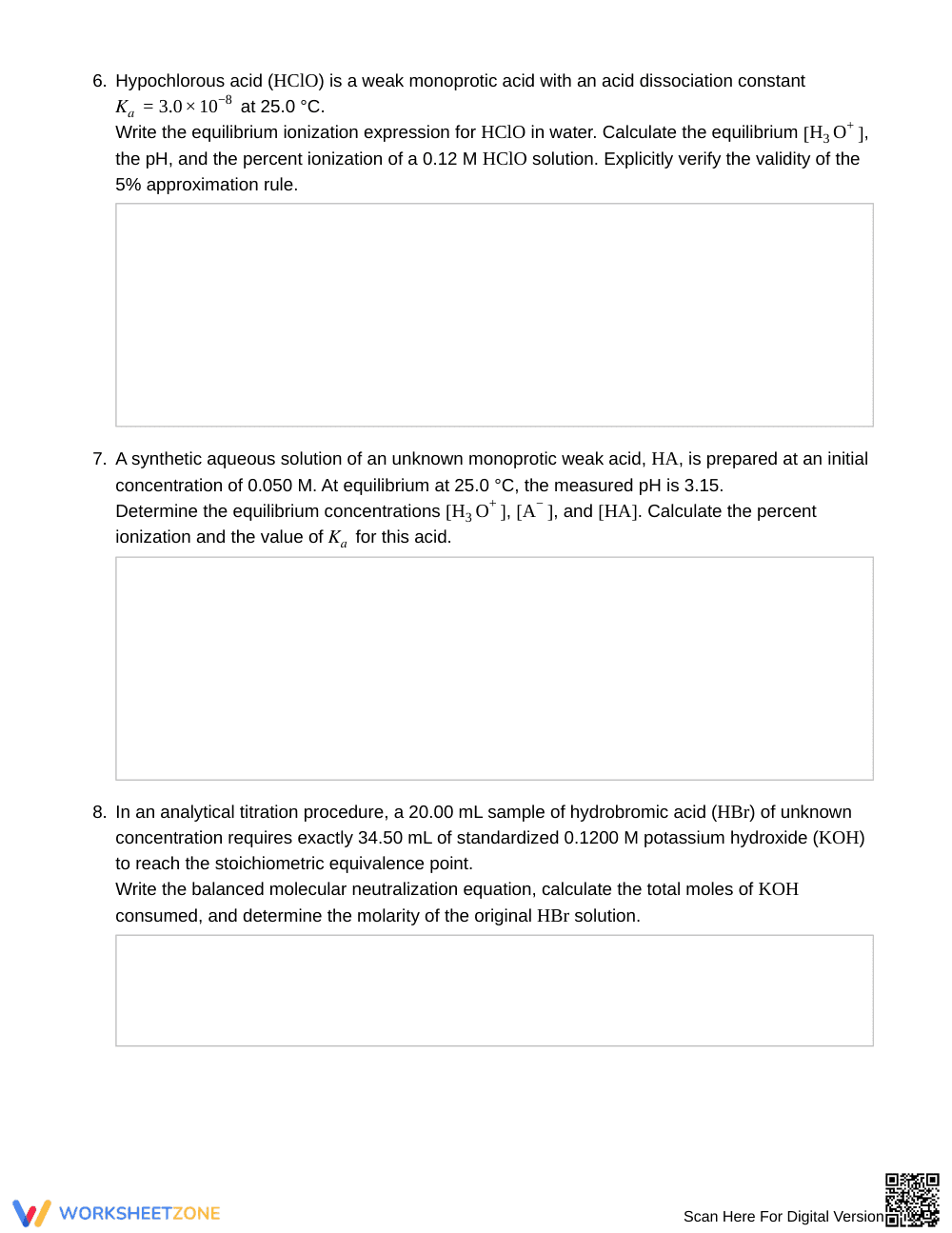
- Supported practice (Part B, Problems 4–9): Learners tackle 6 multi-step quantitative applications spanning solution dilutions, mass-to-pH conversions, weak-acid Ka determinations with the 5% approximation rule, and titration stoichiometry.
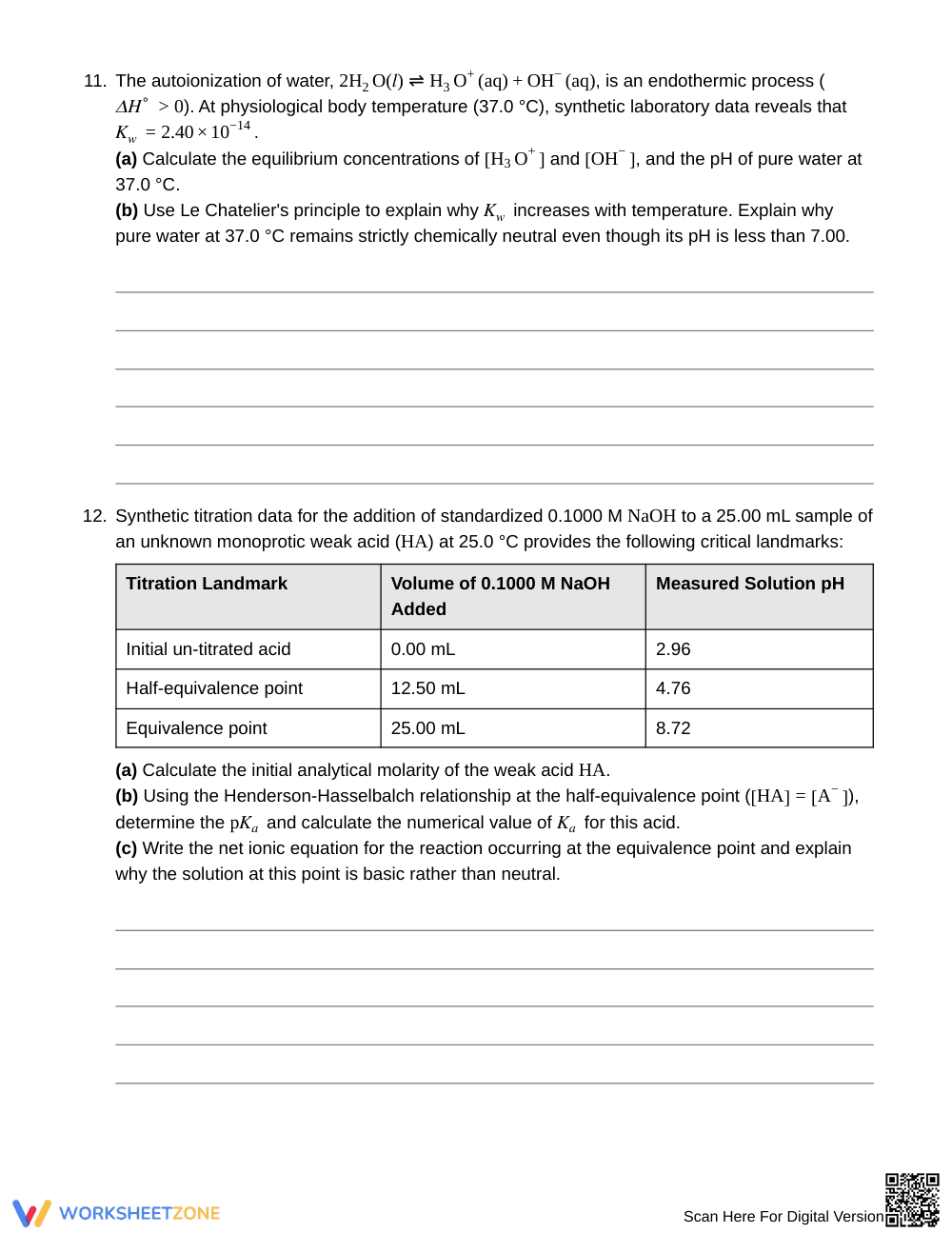
- Independent practice (Part C, Problems 10–12): Students apply equilibrium reasoning to 3 transfer challenges, including temperature-dependent autoionization of water, neutralization comparisons, and weak-acid titration curve analysis.
This systematic design follows the gradual release of responsibility model, shifting students from guided logarithmic manipulation to independent chemical reasoning.
Standards Alignment
This resource aligns with high school chemistry expectations requiring students to calculate hydronium concentrations, determine dissociation constants, and evaluate acid-base neutralizations. Supporting standards emphasize quantitative chemical equilibrium and stoichiometric analysis. Both standard codes can be copied directly into lesson plans, IEP goals, or district curriculum mapping tools.
How to Use It
Deploy this worksheet after direct instruction on acid-base equilibrium and titration curves as an intensive review before a summative unit exam. Alternatively, assign Parts A and B during class for guided collaborative problem-solving, reserving Part C for an individual extension challenge. During work time, check Part B, Problem 6 to observe whether students verify that the ionization remains under 5% before accepting simplified equilibrium approximations. Students typically finish the 12 problems within 45 to 60 minutes.
Who It's For
This exercise targets Grade 11 chemistry students and advanced physical science learners mastering equilibrium calculations. To support struggling learners, highlight the formula box constants on page 1 before independent practice begins. Pair this assignment with a hands-on neutralization laboratory experiment or a modeled titration curve demonstration to connect mathematical symbols to empirical color changes.
Structured quantitative practice in eleventh-grade chemistry directly builds procedural fluency and conceptual transfer across complex chemical equilibrium systems. According to Fisher & Frey (2014), scaffolds that transition learners methodically from modeled calculations to independent analytical challenges significantly enhance problem-solving retention in secondary science. This acid-base calculation resource targets student mastery of aqueous solution equilibria, guiding learners through hydronium and hydroxide determinations, weak-acid dissociation constant evaluations, and stoichiometric titration calculations. By pairing explicit mathematical constraints, such as logarithmic significant figure conventions and the 5% ionization approximation rule, with real-world chemical systems, the 12-problem sequence prevents common algebraic errors and deepens conceptual differentiation between acid concentration and molecular acid strength. High school educators can use this verified five-page set to diagnose analytical misconceptions, reinforce multi-step mathematical workflows, and prepare students for advanced chemistry assessments with complete instructional fidelity.


