































Ready 4-Letter Game Words Word Search | Grades 4–5 ELA

Paste this activity's link or code into your existing LMS (Google Classroom, Canvas, Teams, Schoology, Moodle, etc.).
Students can open and work on the activity right away, with no student login required.
You'll still be able to track student progress and results from your teacher account.
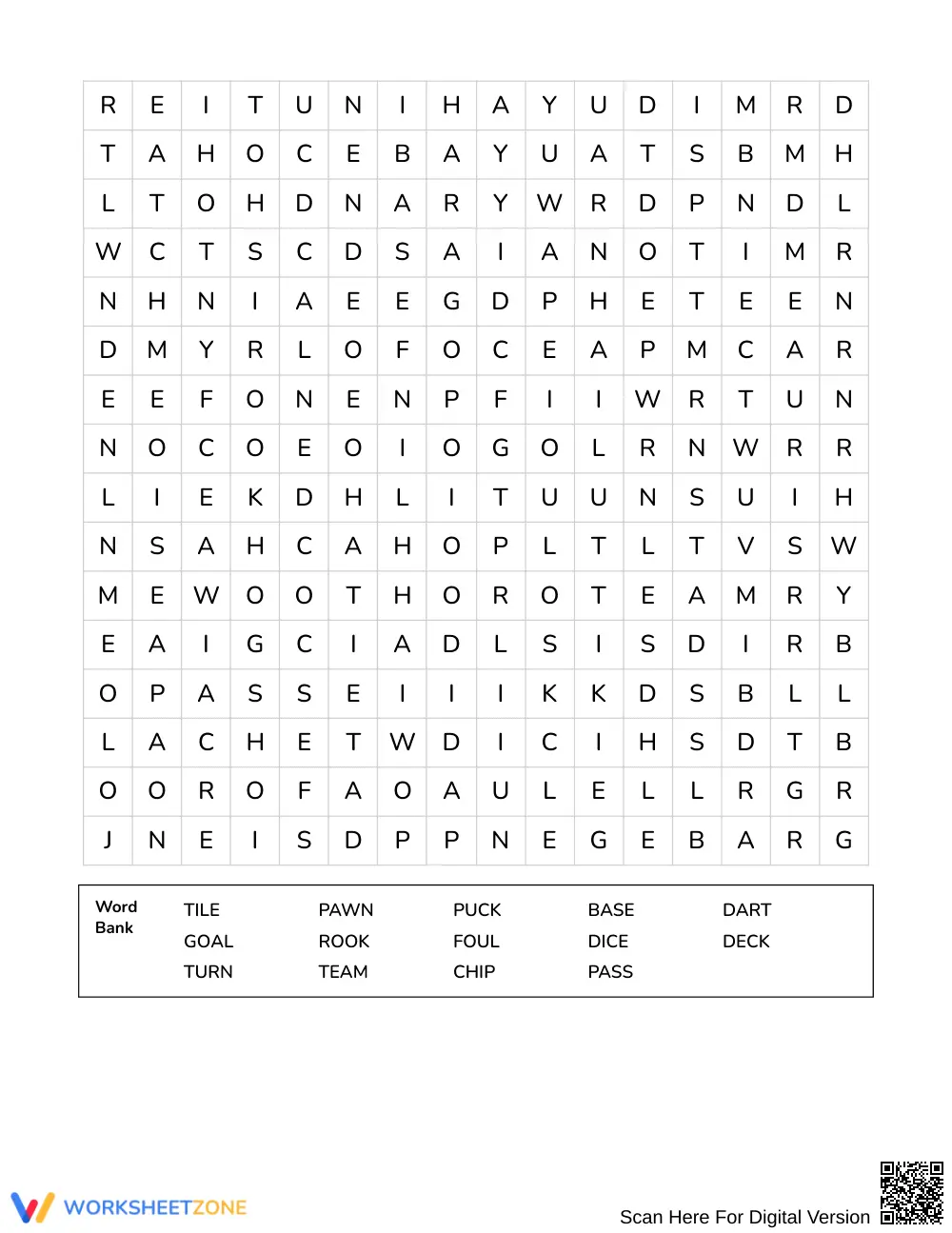
Reinforce sports and tabletop game vocabulary with this engaging clue-based word search designed for upper elementary learners. Students decode 14 contextual clues to identify target four-letter terms before hunting for each word in the puzzle grid, building semantic connections, spelling accuracy, and independent reading comprehension skills across a quick, motivating literacy session.
At a Glance
- Grade: Grades 4–5 upper elementary · Subject: English Language Arts (ELA)
- Standard: Not standards-assessed — vocabulary enrichment
- Skill Focus: Solving definition clues for four-letter game words
- Format: 3 pages · 14 hidden words · Complete full-size answer key included · PDF
- Best For: Independent early finishers, substitute plans, literacy centers
- Time: 15–25 minutes of focused active search
This 3-page printable resource delivers an engaging game-themed vocabulary challenge. The activity features 14 descriptive definition clues covering athletics and board games, accompanied by a shuffled word bank that prompts learners to solve each clue before searching. A complete 3-page solution set with highlighted grid paths allows for swift grading or student self-checking.
Puzzle Mechanics & Grid Design
The puzzle is built on a structured 16 x 16 letter grid. Target words are hidden in four directional paths: northeast (diagonal up-right), east (horizontal forward), southeast (diagonal down-right), and south (vertical downward). Because backward and upward placements are omitted, intermediate readers can focus on letter patterns without visual frustration. Learners read clues for terms like PAWN, PUCK, and FOUL, unscramble or identify the matching word from the shuffled bank, and trace the sequence across the grid.
Standards Alignment
This word search is designed strictly as vocabulary enrichment and is not aligned to a standard. Instead of formal testing criteria, it reinforces contextual inferencing, orthographic memory, and content-area terminology related to recreational games, making it ideal for low-stakes vocabulary growth and cross-curricular physical education tie-ins.
How to Use It
Use this word search after direct instruction on context clues or sports-related thematic units. It functions smoothly as a low-prep early finisher task or as an engaging station within a weekly literacy rotation. During independent work time, observe whether students read the clues first or jump straight to scanning the grid; prompting them to identify the word before searching reinforces vocabulary retention. Most learners finish the entire puzzle within 15 to 25 minutes.
Who It's For
This resource is crafted for students in Grades 4–5 who benefit from purposeful wordplay and semantic reinforcement. It offers natural scaffolding for English language learners and striving readers through clear, student-friendly clue definitions. Pair this activity with an anchor chart on sports idioms or an informational reading passage about the history of board games.
Vocabulary enrichment activities that integrate contextual clues with orthographic search patterns support durable lexical acquisition in intermediate elementary classrooms. As highlighted by Fisher & Frey (2014), intentional word study requires students to interact with target terms across multiple meaningful encounters, linking semantic definitions to visual letter sequences rather than memorizing isolated lists. This 3-page word search for Grades 4–5 targets 14 four-letter game words through descriptive clues, reinforcing athletic and tabletop terminology such as ROOK, TILE, DECK, and PASS. By embedding directional scanning across a structured 16 x 16 grid alongside definition matching, the puzzle strengthens cognitive word retrieval, visual tracking, spelling awareness, and contextual reasoning without standard-specific testing stress. Teachers can deploy this low-prep resource during literacy centers, independent seatwork, or substitute days to sustain purposeful academic engagement while building foundational vocabulary mastery in any classroom.


