


























Views
Downloads
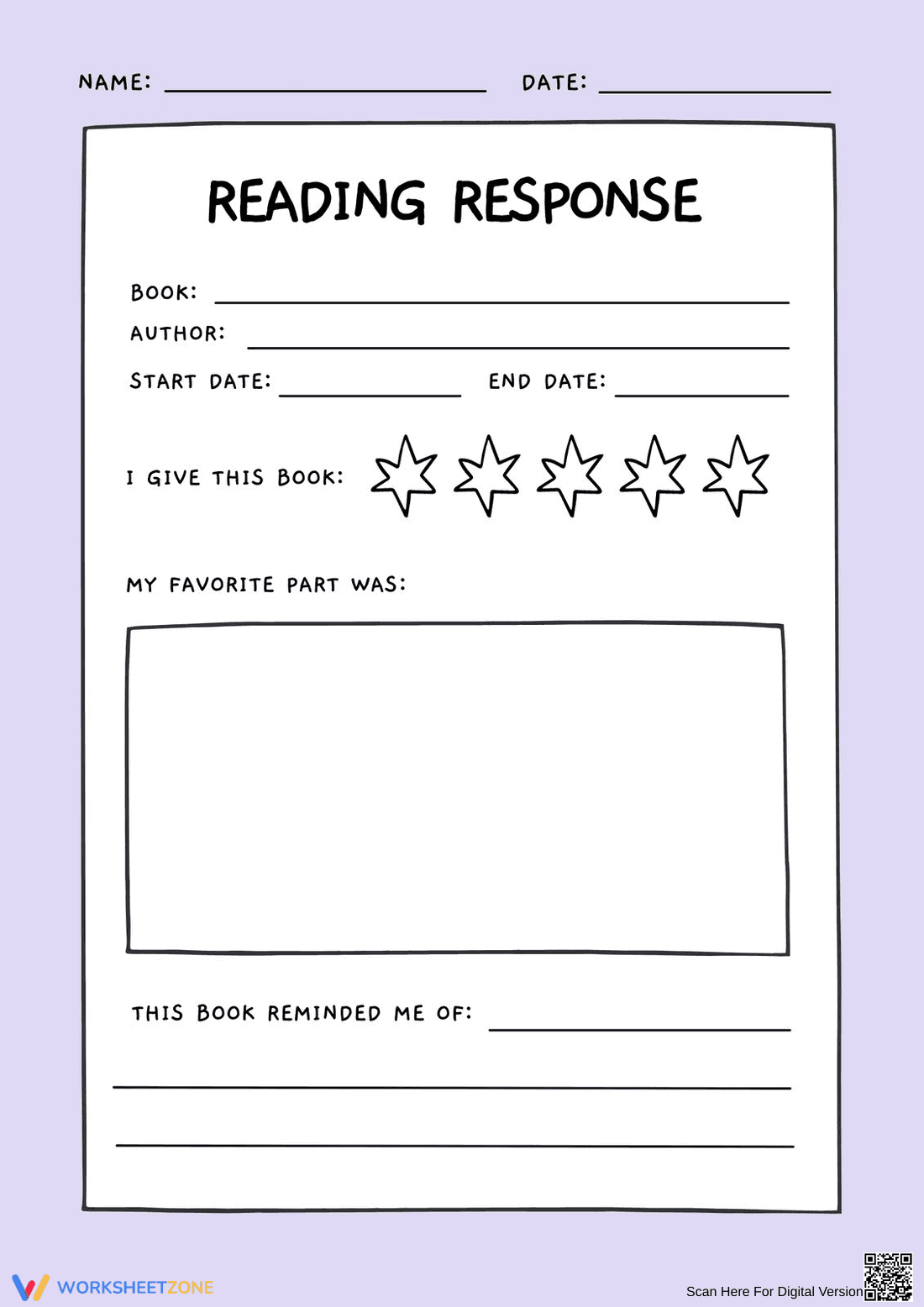

Printable Reading Response Worksheet Grade 1
Paste this activity's link or code into your existing LMS (Google Classroom, Canvas, Teams, Schoology, Moodle, etc.).
Students can open and work on the activity right away, with no student login required.
You'll still be able to track student progress and results from your teacher account.
This reading response worksheet helps early elementary students articulate their thoughts and opinions after completing a book. By prompting learners to rate the story, illustrate their favorite part, and make personal connections, the activity builds foundational comprehension and expressive writing skills in a highly accessible format.
At a Glance
- Grade: 1 · Subject: ELA
- Standard:
CCSS.ELA-LITERACY.W.1.1— Write an opinion about a named book- Skill Focus: Reading comprehension and text connections
- Format: 1 page · 3 tasks · Open-ended · PDF
- Best For: Independent reading centers
- Time: 10–15 minutes
This single-page resource features a clean layout designed for young readers. It includes spaces for the book title and author, a five-star rating system, a large blank box for drawing a favorite scene, and lined space for text connections. Because responses are personal, an answer key is not required.
Zero-Prep Workflow
- Print (1 minute): Generate enough copies for your reading groups or whole class. The black-and-white design is highly printer-friendly.
- Distribute (1 minute): Hand out the sheets immediately following a read-aloud or during independent reading time.
- Review (3 minutes): Students can easily share their star ratings and illustrations with a partner, requiring minimal teacher facilitation.
Total teacher preparation time is under two minutes, making this an ideal, reliable option for emergency sub plans or spontaneous literacy center rotations.
Standards Alignment
This activity aligns directly with CCSS.ELA-LITERACY.W.1.1, requiring students to write opinion pieces naming the book, stating an opinion, and supplying a reason. By asking students to rate the book and identify a favorite part, it scaffolds foundational opinion writing. Both standard codes can be copied directly into lesson plans, IEP goals, or district curriculum mapping tools.
How to Use It
Deploy this worksheet during independent reading blocks to hold students accountable for their self-selected texts. Alternatively, use it as a whole-class follow-up activity after a shared read-aloud to guide group discussion. As a formative assessment tip, observe whether students' illustrations accurately reflect key details from the text rather than unrelated concepts. Most students will complete the required drawing and writing tasks within a 10 to 15-minute timeframe.
Who It's For
This resource is primarily designed for first-grade students, though it serves as an excellent tool for kindergarteners who can express their thoughts through drawing, or second graders needing a quick comprehension check. To differentiate for developing writers, teachers can allow students to dictate their text connections while focusing independently on the illustration component. It pairs perfectly with any classroom library book or decodable reader.
Integrating structured response activities into early literacy routines significantly impacts long-term reading comprehension. When students engage with CCSS.ELA-LITERACY.W.1.1 to write an opinion about a named book, they actively transition from passive listeners to critical thinkers. According to Fisher & Frey (2014), providing consistent, low-stakes opportunities for students to articulate their thoughts about texts fosters deeper cognitive engagement and improves overall retention of narrative structures. This worksheet format encourages that engagement by combining visual representation with brief written reflections. By routinely asking students to evaluate texts and draw personal connections, educators build a solid foundation for the complex analytical skills required in later grades. This simple tool effectively bridges the gap between basic decoding and meaningful text interaction, ensuring young readers develop both competence and confidence.


