


























Views
Downloads



Printable Telling Time Worksheet: Reading Hours — Grade 2-4
Paste this activity's link or code into your existing LMS (Google Classroom, Canvas, Teams, Schoology, Moodle, etc.).
Students can open and work on the activity right away, with no student login required.
You'll still be able to track student progress and results from your teacher account.
This printable Grade 2-4 math worksheet provides comprehensive practice for students mastering the essential skill of telling time on analog clocks. By identifying hour-hand positions across 24 distinct problems, learners build the foundational visual literacy required for time management. This resource ensures students can accurately translate analog dial positions into written numerical time formats.
At a Glance
- Grade: 2–4 · Subject: Math
- Standard:
CCSS.2.MD.C.7— Tell and write time from analog and digital clocks- Skill Focus: Reading hours on analog clocks
- Format: 4 pages · 24 problems · Answer key included · PDF
- Best For: Independent practice and morning work
- Time: 15–25 minutes
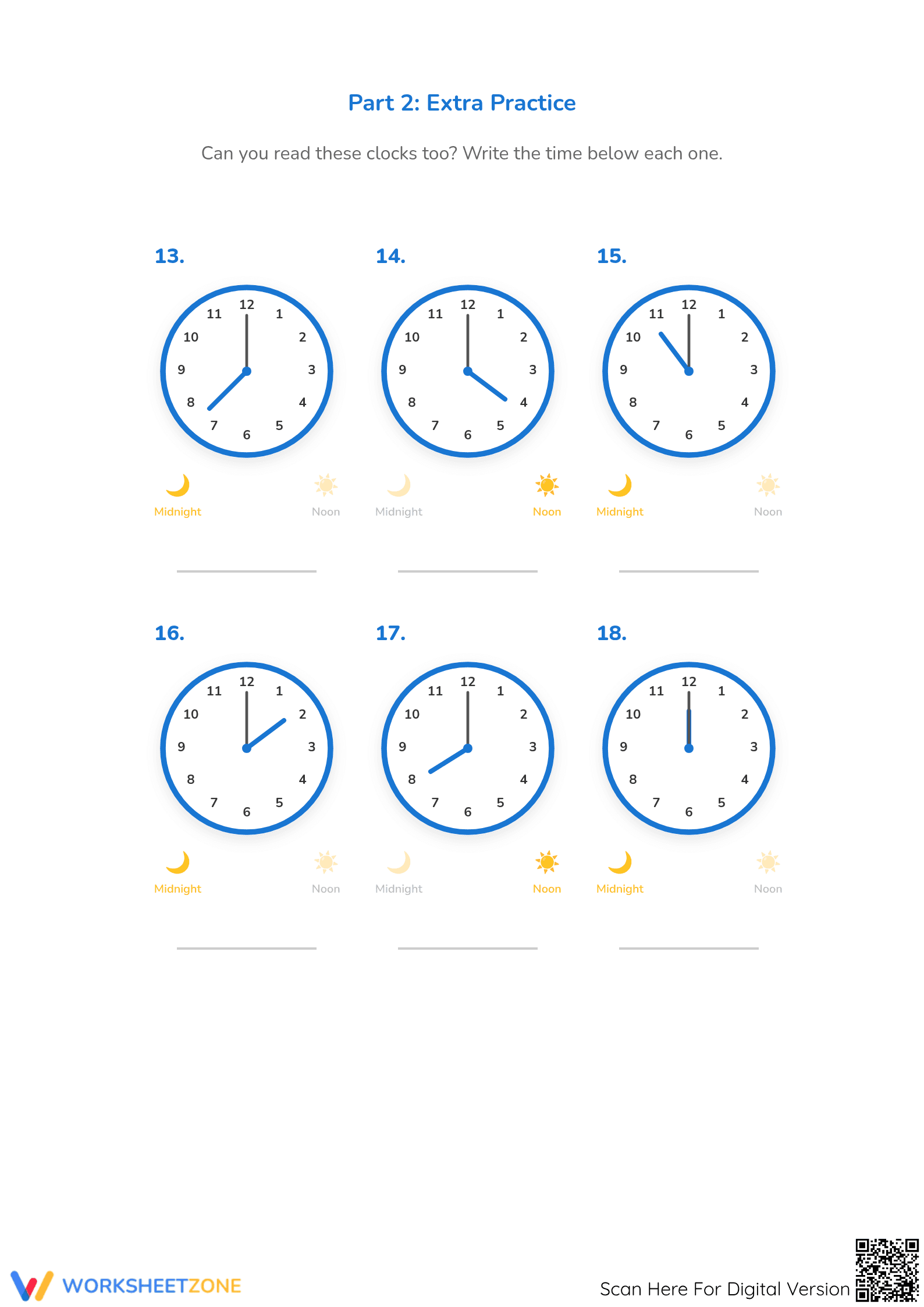
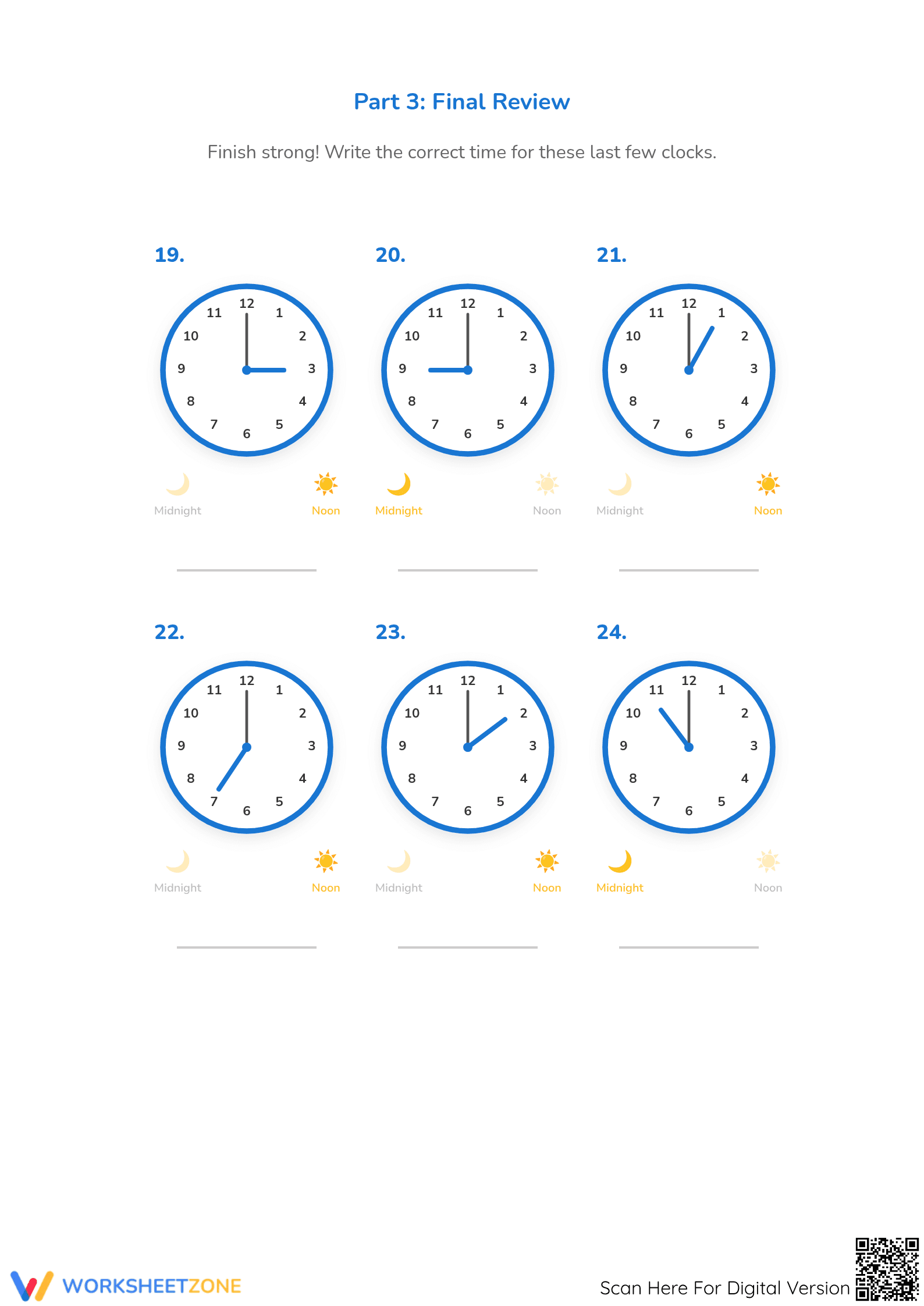
This four-page instructional set contains 24 problems focused on one-hour intervals. The worksheet features high-contrast analog faces with hour and minute hands clearly distinguished. Each page is divided into manageable sections: Part 1 focuses on Morning and Afternoon identification, Part 2 provides Extra Practice, and Part 3 serves as a Final Review. A complete answer key is provided.
Implementing this resource requires zero teacher preparation. 1. Print: Simply select the pages needed and print for your class. 2. Distribute: Hand out the worksheets as a transition activity. 3. Review: Use the included answer key to check for accuracy or allow students to self-correct. Total preparation time is under two minutes, making it ideal for busy classroom environments or unexpected sub plans.
The primary standard addressed is `CCSS.MATH.CONTENT.2.MD.C.7`, which requires students to "tell and write time from analog and digital clocks to the nearest five minutes." This resource provides the necessary scaffolding by focusing on the hour mark. Additionally, it supports `CCSS.MATH.CONTENT.1.MD.B.3` regarding time in hours. Both standard codes can be copied directly into lesson plans, IEP goals, or district curriculum mapping tools.
Use this worksheet as a formative assessment after introducing clock faces. It is effective during the Independent Practice phase of a lesson to verify that students distinguish the hour hand's role. Another use case is for morning work to reinforce time-telling fluency. Teachers should observe if students correctly identify the twelve position for the minute hand during these hourly intervals.
This resource is designed for elementary students in Grades 2, 3, and 4 who are developing or reviewing clock-reading skills. It serves as an excellent intervention tool for older students requiring remedial support or as an enrichment activity for first graders ahead of the curve. It pairs naturally with physical Judy Clocks or time-themed anchor charts during direct instruction.
According to the RAND AIRS 2024 analysis of instructional materials, structured visual practice is critical for internalizing abstract concepts like temporal measurement. This Grade 2-4 telling time worksheet applies these findings by providing 24 repetitions of analog clock reading, specifically targeting the primary standard CCSS.2.MD.C.7. Fisher & Frey (2014) emphasize that such scaffolded independent practice is essential for the gradual release of responsibility in mathematics. By isolating the hour-hand movement, this resource reduces cognitive load, allowing students to focus on the spatial relationship between the hands and the numbers. Educational researchers note that frequent, low-stakes practice with analog dials improves overall numerical fluency and spatial reasoning. This printable resource ensures students meet grade-level expectations for reading hours with high accuracy. It is a reliable tool for classroom teachers, tutors, and homeschooling parents seeking verified, standards-aligned content.


