


























Views
Downloads



Essential Reading Hours Analog Clock Worksheet | Grade 2
Paste this activity's link or code into your existing LMS (Google Classroom, Canvas, Teams, Schoology, Moodle, etc.).
Students can open and work on the activity right away, with no student login required.
You'll still be able to track student progress and results from your teacher account.
This essential Grade 2 math worksheet helps students master the foundational skill of reading analog clocks in one-hour intervals. By focusing on whole-hour increments, learners build the spatial awareness needed to identify the hour hand's position accurately. This practice ensures students can fluently translate visual clock faces into written time formats with confidence.
At a Glance
- Grade: 2 · Subject: Math
- Standard:
CCSS.MATH.CONTENT.2.MD.C.7— Tell and write time from analog and digital clocks using a.m. and p.m.- Skill Focus: Analog Clock Reading (Hours)
- Format: 5 pages · 14 problems · Answer key included · PDF
- Best For: Initial time-telling instruction and review
- Time: 15–20 minutes
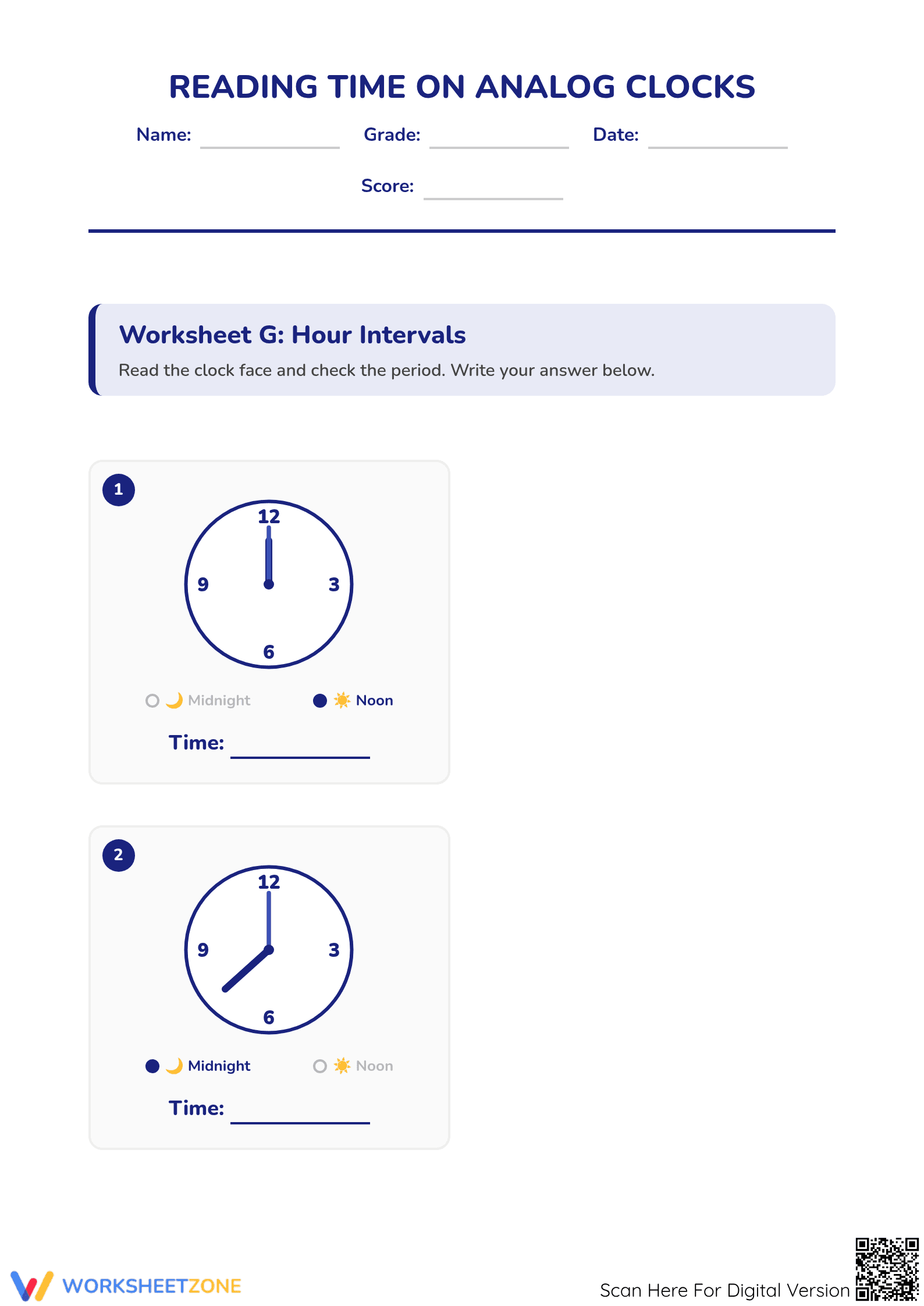
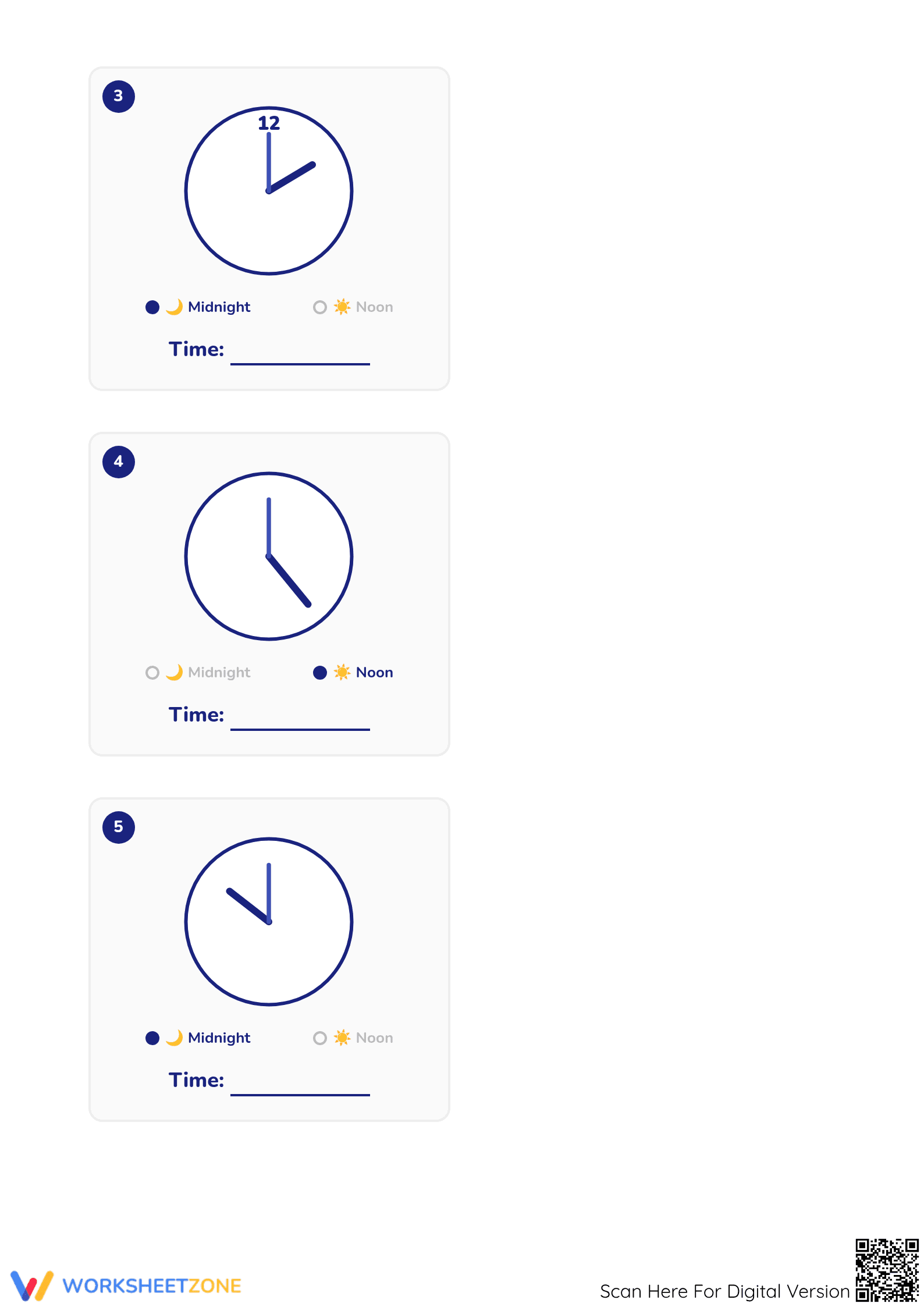
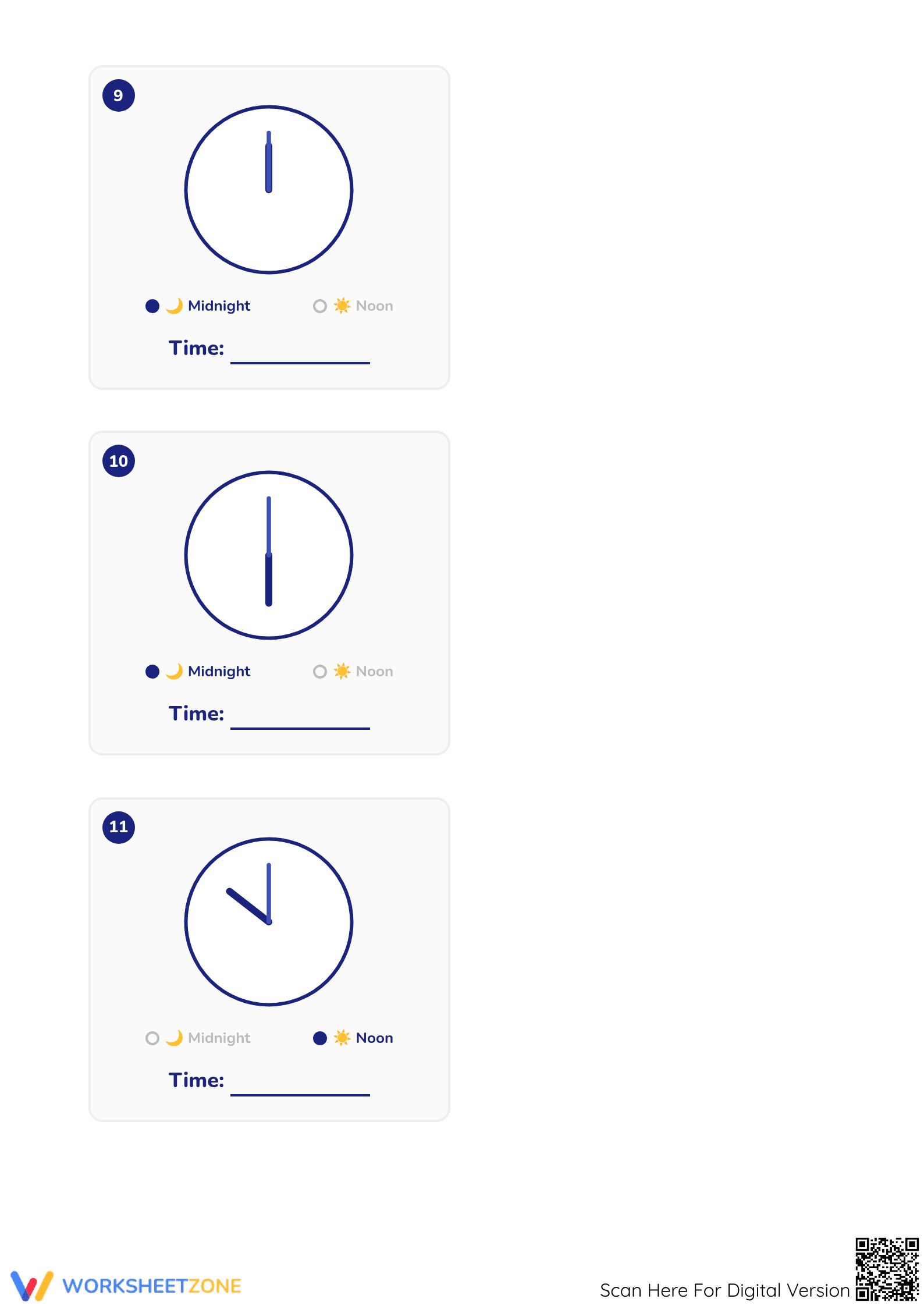
Inside this comprehensive set, teachers will find five pages of structured practice, each featuring large, clear analog clock faces. There are 14 unique problems where students must identify the time and specify the period (Midnight/Noon). The clean layout includes a dedicated scoring section and a QR code for accessing digital versions, while the full answer key ensures immediate feedback.
- Guided practice: Problems 1-2 establish vertical and diagonal positions of the hour hand to build baseline recognition.
- Supported practice: Middle tasks involve varied orientations (2:00, 5:00, 10:00) with am/pm selection to reinforce conceptual understanding.
- Independent practice: Final clocks require students to independently write the numerical time, solidifying mastery of the hour hand movement.
This approach follows the gradual-release model, moving from recognition to independent writing. The primary focus is CCSS.MATH.CONTENT.2.MD.C.7, which requires students to "Tell and write time from analog and digital clocks to the nearest five minutes, using a.m. and p.m." This worksheet provides the essential prerequisite skill of identifying whole hours. Both standard codes can be copied directly into lesson plans, IEP goals, or district curriculum mapping tools.
Use this during the "We Do" phase of a lesson to model hand movement. It also serves as an exit ticket to observe if students confuse the hour and minute hands. Expect students to complete the 14 problems in about 20 minutes. This resource is designed for second-grade students starting their time unit, but it is also effective for third-graders needing remedial support. It pairs naturally with a physical classroom Judy clock to provide a multisensory learning experience.
Proficiency in reading analog clocks is a critical spatial-reasoning milestone that bridges concrete counting with abstract temporal concepts. According to the RAND AIRS 2024 report on elementary mathematics, students who master whole-hour clock reading early demonstrate significantly higher accuracy when transitioning to five-minute intervals and elapsed-time calculations. This Grade 2 resource addresses the specific cognitive load associated with discriminating between the hour and minute hands, a common hurdle in early primary grades. By isolating the hour intervals, the worksheet allows learners to solidify their understanding of the circular number line without the distraction of fractional hour placements. Standardized assessments like the NAEP consistently show that temporal literacy is a predictor of broader mathematical success in later grades. Integrating this focused practice ensures that the standard CCSS.MATH.CONTENT.2.MD.C.7 is met through a logically sequenced pedagogical approach that prioritizes visual clarity and repetitive reinforcement for long-term retention.


