


























Views
Plays
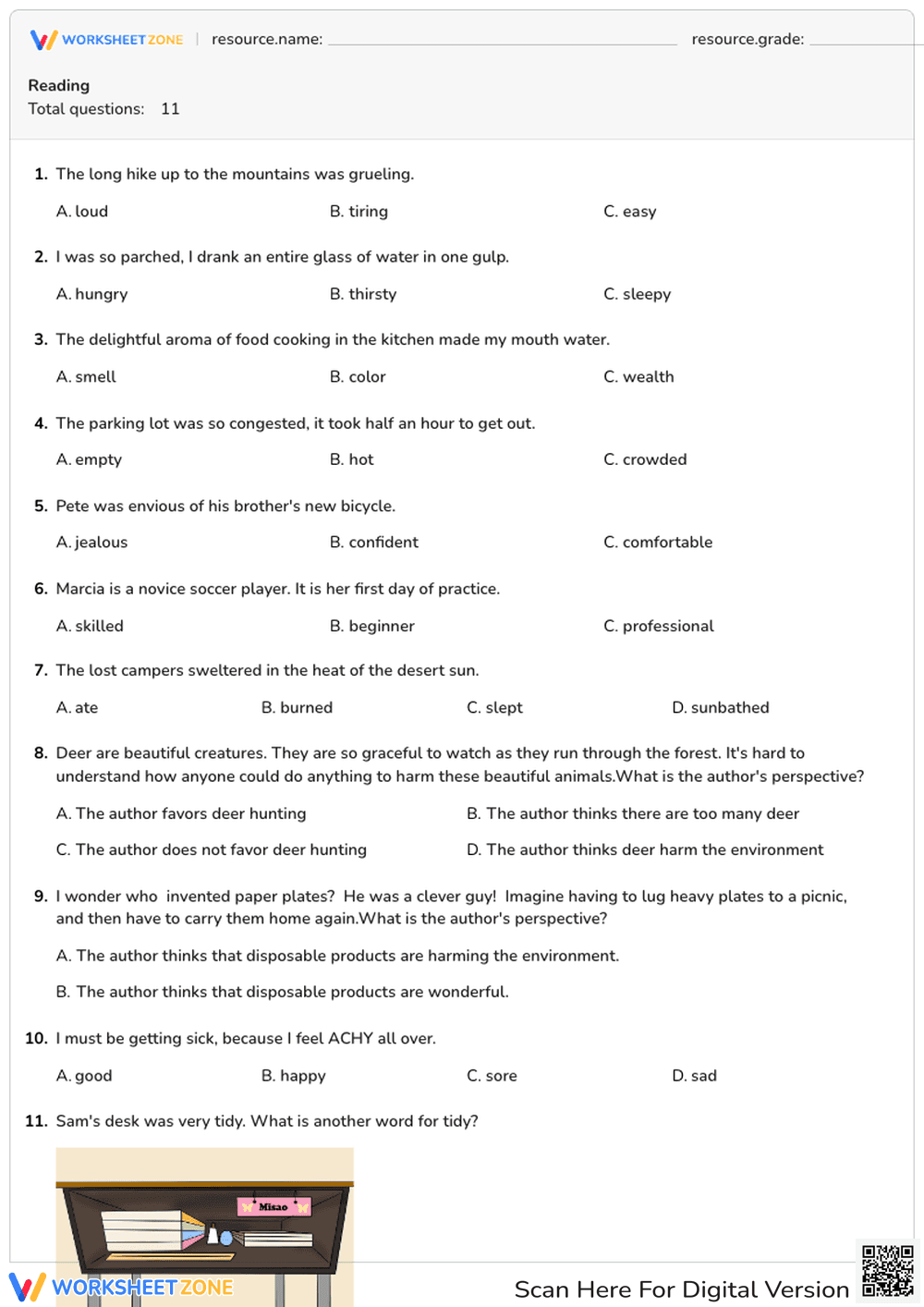

Grade 6-7 Synonyms & Perspective | Essential Worksheet
Paste this activity's link or code into your existing LMS (Google Classroom, Canvas, Teams, Schoology, Moodle, etc.).
Students can open and work on the activity right away, with no student login required.
You'll still be able to track student progress and results from your teacher account.
This Grade 6 and 7 ELA worksheet strengthens vocabulary acquisition and reading comprehension through targeted synonym identification and perspective analysis. Students engage with 11 contextual problems designed to improve word choice recognition and inferential thinking. By identifying nuances in meaning, learners build the linguistic precision necessary for middle school academic success.
At a Glance
- Grade: 6-7 · Subject: ELA Reading
- Standard:
CCSS.ELA-LITERACY.L.6.5.C— Use the relationship between particular words to better understand each of the words- Skill Focus: Synonyms and Author's Perspective
- Format: 1 page · 11 problems · Answer key included · PDF
- Best For: Quick formative assessment or bell-ringer
- Time: 15–20 minutes
The resource features a single-page layout containing 11 multiple-choice questions. The first seven items focus on identifying synonyms for Tier 2 vocabulary words like "grueling," "parched," and "novice" within sentence contexts. Questions 8 and 9 transition to short-passage analysis to determine the author's perspective, while the final items return to vocabulary reinforcement. A complete answer key is provided for rapid grading.
This worksheet is designed for immediate classroom implementation with a total teacher prep time of under 2 minutes. Simply print the single-page PDF (30 seconds), distribute to students as a warm-up or exit ticket (30 seconds), and use the included answer key for a quick whole-class review or individual grading (1 minute). It serves as an ideal sub-plan component or a low-stakes quiz.
The primary focus is `CCSS.ELA-LITERACY.L.6.5.C`, which requires students to use word relationships to understand meaning. It also supports `CCSS.ELA-LITERACY.RI.6.6` by asking students to determine an author's point of view or purpose in a text. Both standard codes can be copied directly into lesson plans, IEP goals, or district curriculum mapping tools.
Use this worksheet as a formative assessment after a unit on context clues to gauge student mastery of word relationships. Alternatively, assign it as a "Do Now" activity to settle the class while practicing high-frequency vocabulary. Teachers should observe if students struggle with the transition from single-sentence synonyms to the multi-sentence perspective questions. Completion typically takes 15 to 20 minutes.
This resource is tailored for Grade 6 and 7 students, including English Language Learners (ELL) who benefit from explicit synonym practice. It works well for general education classrooms, resource rooms, or as a supplemental homework assignment. It pairs naturally with a vocabulary anchor chart or a direct instruction lesson on identifying tone and bias in informational texts.
Vocabulary development in the middle grades is a critical predictor of long-term reading proficiency. According to Fisher & Frey (2014), the gradual release of responsibility model is most effective when students are given opportunities to apply word-relationship skills, such as identifying synonyms (CCSS.ELA-LITERACY.L.6.5.C), across varied contexts. This worksheet provides that application by moving from isolated sentence context to short-passage perspective analysis. Research from EdReports (2024) emphasizes that high-quality ELA materials must integrate language standards with reading comprehension to ensure students can decode complex texts. By requiring students to distinguish between subtle word meanings and infer an author's stance, this resource aligns with evidence-based practices for improving literacy outcomes. The 11-task structure offers a statistically significant sample for teachers to identify specific gaps in student vocabulary acquisition or inferential reasoning during formative assessment cycles.


