


























Views
Downloads


Grade 1 Postcard Reading — Printable No-Prep Worksheet
Paste this activity's link or code into your existing LMS (Google Classroom, Canvas, Teams, Schoology, Moodle, etc.).
Students can open and work on the activity right away, with no student login required.
You'll still be able to track student progress and results from your teacher account.
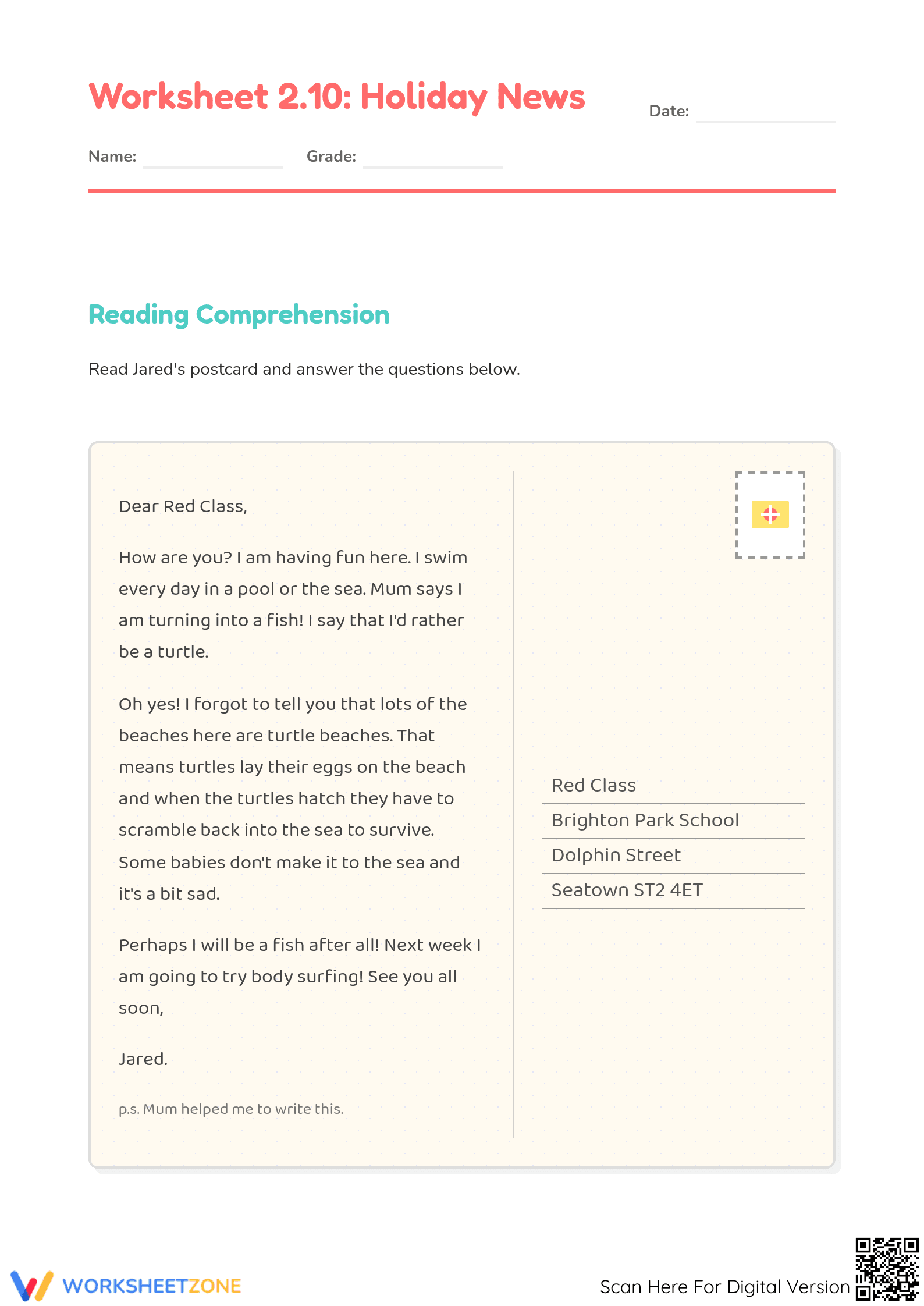
This Grade 1 reading comprehension worksheet helps students practice extracting key details from a short text. By reading a fun, relatable postcard about a beach holiday, young learners develop essential literacy skills and demonstrate their understanding through targeted questions and a creative drawing activity.
At a Glance
- Grade: 1 · Subject: ELA
- Standard:
CCSS.ELA-LITERACY.RL.1.1— Ask and answer questions about key details.- Skill Focus: Reading Comprehension
- Format: 3 pages · 7 problems · Answer key included · PDF
- Best For: Independent practice and sub plans
- Time: 15–20 minutes
What's Inside
This resource includes a three-page packet for early readers. The first page features an engaging postcard text. The second page contains six comprehension questions to test understanding. The third page offers a creative drawing prompt where students illustrate a scene. A complete answer key is provided.
Zero-Prep Workflow
Designed for busy educators, this resource requires absolutely no teacher setup.
- Print (1 minute): Simply print the three-page PDF packet and the separate answer key.
- Distribute (1 minute): Hand out the reading passage and question sheets to students during your literacy block.
- Review (3 minutes): Use the included answer key to quickly check student responses or guide a whole-class review session.
With a total prep time of under two minutes, this activity is an excellent addition to any emergency sub plan or morning work routine.
Standards Alignment
This worksheet is directly aligned to primary standard CCSS.ELA-LITERACY.RL.1.1, requiring students to ask and answer questions about key details in a text. It also supports foundational reading skills by encouraging students to read with sufficient accuracy and fluency to support comprehension. Both standard codes can be copied directly into lesson plans, IEP goals, or district curriculum mapping tools.
How to Use It
Teachers can utilize this postcard reading activity during independent literacy centers or as a whole-group guided reading exercise. When used after direct instruction on finding text evidence, it serves as a practical application of the skill. As a formative assessment observation tip, watch how students locate answers; note whether they look back at the postcard text or attempt to guess from memory. Expected completion time ranges from 15 to 20 minutes, depending on the student's reading fluency.
Who It's For
This resource is primarily designed for Grade 1 and Grade 2 students developing their independent reading abilities. It is easily differentiated by allowing emerging readers to complete the activity in pairs or with teacher guidance, while advanced students can tackle the questions independently. It pairs perfectly with an anchor chart on finding text evidence or a direct instruction lesson on reading friendly letters and postcards.
Mastering early reading comprehension is a critical milestone in elementary education. Aligned with CCSS.ELA-LITERACY.RL.1.1, this resource requires students to ask and answer questions about key details, a foundational skill for lifelong literacy. According to a recent EdReports 2024 analysis, instructional materials that pair short, relatable texts with immediate questioning significantly improve student retention and text-engagement metrics. By utilizing a familiar format like a postcard, young learners can contextualize the information, making the cognitive leap from decoding words to extracting meaning much smoother. This targeted practice ensures that students not only read the words on the page but actively process and reflect upon the narrative. Providing structured opportunities to locate specific information within a text builds the analytical habits necessary for more complex reading tasks in later grades.


