




























Views
Downloads

Sequencing Events Worksheet | Grade K ELA Printable

Paste this activity's link or code into your existing LMS (Google Classroom, Canvas, Teams, Schoology, Moodle, etc.).
Students can open and work on the activity right away, with no student login required.
You'll still be able to track student progress and results from your teacher account.
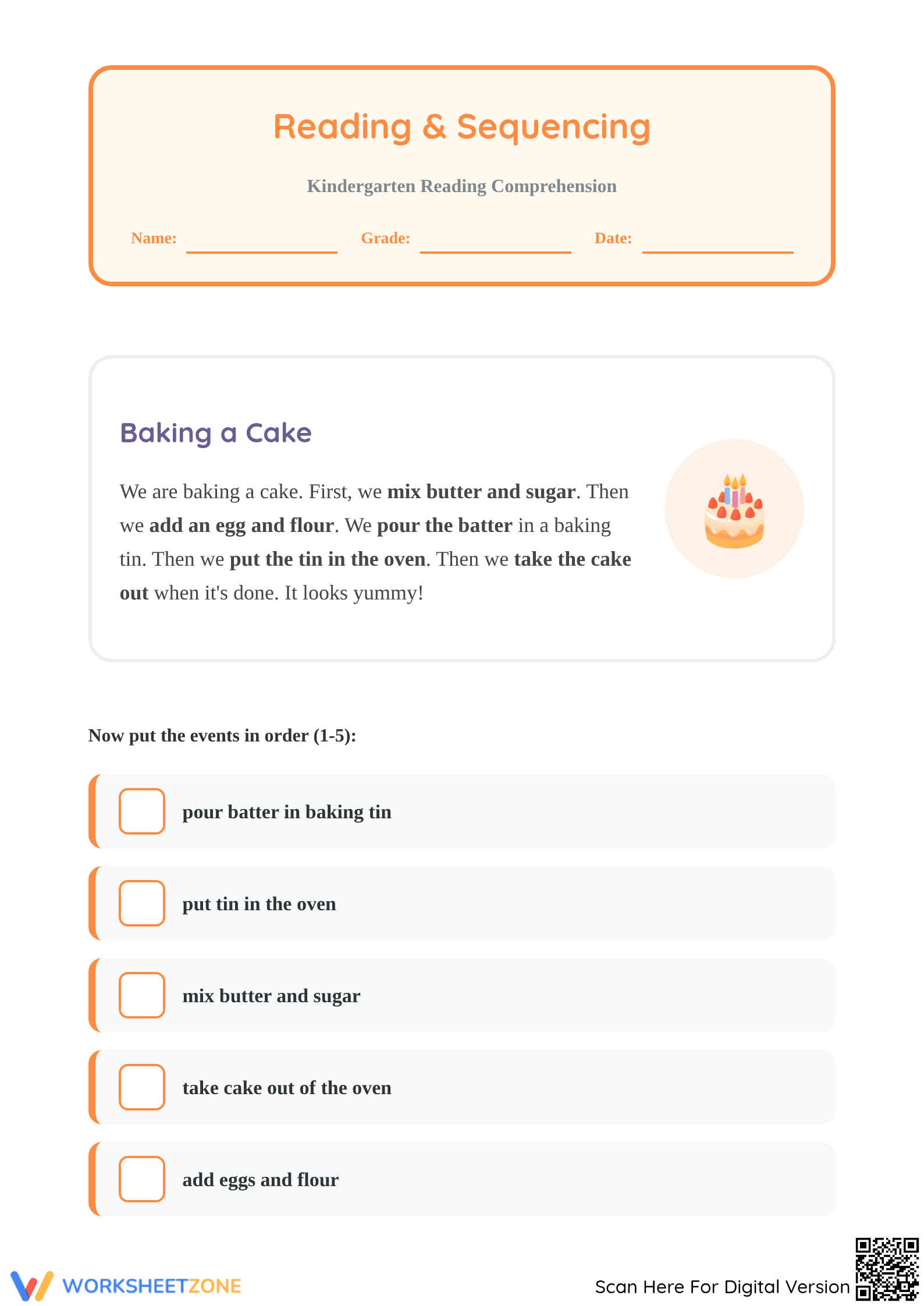
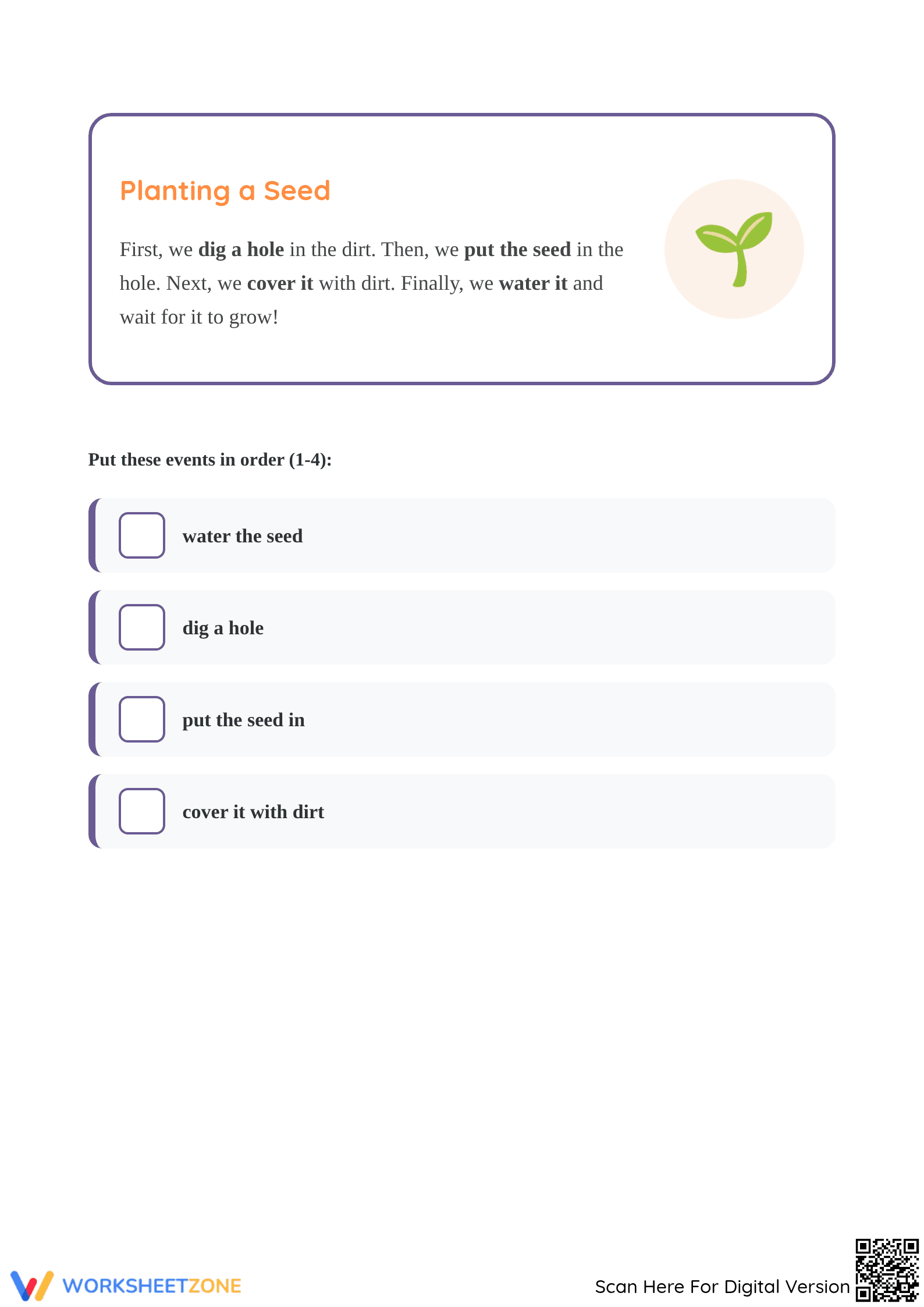
This printable Kindergarten reading comprehension worksheet helps early learners master sequencing by ordering events from short texts. By reading simple passages about baking and planting, students develop foundational literacy skills and learn to identify the beginning, middle, and end of a story.
At a Glance
- Grade: K · Subject: ELA
- Standard:
CCSS.ELA-LITERACY.RL.K.2— Retell stories and order key details- Skill Focus: Sequencing Events
- Format: 2 pages · 9 problems · Answer key included · PDF
- Best For: Independent practice or centers
- Time: 15–20 minutes
Inside this resource, educators will find two reading passages tailored for early readers. The first page features a text about baking a cake, followed by five events to number chronologically. The second page focuses on planting a seed, requiring students to sequence four steps. The worksheet utilizes bolded transition words like "First" and "Then" to provide clear structural cues. A complete answer key is provided.
- Guided practice: Teachers read the passages aloud, emphasizing bolded sequence words to help students identify the narrative flow.
- Supported practice: Students work in pairs to match the question bank sentences to the story, numbering the first steps together.
- Independent practice: Learners complete the remaining sequencing tasks on their own.
This gradual-release approach ensures young readers build confidence as they transition from teacher modeling to independent application.
This worksheet is directly aligned to CCSS.ELA-LITERACY.RL.K.2, requiring students to retell familiar stories and key details with support. By numbering events in the exact order they occurred, children practice cognitive skills necessary for accurate reading comprehension. Both standard codes can be copied directly into lesson plans, IEP goals, or district curriculum mapping tools.
Use this resource during small group literacy centers after a whole-class read-aloud. Alternatively, assign it as morning work to reinforce sequencing concepts. As a formative assessment tip, observe whether students look back at the text to find bolded transition words or guess based on background knowledge. Students typically complete these pages in 15 to 20 minutes.
Designed for Kindergarten students developing basic reading comprehension, this worksheet also serves first-graders needing targeted intervention. To support diverse learners, teachers can pre-highlight transition words. This activity pairs perfectly with a direct instruction lesson on transition words or an anchor chart detailing "First, Next, Then, and Last."
Developing the ability to sequence events is a critical milestone in early childhood literacy that lays the groundwork for advanced reading comprehension. According to a recent ScienceDirect TpT Analysis, explicit instruction in narrative structure and chronological ordering significantly improves overall reading comprehension and information retention in primary grades. When students practice with targeted materials aligned to CCSS.ELA-LITERACY.RL.K.2, they learn to retell stories and order key details with much greater accuracy. This foundational skill not only aids in understanding simple fictional narratives but also prepares young learners for the complex informational texts they will encounter in later academic years. By identifying the beginning, middle, and end of a sequence, children actively strengthen their working memory and logical reasoning capabilities. Providing structured, text-based sequencing tasks ensures that early readers build the essential cognitive frameworks necessary to process, organize, and retain written information effectively throughout their entire educational journey.


