


























Views
Downloads
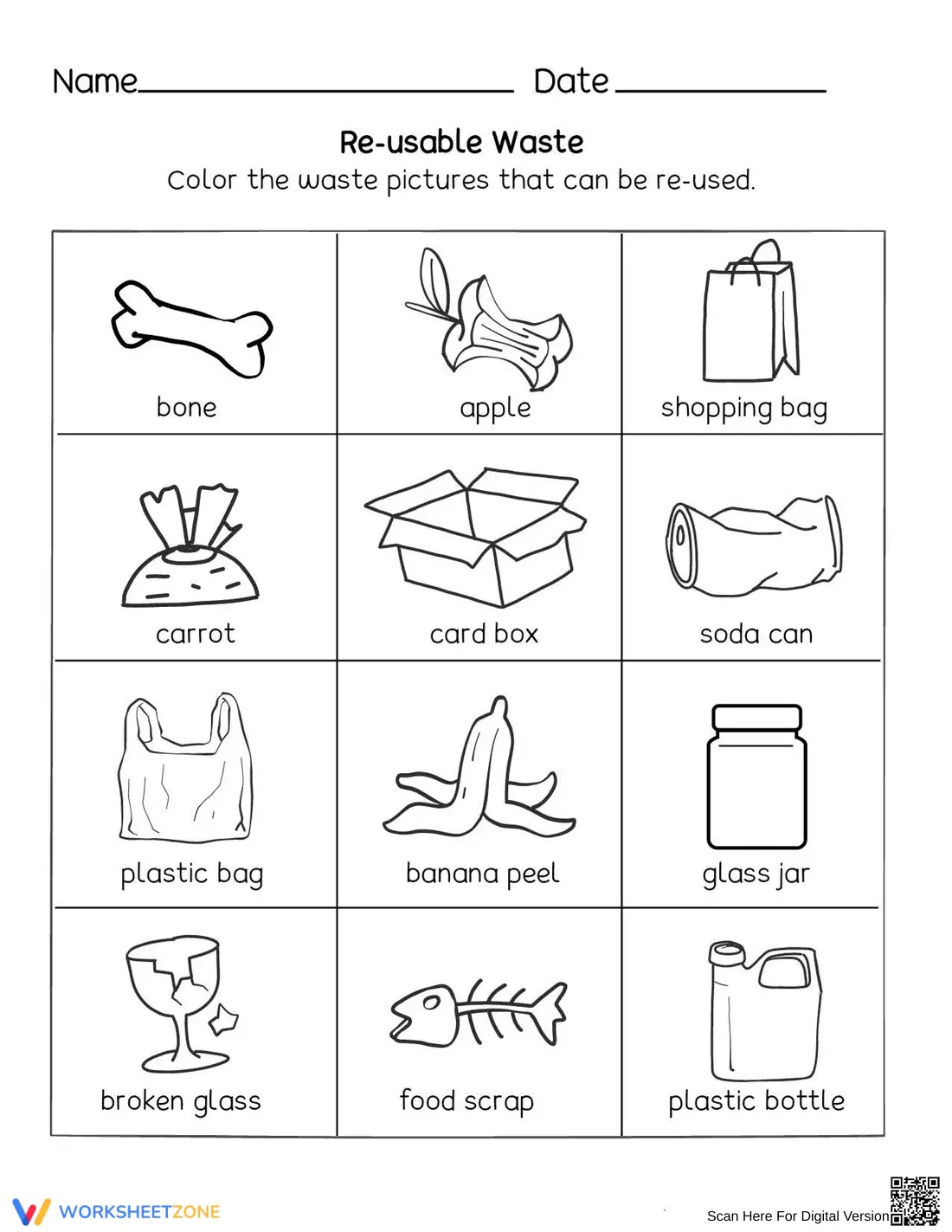

Printable Re-usable Waste Worksheet | Grade 1-3 Science
Paste this activity's link or code into your existing LMS (Google Classroom, Canvas, Teams, Schoology, Moodle, etc.).
Students can open and work on the activity right away, with no student login required.
You'll still be able to track student progress and results from your teacher account.
Identifying reusable items is a core environmental science skill. This worksheet helps students distinguish between trash and treasure by evaluating 12 common household objects. Students develop critical thinking about sustainability while practicing fine motor skills through coloring. It is an essential tool for Earth Day or units on human impact.
At a Glance
- Grade: 1–3 · Subject: Science
- Standard:
K-ESS3-3— Identify items that can be reused to reduce environmental impact- Skill Focus: Identifying reusable materials and waste management
- Format: 1 page · 12 problems · Answer key included · PDF
- Best For: Earth Day activities and environment units
- Time: 15–20 minutes
What's Inside
This single-page PDF features 12 illustrated boxes containing various waste items such as soda cans, glass jars, and food scraps. Each illustration is clearly labeled to support literacy and vocabulary development. The task requires students to evaluate each object based on its potential for reuse, providing a visual and interactive way to engage with sustainability concepts.
Zero-Prep Workflow
- Print the single-page worksheet for your class (30 seconds).
- Distribute the handouts and have students identify and color reusable items (15 minutes).
- Review the answers together using the included key to reinforce environmental concepts (5 minutes).
Total teacher prep time is under 2 minutes, making this an ideal sub plan or quick science filler.
Standards Alignment
This activity aligns with K-ESS3-3, which focuses on communicating solutions to reduce human impact on the land and environment. By identifying items that can be diverted from landfills, students demonstrate an understanding of resource conservation. Both standard codes can be copied directly into lesson plans, IEP goals, or district curriculum mapping tools.
How to Use It
Use this worksheet as a formative assessment after a direct instruction lesson on the Three Rs. Observe students as they work to see if they can justify why certain items like card boxes or glass jars are reusable while food scraps are not. It also serves as a great homework assignment to encourage students to audit waste in their own homes.
Who It's For
Designed for students in Grade 1, Grade 2, and Grade 3, this resource is perfect for general education classrooms, homeschool environments, and special education settings. It pairs naturally with an anchor chart on recycling symbols or a short reading passage about landfill reduction and sustainable living.
The Re-usable Waste Worksheet facilitates mastery of the K-ESS3-3 standard by requiring students to categorize various common materials based on their lifecycle potential. According to the RAND AIRS 2024 report, high-quality visual aids in early science education significantly improve long-term retention of conservation principles and resource management strategies. By engaging with 12 distinct objects in a structured format, students build a robust mental model of waste management that extends beyond the immediate classroom environment. Research from Fisher & Frey (2014) suggests that such scaffolded identification tasks are absolutely critical for developing the foundational environmental literacy needed for more complex ecological studies in later elementary grades. This resource provides a highly structured, evidence-based approach to teaching sustainability, ensuring that young learners can accurately communicate practical solutions for reducing human impact on the planet. By focusing on reuse as a primary strategy, the activity aligns with modern pedagogical shifts toward proactive environmental stewardship and global citizenship.


