


























Views
Downloads

Rate Your Communication — Essential Grade 3-5 Worksheet
Paste this activity's link or code into your existing LMS (Google Classroom, Canvas, Teams, Schoology, Moodle, etc.).
Students can open and work on the activity right away, with no student login required.
You'll still be able to track student progress and results from your teacher account.
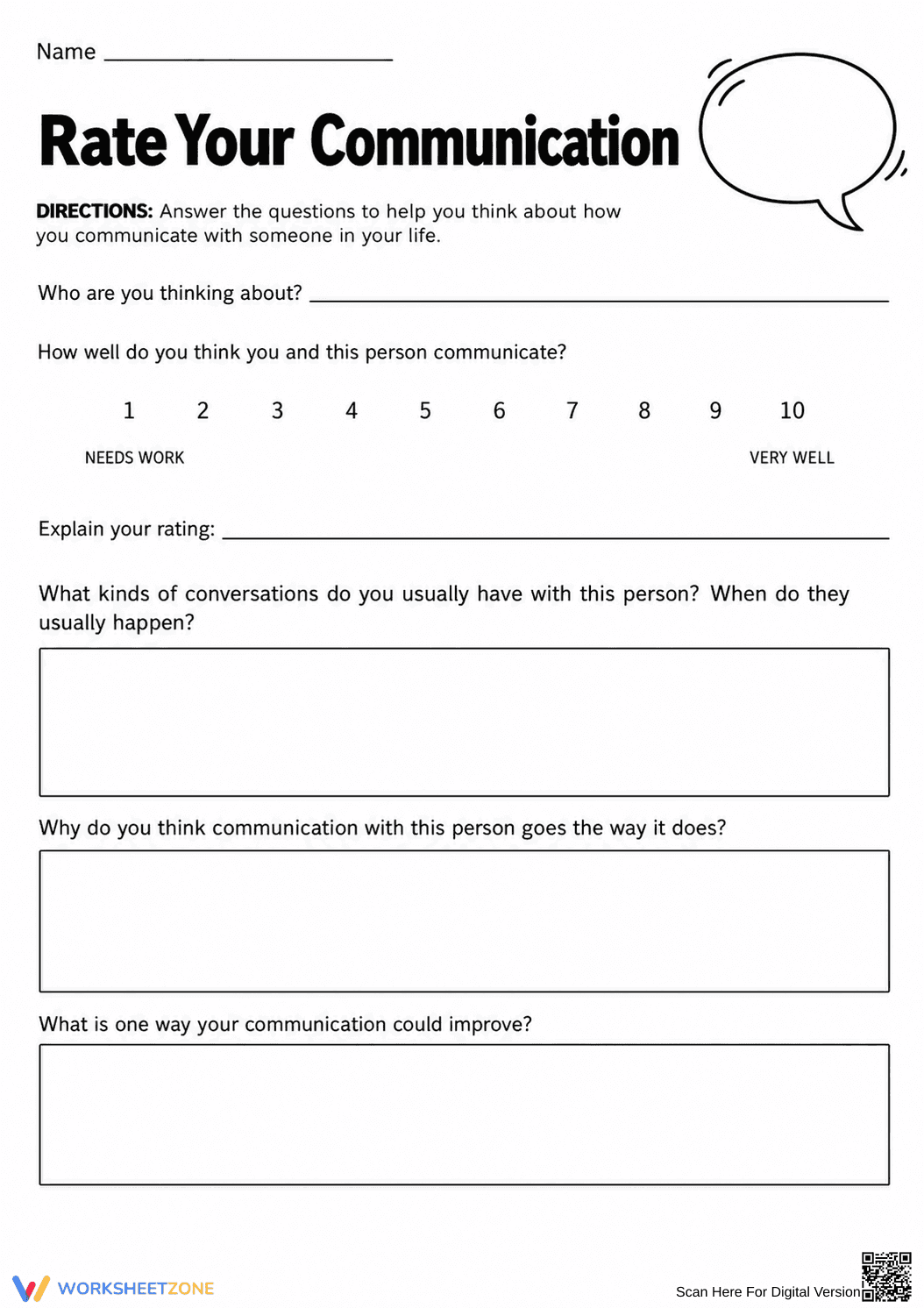
This Grade 3-5 communication worksheet helps students evaluate their interpersonal relationships through structured self-reflection. By rating and analyzing specific interactions, learners identify strengths and areas for growth in their social dynamics. It provides a framework for students to articulate the quality of daily conversations, fostering social-emotional awareness.
At a Glance
- Grade: 3-5 · Subject: Social Skills
- Standard:
CCSS.ELA-LITERACY.SL.3.1— Engage effectively in collaborative discussions and express ideas clearly- Skill Focus: Interpersonal Communication Analysis
- Format: 1 page · 5 problems · No answer key needed · PDF
- Best For: Social-emotional learning and behavior reflection
- Time: 15–20 minutes
This single-page PDF features five targeted reflection prompts designed to guide students through a comprehensive communication audit. It includes a 1-to-10 Likert scale for quantitative self-assessment, followed by open-ended response boxes for qualitative analysis. The layout is clean and distraction-free, providing ample writing space for students to describe communication contexts and brainstorm actionable steps for improving their interpersonal exchanges with specific individuals.
Zero-Prep Workflow
- Print: Generate the single-page PDF for your class in under 1 minute.
- Distribute: Hand out the sheets and explain the goal of reflecting on a specific relationship (30 seconds).
- Review: Analyze student responses during one-on-one check-ins or small group discussions to identify common social hurdles (30 seconds).
The primary focus is `CCSS.ELA-LITERACY.SL.3.1`, which requires students to engage effectively in a range of collaborative discussions and build on others' ideas. By reflecting on their own communication patterns, students develop the metacognitive skills necessary to meet these speaking and listening requirements. Both standard codes can be copied directly into lesson plans, IEP goals, or district curriculum mapping tools.
How to Use It
Use this worksheet during a Social-Emotional Learning (SEL) block after a lesson on active listening or conflict resolution. It serves as an excellent formative assessment tool; observe whether students can identify the "why" behind their communication successes or failures. Expect students to spend 15 to 20 minutes completing the prompts, making it a perfect transition activity or a quiet reflection period following a playground incident.
Who It's For
This resource is designed for elementary students in grades 2 through 5, particularly those working on social skills or behavioral goals. It is highly effective for students with IEPs focusing on pragmatic language or social-emotional regulation. Pair this worksheet with an anchor chart on "I-statements" or a direct instruction lesson on non-verbal communication cues to provide a complete instructional cycle.
According to the RAND AIRS 2024 report, structured self-reflection tools are vital for developing social-emotional competencies in middle childhood. This worksheet addresses the core components of interpersonal effectiveness by requiring students to analyze the context and quality of their interactions. By using the CCSS.ELA-LITERACY.SL.3.1 standard as a foundation, the resource ensures that social skill development is grounded in academic speaking and listening expectations. Research from Fisher & Frey (2014) suggests that metacognitive reflection on social tasks helps students internalize better communication habits over time. This 1-page tool provides the necessary scaffolding for students to move from reactive behavior to intentional interaction. By documenting their thoughts on a 1-to-10 scale and providing written evidence, students create a tangible record of their social growth that can be used for progress monitoring in various educational settings.


