


























Views
Downloads


Printable Past Simple Tense Worksheet | Grade 4 ELA
Paste this activity's link or code into your existing LMS (Google Classroom, Canvas, Teams, Schoology, Moodle, etc.).
Students can open and work on the activity right away, with no student login required.
You'll still be able to track student progress and results from your teacher account.
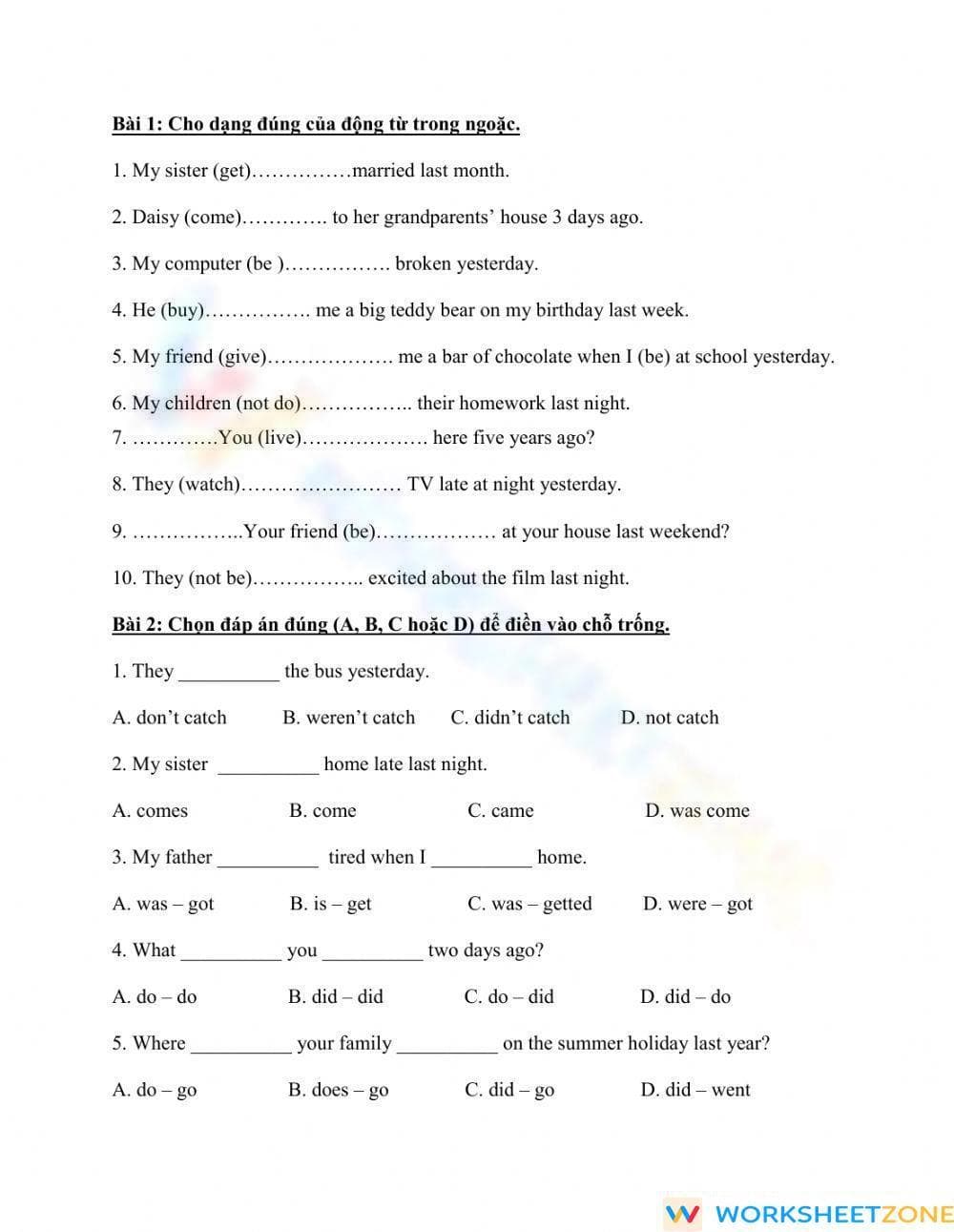
This Past Simple tense worksheet helps students master the formation and use of regular and irregular verbs in the past. By completing 15 structured exercises, learners develop the ability to accurately describe completed actions using correct verb conjugations. Students will successfully transition from identifying time cues to applying precise grammatical rules in both affirmative and negative contexts.
At a Glance
- Grade: Grade 4 · Subject: English Language Arts (ELA)
- Standard:
CCSS.ELA-LITERACY.L.3.1.D— Form and use regular and irregular verbs in the past tense.- Skill Focus: Past Simple Tense Conjugation
- Format: 1 page · 15 problems · Answer key included · PDF
- Best For: Grammar reinforcement and formative assessment
- Time: 15–20 minutes
This single-page PDF contains two distinct sections designed to build verb mastery. The first section provides 10 fill-in-the-blank sentences where students conjugate verbs like "get" and "buy" using temporal cues like "yesterday." The second section features 5 multiple-choice questions that challenge students to select correct auxiliary verbs and past forms, ensuring a comprehensive understanding of sentence structure and negative forms.
- Guided Practice: Contextualized sentences provide time-based clues, helping students identify past tense usage across 10 initial problems.
- Supported Practice: Bracketed base verbs offer structural support, allowing students to focus on the morphological changes of irregular forms.
- Independent Practice: The multiple-choice assessment requires students to evaluate distractors, reinforcing the distinction between present and past auxiliary usage.
This progression follows a gradual-release model, moving from scaffolded conjugation to independent selection and error correction.
The primary focus is CCSS.ELA-LITERACY.L.3.1.D, covering regular and irregular verbs. Exercises target identification of irregular forms (e.g., "came," "bought") and correct auxiliary usage in negative constructions. This standard code can be copied directly into lesson plans, IEP goals, or district curriculum mapping tools.
Use this worksheet as a focused practice session during the "We Do" phase of direct instruction to check for immediate understanding of irregular verb patterns. It also serves as an excellent formative assessment exit ticket after a lesson on past temporal markers. Expect students to complete the entire set of 15 questions within a 15-to-20-minute window.
This resource is ideal for Grade 4 students refining narrative writing or preparing for grammar assessments. It is particularly effective for English Language Learners (ELLs) who require practice with irregular forms. Pair this worksheet with a short passage to have students identify past tense verbs in a broader context.
The ability to accurately conjugate verbs in the Past Simple tense is a foundational requirement for meeting CCSS.ELA-LITERACY.L.3.1.D, ensuring students communicate completed events with precision. Research from Fisher & Frey (2014) emphasizes that targeted practice with irregular verbs is essential for developing grammatical automaticity, which reduces cognitive load during writing. This worksheet provides 15 opportunities for students to apply conjugation rules to regular and irregular verbs, a practice proven to enhance language proficiency. By moving from scaffolded sentences to independent multiple-choice selection, students internalize the relationship between time-based adverbs and verb morphology. Consistent use of focused grammar practice helps bridge the gap between isolated skill acquisition and fluent application in narrative composition. Educators can use the resulting data to identify specific irregular patterns that require further re-teaching or intervention.


