


























Views
Downloads

Printable Letter Q Tracing Worksheet | Grade K ELA
Paste this activity's link or code into your existing LMS (Google Classroom, Canvas, Teams, Schoology, Moodle, etc.).
Students can open and work on the activity right away, with no student login required.
You'll still be able to track student progress and results from your teacher account.
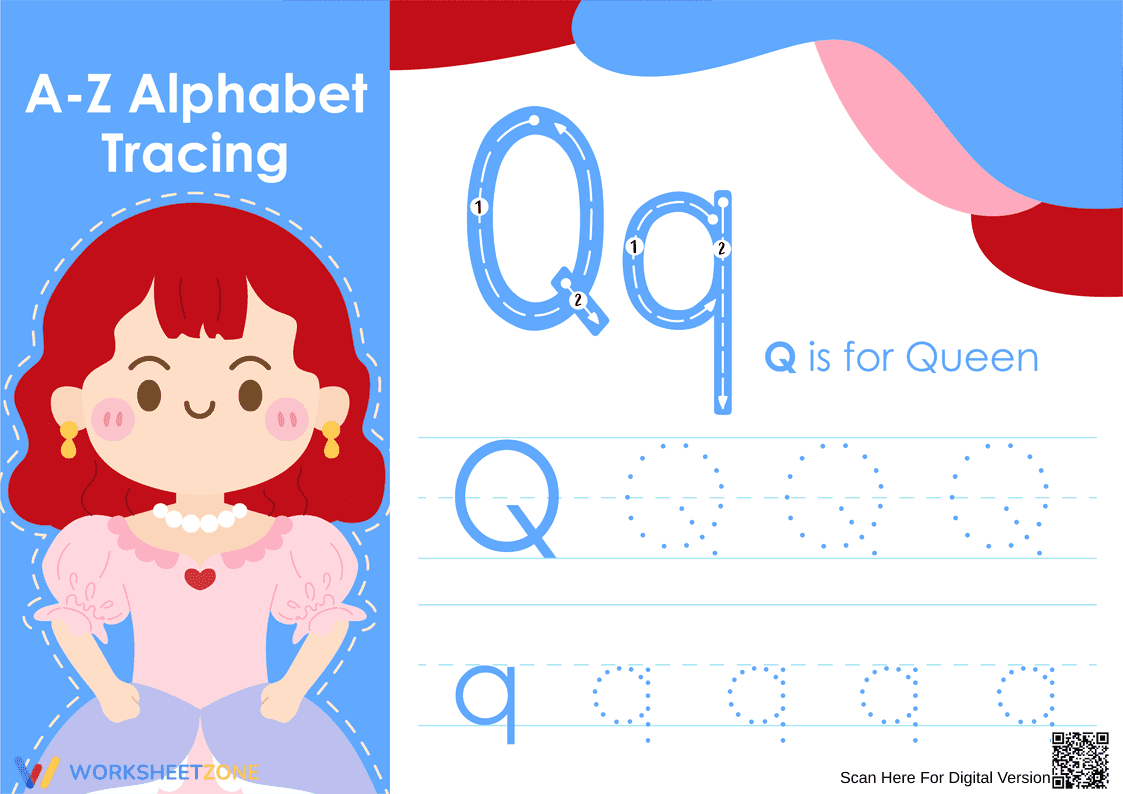
This printable letter Q tracing worksheet helps early learners develop essential fine motor skills and proper letter formation. By practicing both uppercase and lowercase strokes, students build the foundational penmanship required for fluent writing. The clear directional arrows guide young writers toward confident, independent alphabet mastery.
At a Glance
- Grade: K · Subject: ELA
- Standard:
CCSS.ELA-LITERACY.L.K.1.A— Print many upper- and lowercase letters- Skill Focus: Letter Q Formation
- Format: 1 page · 8 problems · No answer key · PDF
- Best For: Morning work and centers
- Time: 5–10 minutes
This single-page resource offers a structured approach to handwriting practice. The page features a large, guided example of both the uppercase and lowercase letter Q, complete with numbered directional arrows to ensure correct stroke order. Below the guided example, students are provided with dotted tracing lines to practice three uppercase and four lowercase letters independently. A visual cue of a queen reinforces the phonetic connection to the letter.
This resource is designed for a zero-prep workflow.
- Print (1 minute): Simply download the PDF and print the required number of copies. No special formatting or color ink is necessary.
- Distribute (1 minute): Hand out the pages along with pencils or crayons. The visual instructions are intuitive for early learners.
- Review (3 minutes): Quickly check student grip and stroke direction as they work through the guided lines.
Total teacher preparation time is under two minutes, making this an excellent addition to any emergency sub plan or independent center rotation.
This worksheet is tightly aligned to CCSS.ELA-LITERACY.L.K.1.A: Print many upper- and lowercase letters. It specifically targets the motor memory and spatial awareness required to form the letter Q correctly on standard handwriting lines. Both standard codes can be copied directly into lesson plans, IEP goals, or district curriculum mapping tools.
Use this tracing page as focused morning work as students arrive, allowing them to settle in with a familiar task. Alternatively, place it in a literacy center alongside tactile letter-building materials like playdough or sand trays. While students trace, observe their pencil grip and ensure they are starting their strokes from the top down, intervening gently if they begin forming the circle of the Q from the bottom. Expected completion time is a brief 5 to 10 minutes.
This resource is designed for preschool and kindergarten students learning the alphabet and developing fine motor control. It serves as an excellent intervention tool for first graders who need remedial handwriting practice or occupational therapy support. Pair this tracing sheet with a whole-group phonics lesson on the /kw/ sound or an interactive read-aloud featuring words that start with the letter Q.
Mastering letter formation is a critical stepping stone toward reading and writing fluency in early childhood education. According to Fisher & Frey (2014), explicit instruction in handwriting and letter recognition significantly impacts a student's cognitive load, allowing them to focus on composition and reading comprehension rather than the physical mechanics of writing. By targeting CCSS.ELA-LITERACY.L.K.1.A, this resource ensures students can print many upper- and lowercase letters with automaticity and precision. The structured progression from guided directional arrows to independent dotted tracing supports the vital development of muscle memory and fine motor control. When young learners practice the specific strokes required for the letter Q, they reinforce the neural pathways connecting visual symbols to motor actions. This foundational skill reduces frustration in later grades and promotes a more confident approach to written expression across all academic subjects.


