




























Views
Downloads

Printable Punnett Square Worksheet | Grade 10 Biology

Paste this activity's link or code into your existing LMS (Google Classroom, Canvas, Teams, Schoology, Moodle, etc.).
Students can open and work on the activity right away, with no student login required.
You'll still be able to track student progress and results from your teacher account.
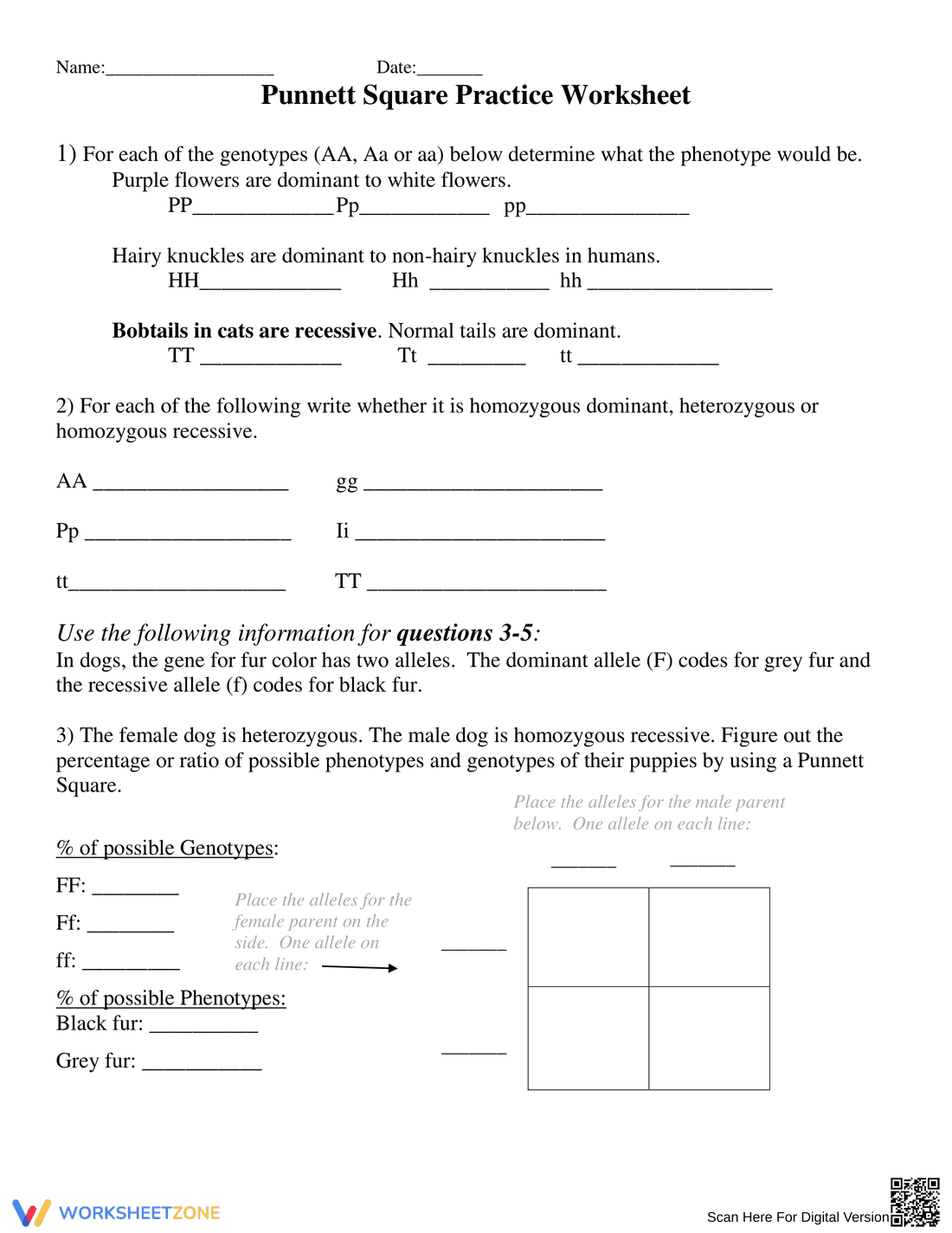
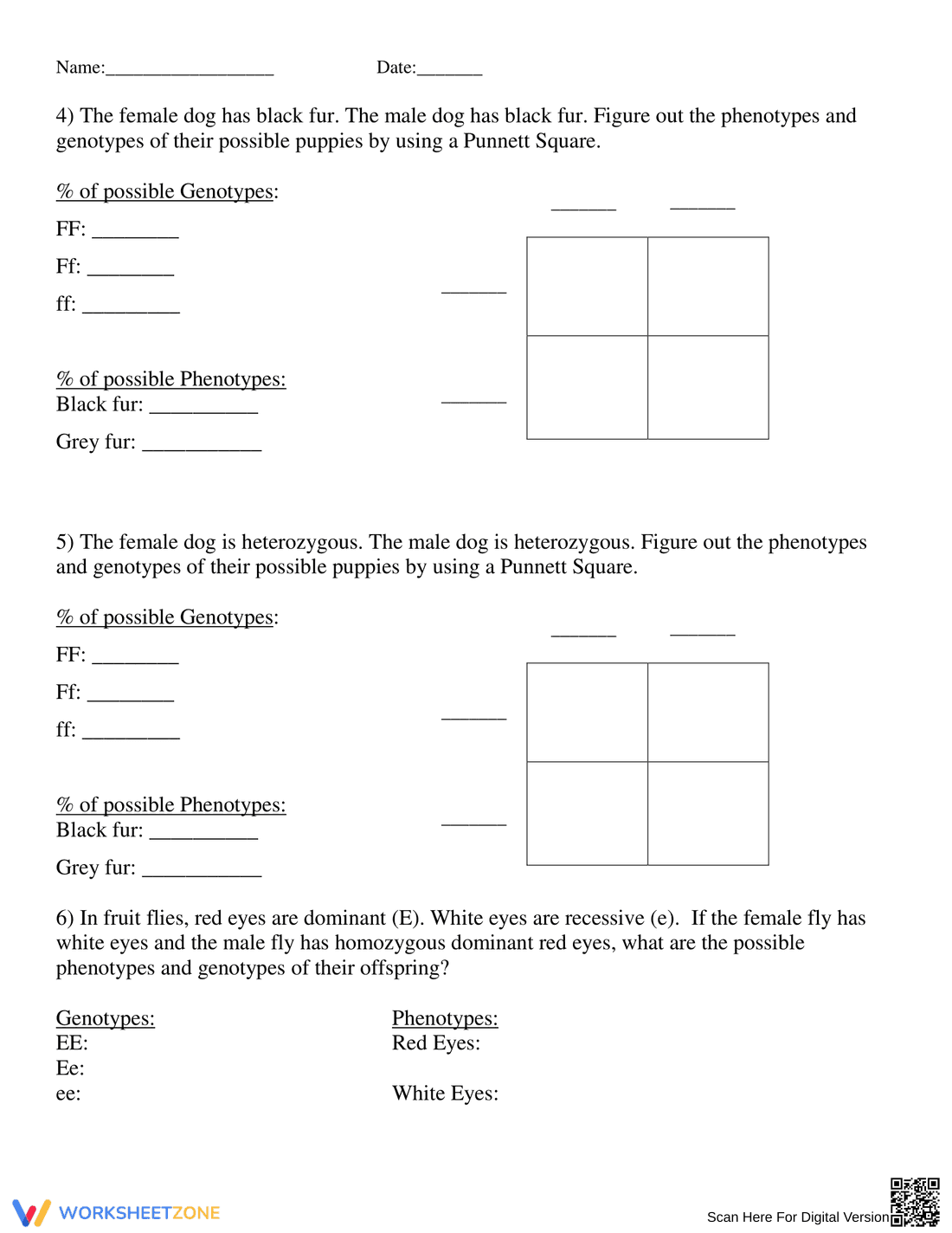
This high school biology worksheet provides targeted practice for calculating genetic probabilities. Students will use Punnett squares to determine the potential genotypes and phenotypes of offspring based on parental traits. By working through these scenarios, learners build a concrete understanding of dominant and recessive inheritance patterns.
At a Glance
- Grade: 10 · Subject: Biology
- Standard:
HS-LS3-3— Apply probability to explain trait variation- Skill Focus: Calculating genotypes and phenotypes
- Format: 3 pages · 8 problems · PDF
- Best For: Independent practice and review
- Time: 25–35 minutes
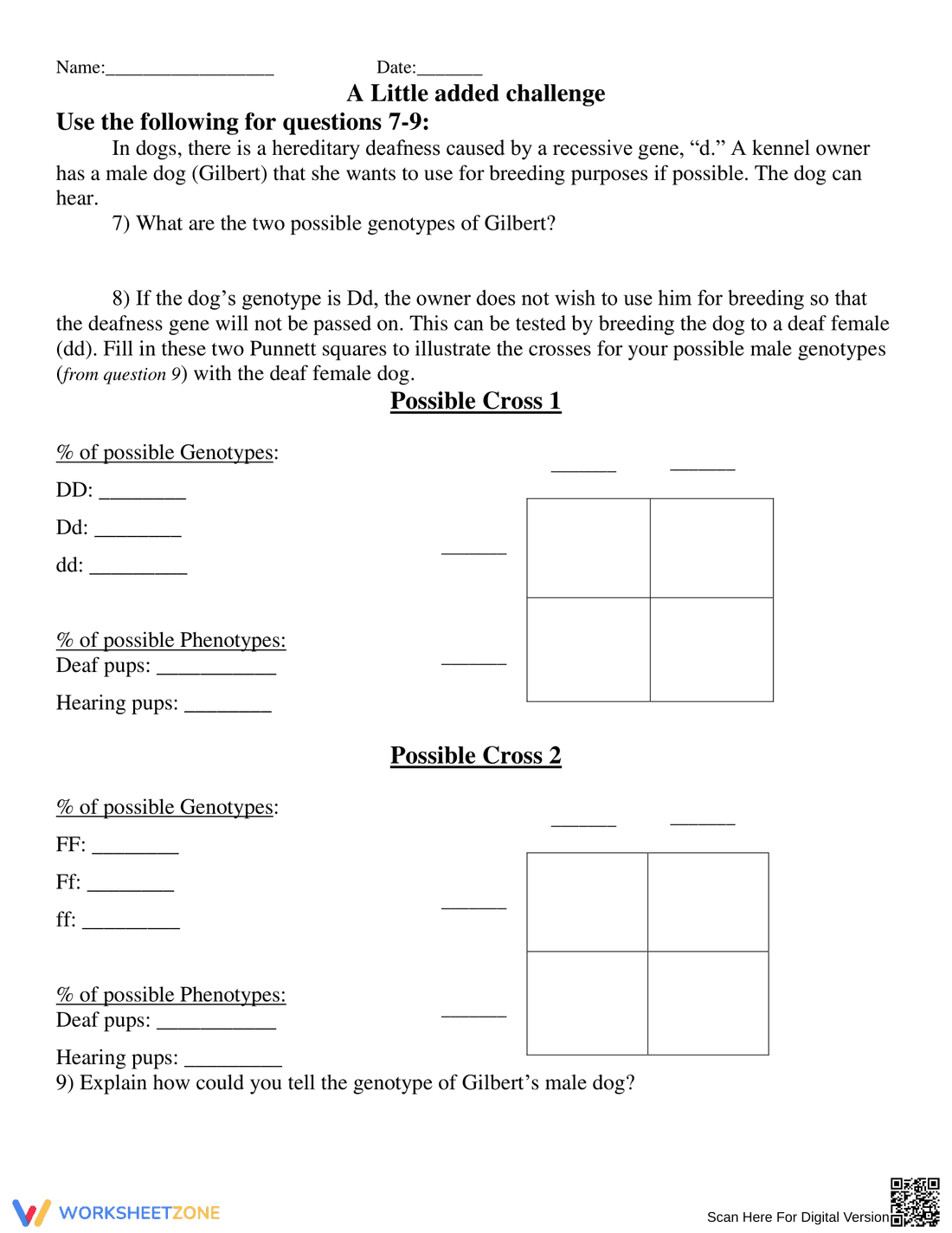
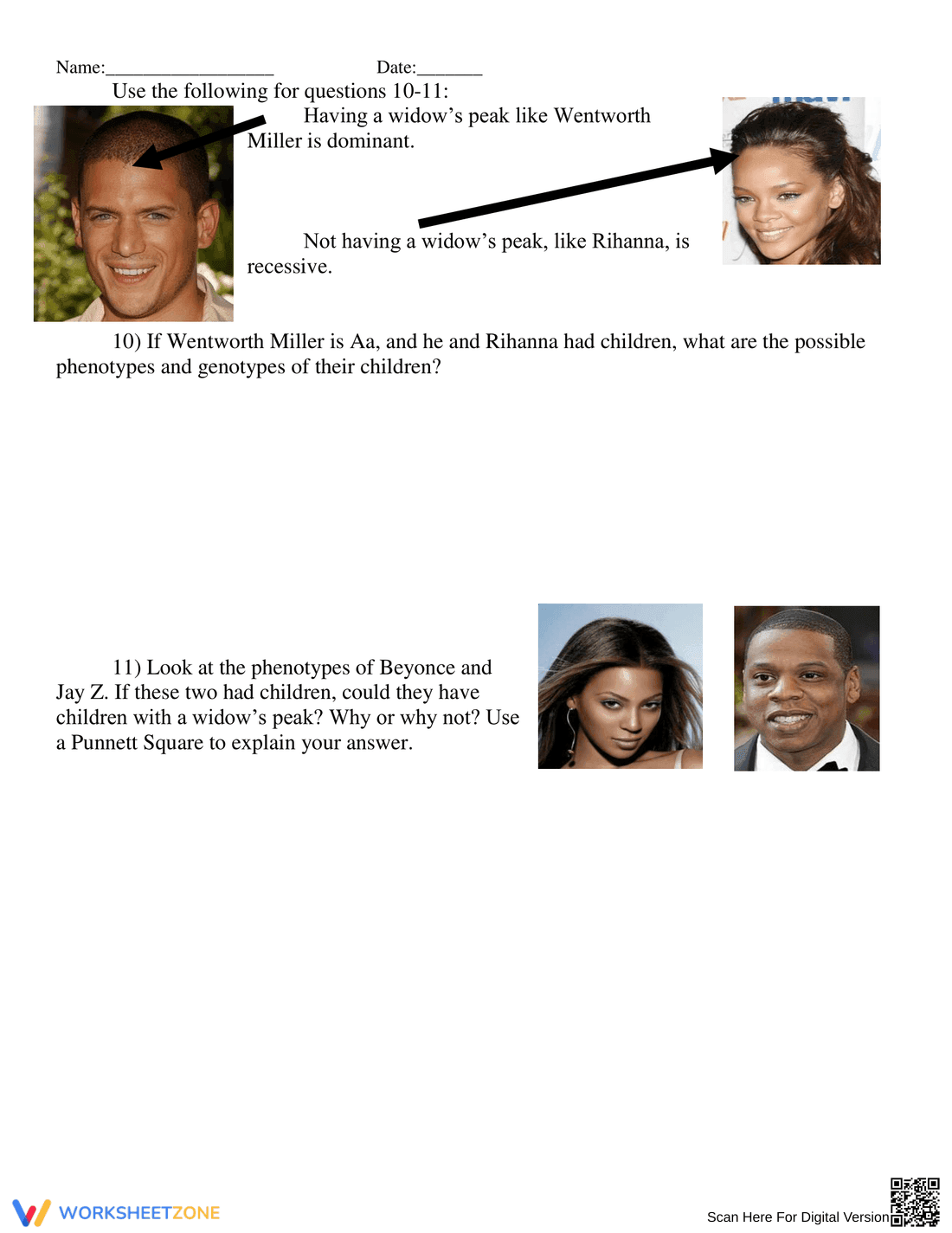
Inside this three-page resource, educators will find eight multi-part genetics problems. The tasks require students to set up Punnett squares, fill in the allele combinations, and calculate the exact percentages for both genotypes and phenotypes. The worksheet features a mix of standard trait scenarios, such as animal fur color, alongside engaging real-world applications involving celebrity traits to maintain student interest.
- Guided practice: The initial problems provide pre-drawn Punnett squares and clear prompts for identifying basic dominant and recessive outcomes, helping students build foundational confidence.
- Supported practice: The middle section introduces a "little added challenge" involving test crosses and hereditary conditions, requiring learners to work backward from known phenotypes.
- Independent practice: The final pages ask students to apply their knowledge to real-world scenarios using photographs of public figures, demanding higher-order critical thinking to justify their genetic predictions.
This gradual-release approach ensures students master the mechanics of the I Do, We Do, You Do model before tackling complex reasoning.
This resource is tightly aligned to HS-LS3-3: Apply concepts of statistics and probability to explain the variation and distribution of expressed traits in a population. It also supports foundational understanding of Mendelian genetics and inheritance laws. Both standard codes can be copied directly into lesson plans, IEP goals, or district curriculum mapping tools.
Deploy this worksheet after direct instruction on Mendelian genetics to reinforce the steps of setting up a Punnett square. It serves as an excellent independent assignment or homework task. As a formative assessment tip, circulate the room while students complete the test-cross challenge on page two; observing how they determine the unknown parental genotype offers immediate insight into their conceptual mastery. Expect most high school students to complete the full packet in 25 to 35 minutes.
This practice set is designed for 10th and 11th-grade biology students learning basic genetics. The visual nature of the Punnett squares provides built-in scaffolding that benefits visual learners and students needing structured graphic organizers. Pair this worksheet with a visual anchor chart detailing the differences between homozygous and heterozygous alleles to maximize student success.
Mastering the calculation of genetic probabilities is a foundational cornerstone of high school biology curricula. Standard HS-LS3-3 requires students to apply probability to explain trait variation, moving beyond simple vocabulary memorization into rigorous mathematical application. According to a ScienceDirect TpT Analysis, integrating structured graphic organizers like Punnett squares significantly reduces cognitive load, allowing students to focus entirely on the underlying statistical relationships rather than the mechanics of data organization. By providing a clear, step-by-step framework for determining both genotypes and phenotypes, this targeted worksheet helps bridge the critical gap between abstract genetic theories and concrete mathematical outcomes. Consistent, structured practice with these visual tools ensures learners can confidently predict inheritance patterns across multiple generations. This represents a critical skill for advanced scientific literacy, standardized testing success, and future coursework in molecular biology and health sciences.


