


























Views
Downloads

Essential Pumpkin Text Features Worksheet | Grades 6-8
Paste this activity's link or code into your existing LMS (Google Classroom, Canvas, Teams, Schoology, Moodle, etc.).
Students can open and work on the activity right away, with no student login required.
You'll still be able to track student progress and results from your teacher account.
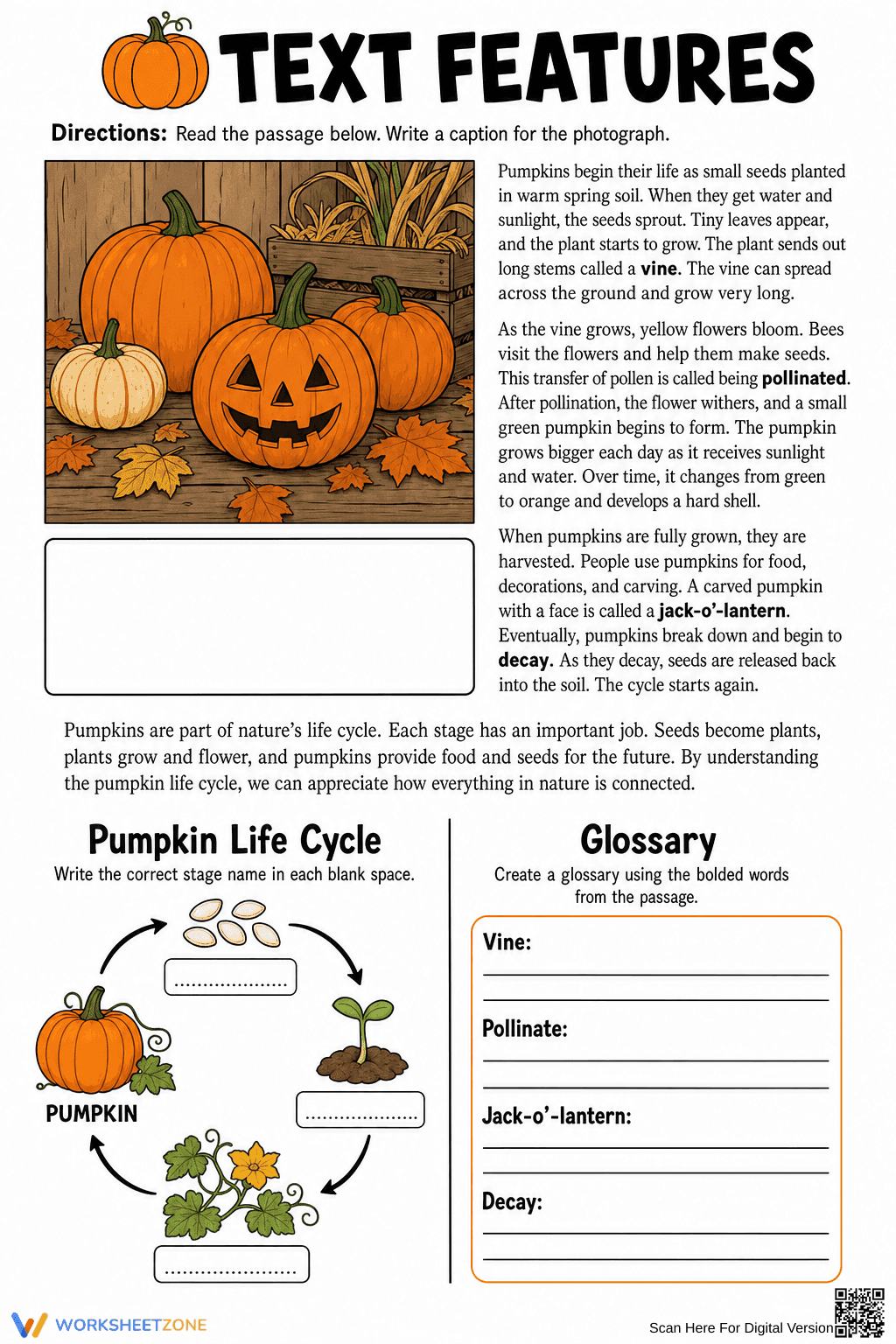
This Grade 6-8 informational text worksheet helps students master nonfiction text features through the lens of a pumpkin's life cycle. By engaging with captions, diagrams, and a glossary, learners develop the critical literacy skills needed to navigate complex technical texts. It bridges the gap between science content and ELA standards effectively.
At a Glance
- Grade: 6-8 · Subject: ELA & Science
- Standard:
CCSS.ELA-LITERACY.RI.6.5— Analyze how a particular sentence, paragraph, chapter, or section fits into text- Skill Focus: Nonfiction Text Features
- Format: 1 page · 8 problems · Answer key included · PDF
- Best For: Fall-themed literacy centers or sub plans
- Time: 20–30 minutes
The worksheet contains a concise informational passage about pumpkin growth, featuring bolded domain-specific vocabulary. Students are tasked with writing an original caption for a photograph, labeling a four-stage life cycle diagram, and constructing a glossary based on context clues. The single-page layout ensures all resources are visible at once, reducing cognitive load while maintaining academic rigor.
This resource is designed for a zero-prep classroom workflow. Teachers can print the PDF in under 1 minute, distribute it immediately as a bell-ringer or independent practice, and review the 8 tasks collectively in less than 5 minutes. It serves as an ideal printable activity for busy autumn schedules or unexpected substitute teacher days, requiring no additional materials beyond a pencil.
Aligned primarily to `CCSS.ELA-LITERACY.RI.6.5`, this activity requires students to analyze how specific text features contribute to the whole. It also supports `CCSS.ELA-LITERACY.L.6.4` by requiring students to define words like "pollinate" and "decay" using context clues from the passage. Both standard codes can be copied directly into lesson plans, IEP goals, or district curriculum mapping tools.
Use this worksheet during the instructional phase of a lesson on informational text structures to model how diagrams clarify prose. Alternatively, assign it as a formative assessment after a science unit on plant biology. Observe if students can successfully synthesize the visual data in the diagram with the written details in the passage. Expected completion time is 20 to 30 minutes.
This resource is perfect for middle school students in Grades 6, 7, and 8 who need targeted practice with technical reading. It is particularly effective for English Language Learners (ELLs) due to the heavy visual support provided by the life cycle illustrations and the structured glossary format. Pair it with a pumpkin-themed anchor chart or a direct instruction lesson on text evidence.
According to the RAND AIRS 2024 report on literacy instruction, the integration of visual literacy tasks—such as labeling diagrams and writing captions—significantly improves retention of informational content in middle school learners. This worksheet addresses the specific need for dual-coding instruction, where students process both verbal and non-verbal information simultaneously. By requiring students to define bolded terms in a glossary format, the activity reinforces the CCSS.ELA-LITERACY.RI.6.5 requirement to understand how text sections provide functional utility to the reader. Research indicates that students who can successfully navigate these extra-textual features score higher on standardized reading comprehension assessments compared to those who focus solely on the primary prose. This resource provides the structured repetition necessary for students to internalize these navigational skills across various academic disciplines, including both ELA and life sciences.


