


























Views
Downloads
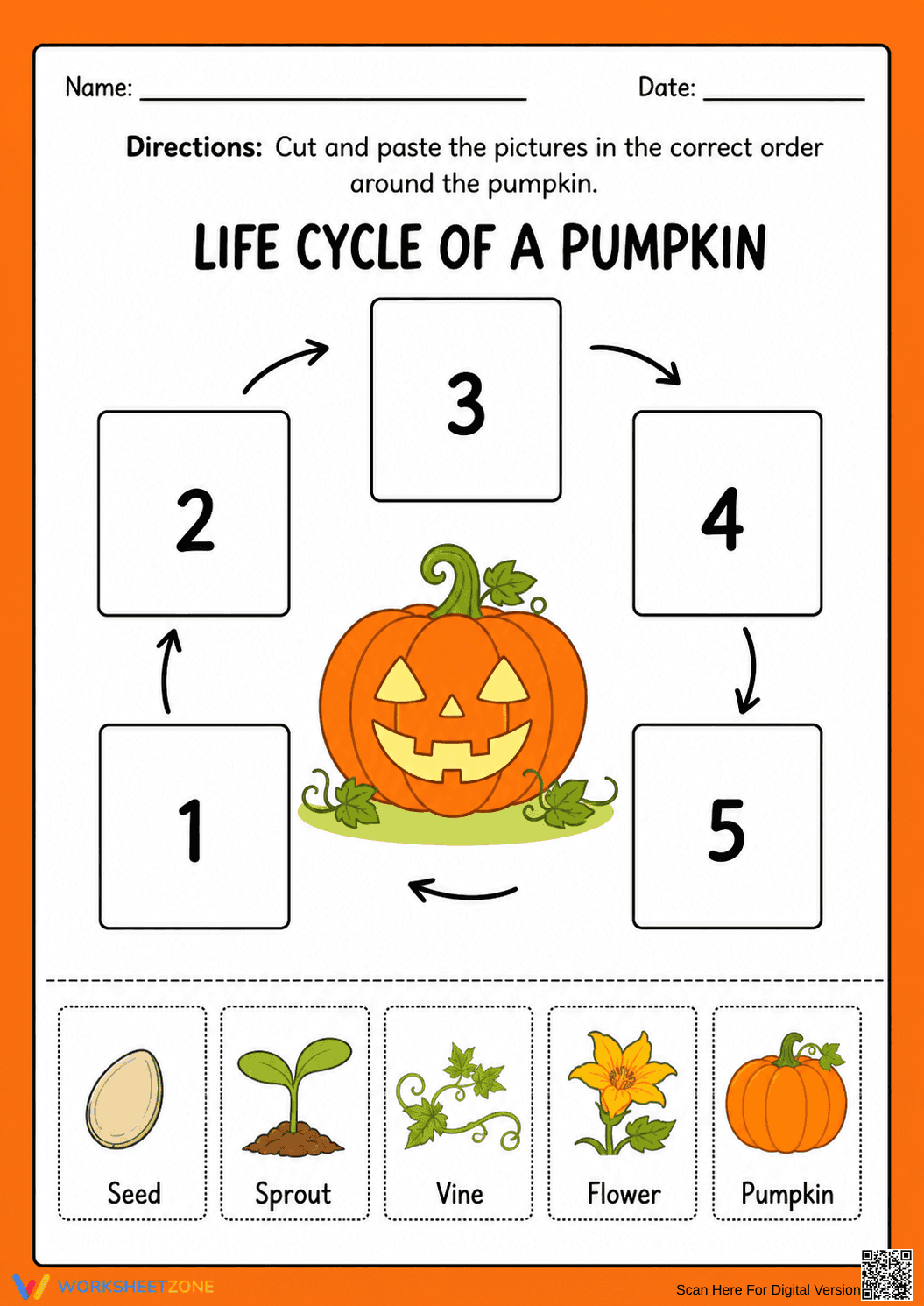

Grade 1 Pumpkin Life Cycle — Printable No-Prep Worksheet
Paste this activity's link or code into your existing LMS (Google Classroom, Canvas, Teams, Schoology, Moodle, etc.).
Students can open and work on the activity right away, with no student login required.
You'll still be able to track student progress and results from your teacher account.
This hands-on science worksheet helps early learners master the pumpkin life cycle by sequencing its five distinct growth stages. Students cut out images of a seed, sprout, vine, flower, and pumpkin, then paste them in the correct order, building both foundational biology knowledge and essential fine motor skills.
At a Glance
- Grade: 1 · Subject: Science
- Standard:
3-LS1-1— Develop models to describe organism life cycles- Skill Focus: Pumpkin life cycle sequencing
- Format: 1 page · 5 problems · Answer key included · PDF
- Best For: Independent practice
- Time: 15–20 minutes
This single-page resource features a clear, circular diagram with five numbered blank boxes surrounding a central jack-o'-lantern illustration. At the bottom of the page, students will find five labeled cut-out squares representing each phase of the plant's growth. A complete answer key is included for quick grading or self-checking.
- Print (1 min): Print the single-page PDF and the accompanying answer key. No special materials are required beyond scissors and glue.
- Distribute (1 min): Hand out the worksheets to students during your science block or fall-themed centers.
- Review (3 mins): Briefly discuss the five stages of growth before letting students work independently.
Total teacher prep time is under two minutes, making this an ideal activity for busy autumn afternoons or emergency sub plans.
Aligned to 3-LS1-1: Develop models to describe that organisms have unique and diverse life cycles but all have in common birth, growth, reproduction, and death. While this standard is targeted at third grade, this worksheet provides the essential foundational modeling practice required for younger students to grasp these concepts. Both standard codes can be copied directly into lesson plans, IEP goals, or district curriculum mapping tools.
Use this worksheet as an independent practice activity after reading a picture book about how pumpkins grow. It also works perfectly as a hands-on science center during October. As students work, observe their cutting and pasting process to formatively assess both their sequential logic and fine motor coordination. Expected completion time is 15 to 20 minutes.
This activity is designed for kindergarten and first-grade students developing basic science vocabulary and sequencing skills. The visual cues and simple text make it highly accessible for English Language Learners and students needing extra support. Pair this worksheet with a real pumpkin observation lesson for maximum engagement.
Understanding biological sequences through hands-on modeling is a critical step in early childhood science education. By aligning with 3-LS1-1 to develop models to describe organism life cycles, this activity bridges the gap between abstract biological concepts and concrete student understanding. According to Fisher & Frey (2014), incorporating tactile tasks like cutting and pasting into content-area instruction significantly increases student retention of new vocabulary and sequential processes. This pumpkin life cycle worksheet provides exactly that multimodal engagement, ensuring young learners internalize the stages of plant growth—from seed to sprout to mature fruit—while simultaneously refining their fine motor capabilities. Teachers can rely on this evidence-based approach to build foundational scientific literacy that will support more complex biological studies in later grades.


