


























Views
Downloads

Proven Vector Error Repair Worksheet | Grade 12 Precalculus
Paste this activity's link or code into your existing LMS (Google Classroom, Canvas, Teams, Schoology, Moodle, etc.).
Students can open and work on the activity right away, with no student login required.
You'll still be able to track student progress and results from your teacher account.
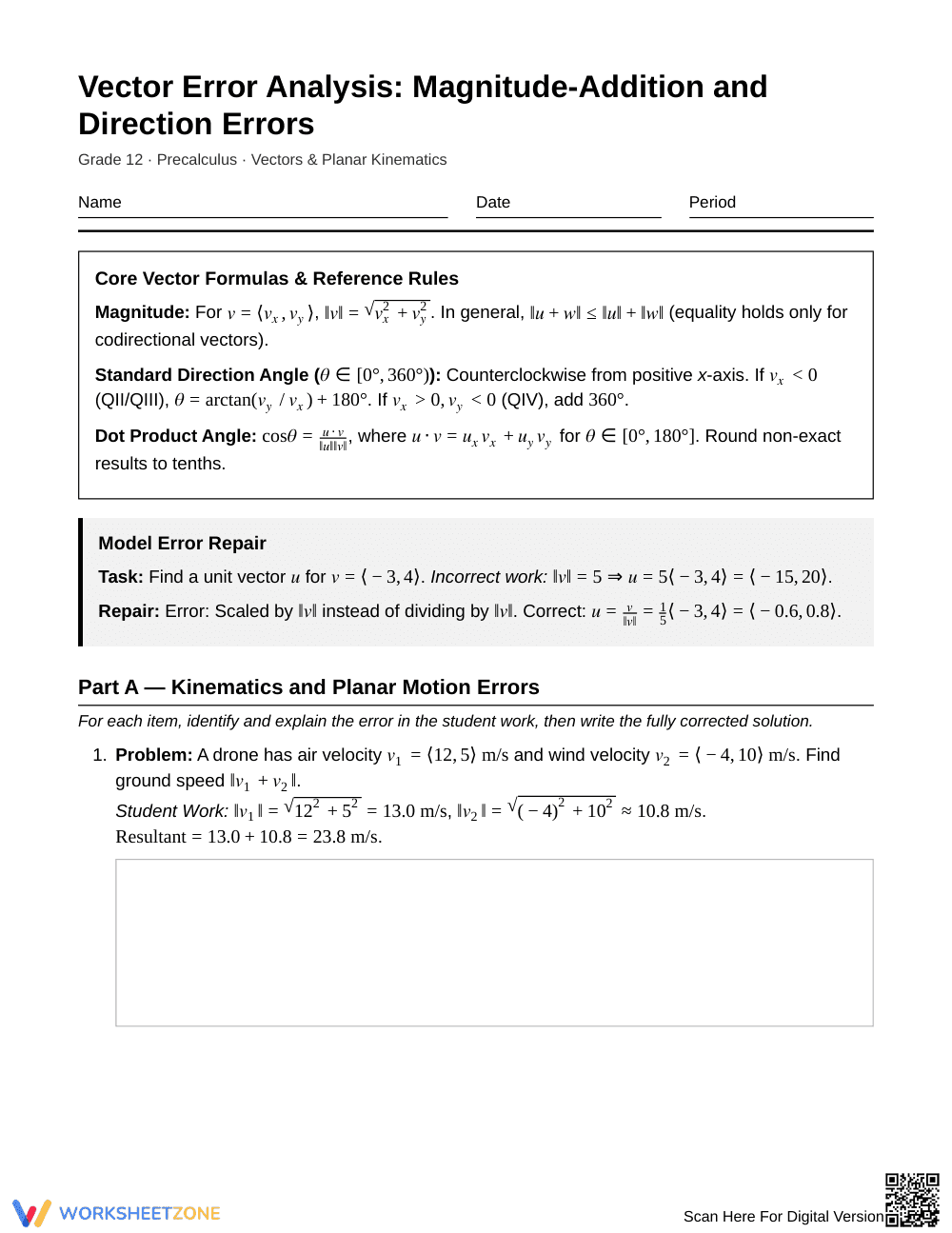
This Precalculus worksheet equips Grade 12 students to diagnose and correct common misconceptions in vector operations, focusing on scalar magnitude addition and quadrant angle errors. Through 10 targeted tasks, learners transform procedural pitfalls into robust mathematical understanding, mastering resultant calculations and planar motion mechanics.
At a Glance
- Grade: 12 · Subject: Precalculus
- Standard:
HSN-VM.B.4— Add and subtract vectors algebraically and graphically in applied contexts- Skill Focus: Correct Magnitude-Addition and Angle Errors
- Format: 4 pages · 10 problems · Answer key included · PDF
- Best For: Vector remediation and exam review
- Time: 40–55 minutes
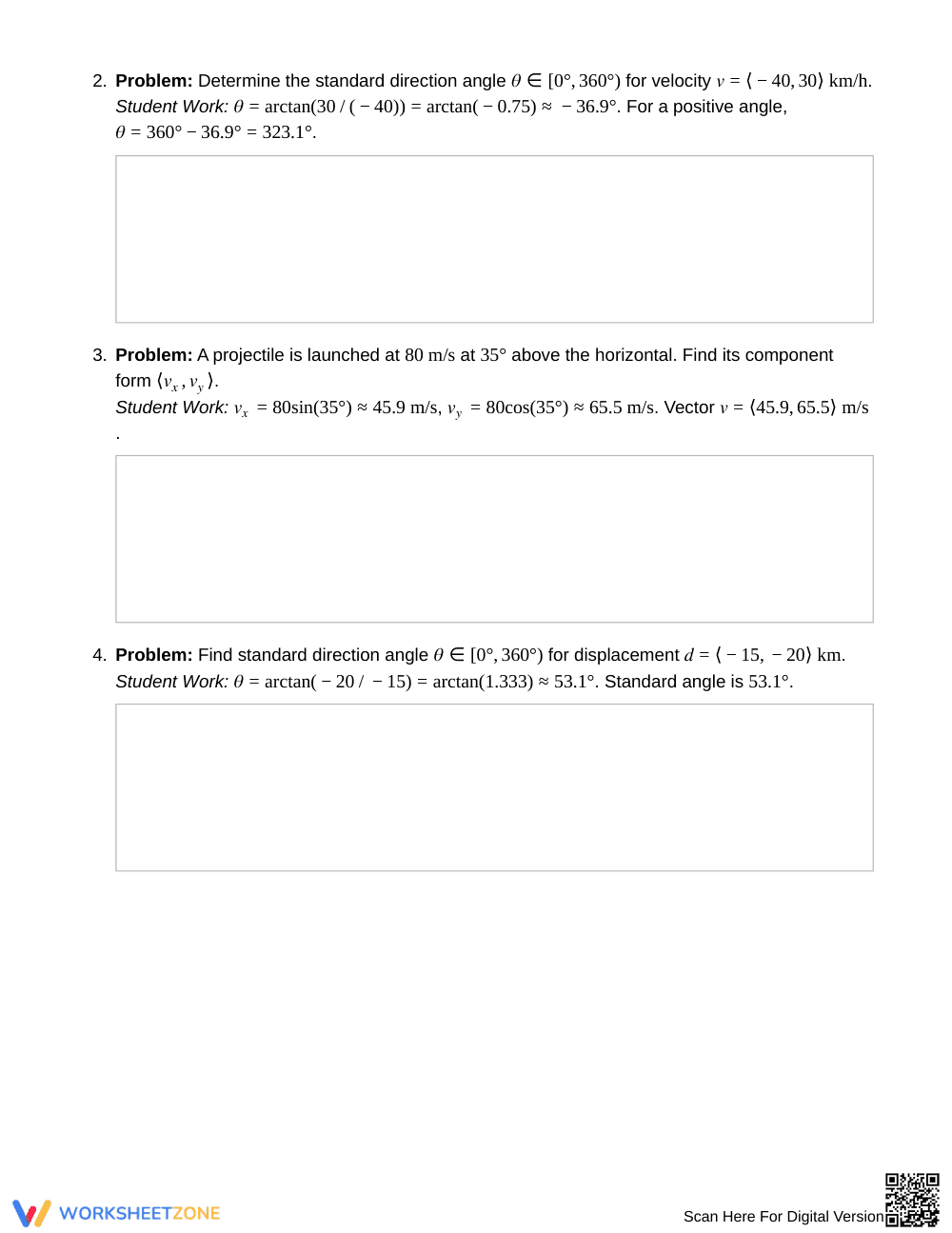
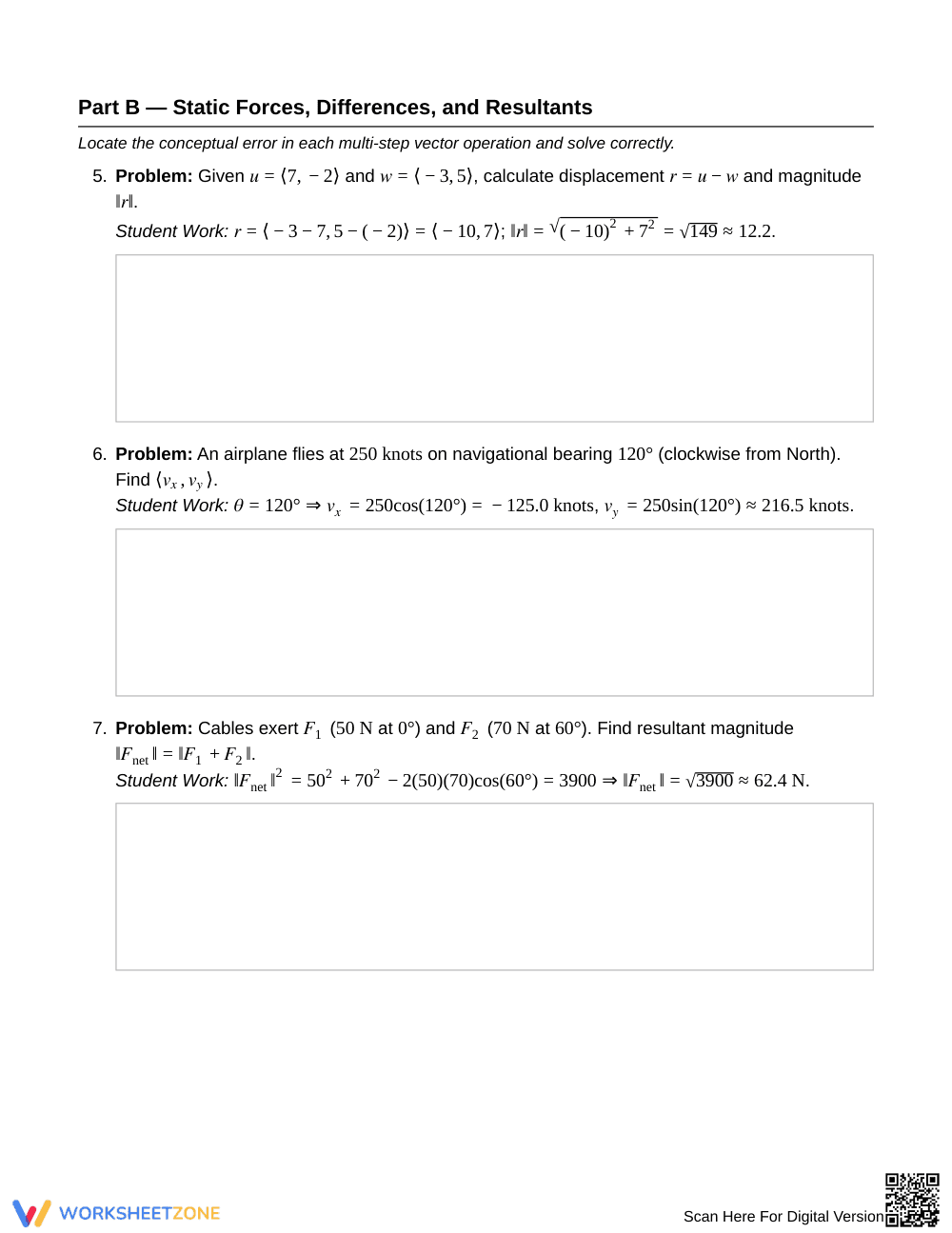
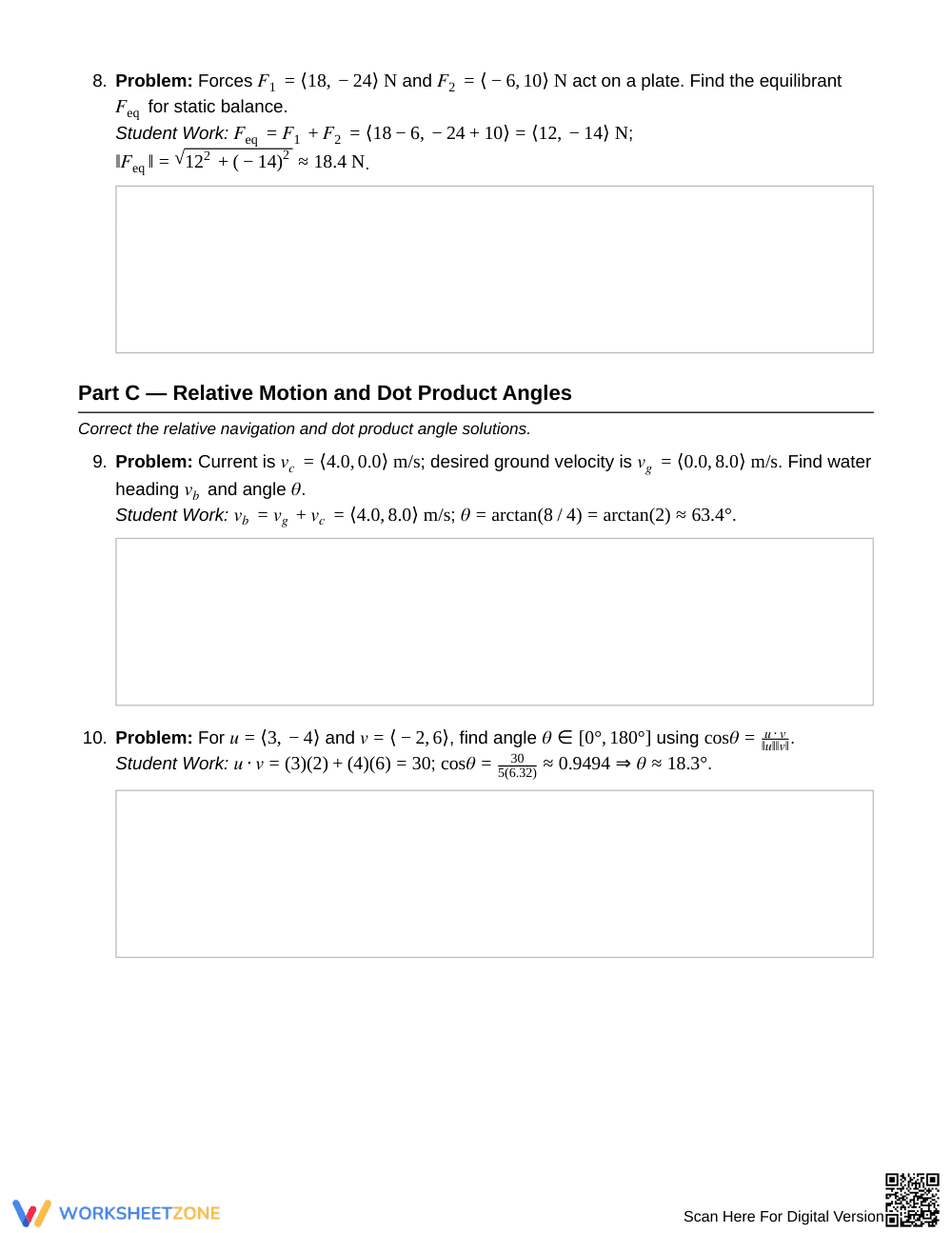
The 4-page worksheet includes a Core Vector Formulas reference box and a solved Model Error Repair. Across three parts, students analyze pre-written student solutions, isolate misconceptions—such as adding magnitudes directly or misapplying bearings—and write complete corrected solutions. A 2-page answer key provides step-by-step calculations and error explanations for all 10 problems.
Skill Progression
- Guided Practice (Part A — Kinematics and Planar Motion Errors): 4 problems targeting quadrant adjustments, projectile components, and ground velocities using formula scaffolds.
- Supported Practice (Part B — Static Forces, Differences, and Resultants): 4 multi-step tasks covering static equilibrium, subtraction order, navigational bearings, and non-collinear force vectors.
- Independent Practice (Part C — Relative Motion and Dot Product Angles): 2 complex problems analyzing water current headings and dot product coordinate sign tracking without prompts.
This structured sequence follows a gradual-release model, progressing from guided error identification to independent multi-step problem-solving.
Standards Alignment
This worksheet directly targets `HSN-VM.B.4`, requiring students to add and subtract vectors geometrically and algebraically while computing magnitudes and directions. It also supports `HSN-VM.B.5` through scalar multiplication and direction angle applications. Both standard codes can be copied directly into lesson plans, IEP goals, or district curriculum mapping tools.
How to Use It
Assign this activity after direct instruction on vector operations to consolidate mastery during a 40- to 55-minute practice block. It functions well for collaborative peer critique. For formative assessment, observe whether students apply tangent quadrant rules (adding 180° for Quadrants II/III) or mistakenly accept unadjusted inverse tangent values.
Who It's For
This resource serves Grade 12 Precalculus and physics students mastering planar kinematics. For differentiated support, pair this worksheet with a coordinate grid visualizer so struggling students can sketch components before writing algebraic corrections.
According to Fisher & Frey (2014), engaging learners in structured error analysis significantly deepens conceptual understanding by requiring students to justify mathematical reasoning rather than merely executing algorithms. Aligned to standard HSN-VM.B.4, this resource targets the essential skill of diagnosing and correcting vector magnitude addition, bearing calculations, and direction angle misconceptions. High school precalculus students frequently conflate scalar magnitude addition with true vector resultants or miscalculate reference angles across non-first quadrants; addressing these common errors directly strengthens foundational mathematical schemas. Empirical research demonstrates that when students actively evaluate plausible student errors and explain why a method fails, conceptual retention of planar kinematics and vector mechanics increases substantially compared to repetitive procedural drill alone. This 4-page worksheet provides rigorous, standards-aligned practice that transforms frequent calculation traps into durable analytical competence for college-level mathematics and physics coursework.


