


























Views
Downloads

Proven Vector Equivalence Worksheet | Grade 12 Precalculus
Paste this activity's link or code into your existing LMS (Google Classroom, Canvas, Teams, Schoology, Moodle, etc.).
Students can open and work on the activity right away, with no student login required.
You'll still be able to track student progress and results from your teacher account.
This Precalculus worksheet strengthens analytical reasoning by training Grade 12 students to rigorously justify vector equivalence across Cartesian, polar, and physical contexts. Learners evaluate mathematical claims, prove geometric conditions using coordinate midpoints and component projections, and construct explicit counterexamples, ensuring a complete theoretical and practical command of directed line segments.
At a Glance
- Grade: 12 · Subject: High School Precalculus
- Standard:
HSN-VM.A.1— Represent vector quantities with directed line segments and justify magnitude and direction equivalence- Skill Focus: Rigorous justification of vector equivalence
- Format: 5 printable pages · 8 multi-part problems · Full answer key included · PDF
- Best For: Honors and AP Precalculus analytical practice
- Time: 45–60 minutes
What's Inside
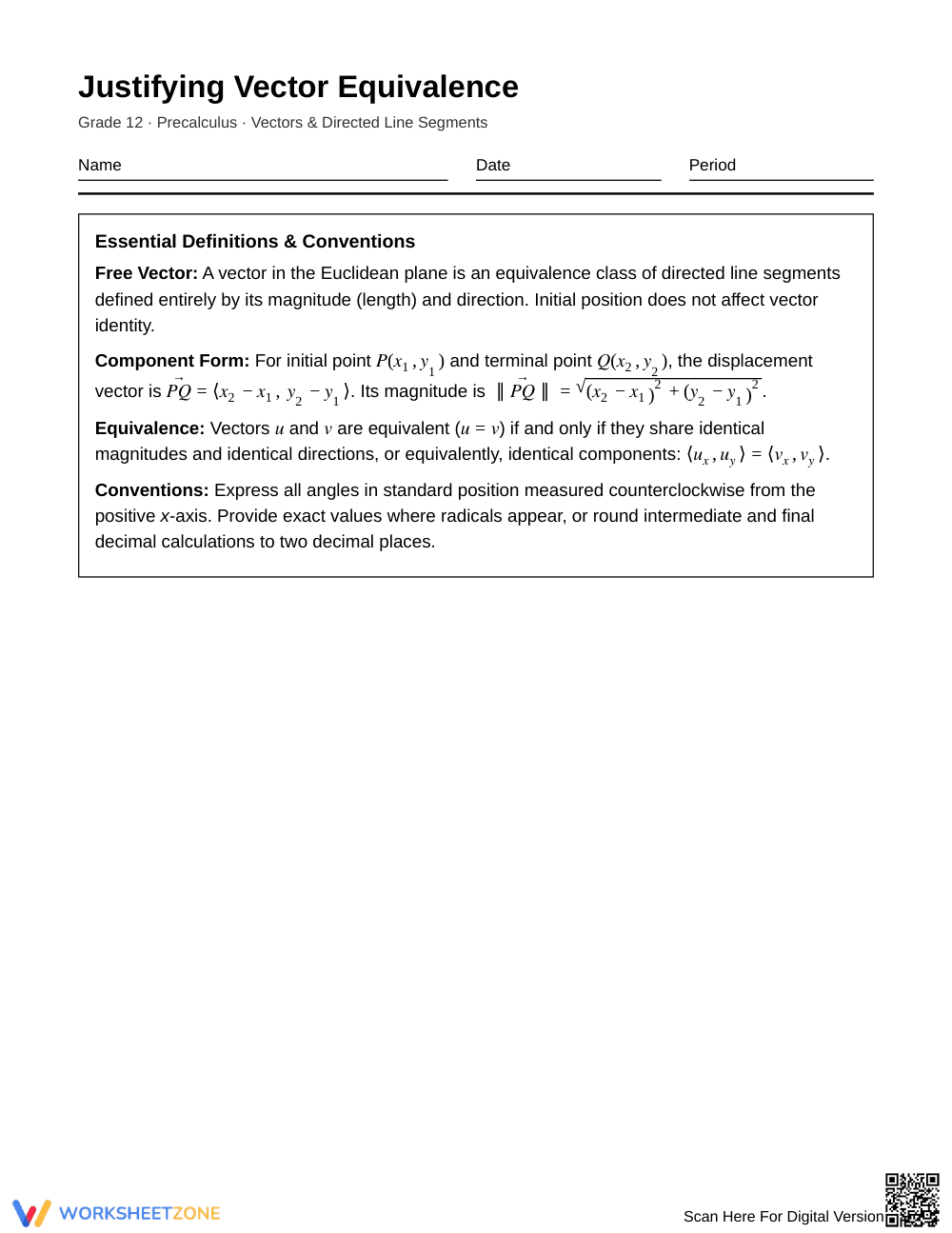
This 5-page resource opens with a definitions reference box detailing free vectors, component forms, and standard-position conventions. Across three sections, students solve 8 rigorous problems featuring coordinate grids, force diagrams, and algebraic proofs. A comprehensive 4-page answer key provides step-by-step proofs, exact radical values, and complete counterexamples.
Skill Progression
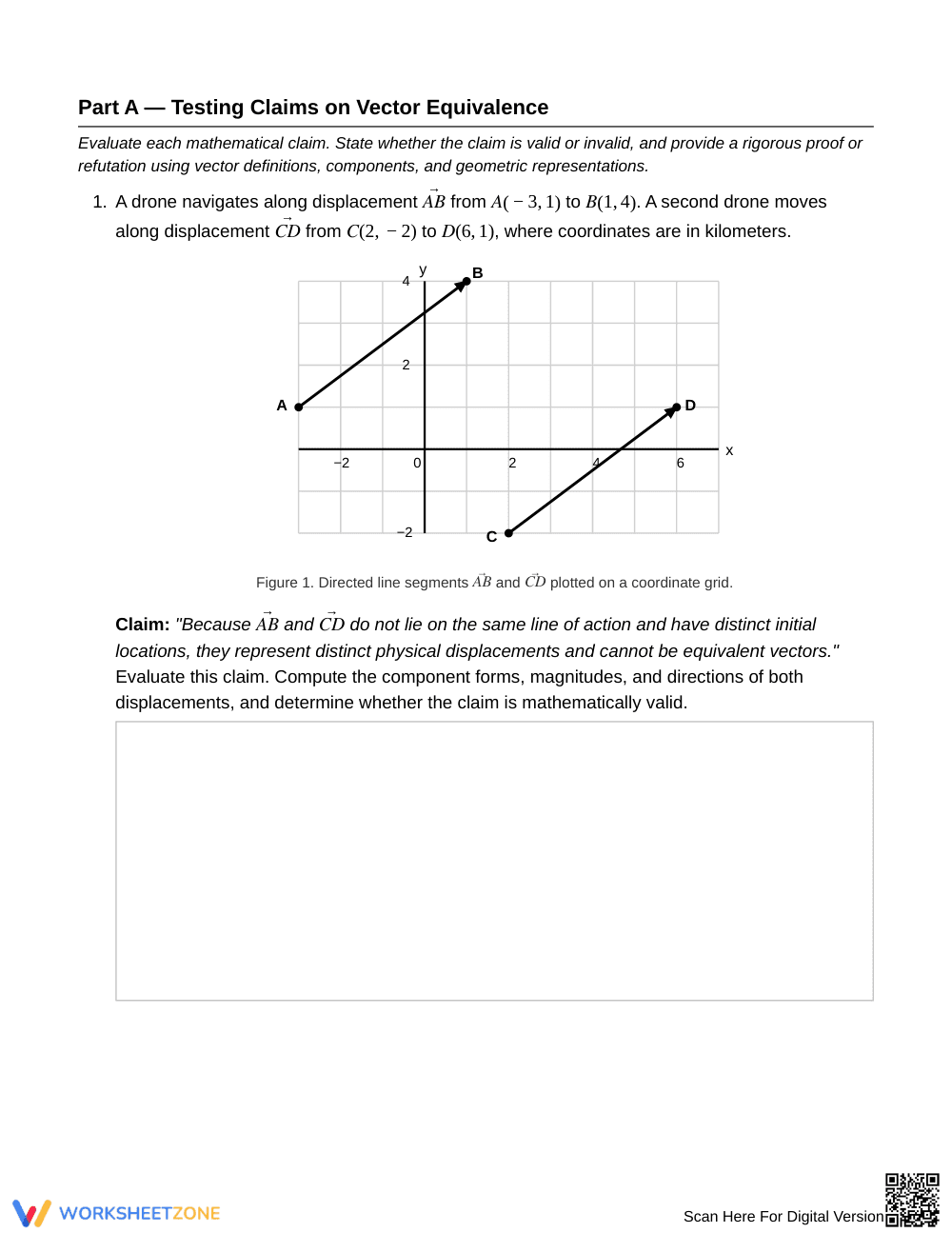
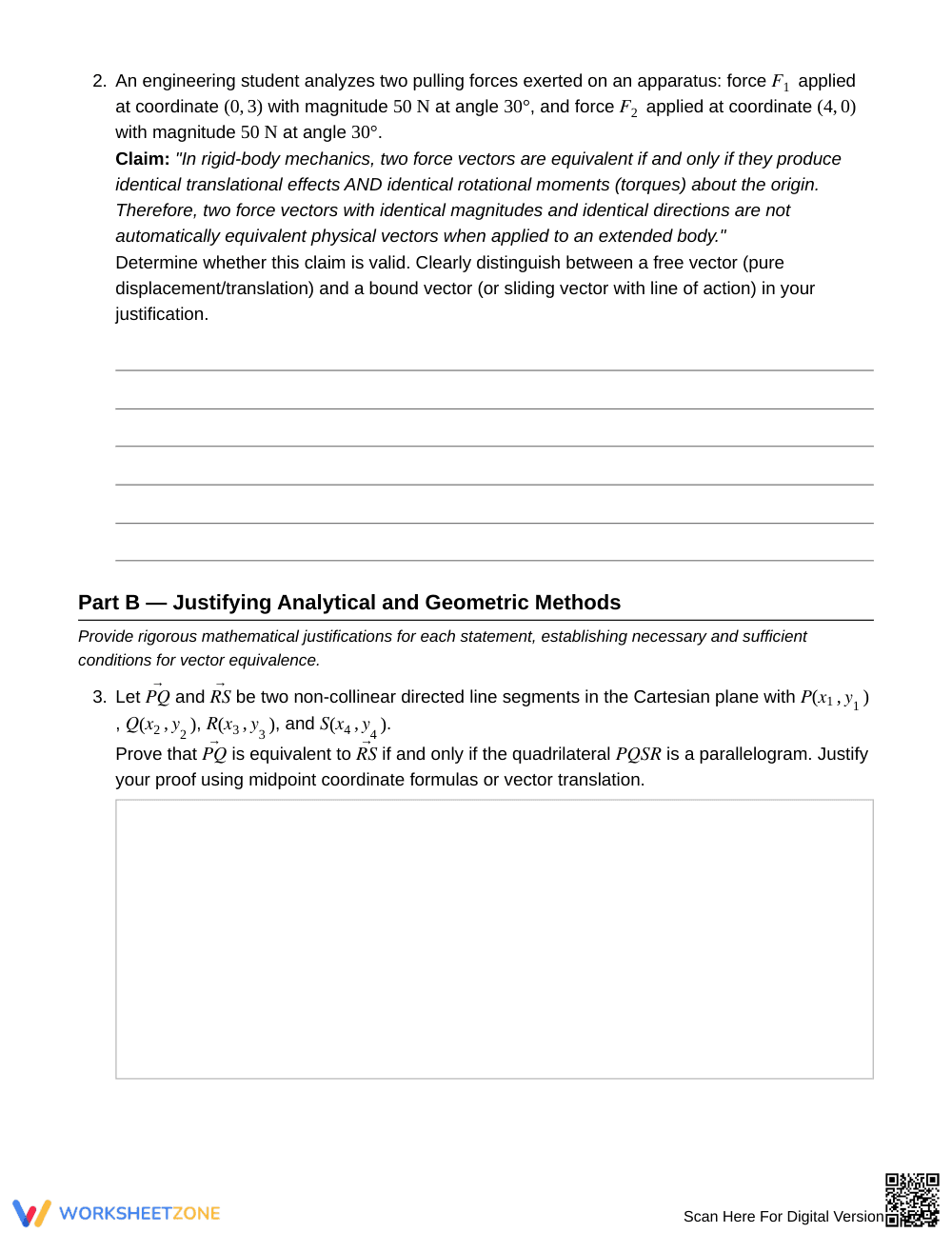
- Guided Practice (Part A, Problems 1–2): Students analyze authentic claims involving drone flights and mechanics forces, referencing definitions to evaluate equivalence and contrast free and bound vectors.
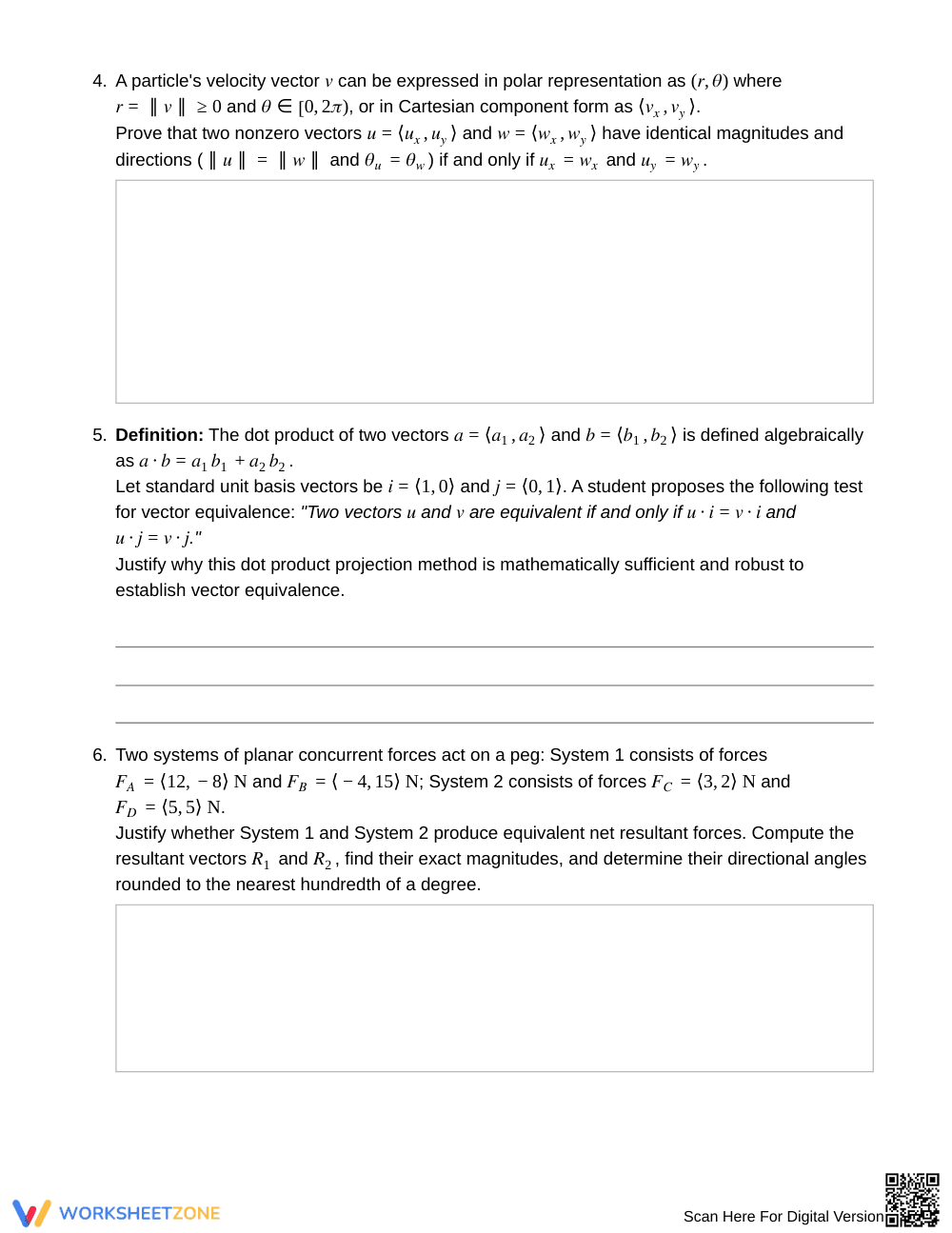
- Supported Practice (Part B, Problems 3–6): Learners construct mathematical proofs across four analytical tasks, applying coordinate midpoints, polar forms, dot product projections, and concurrent force sums.
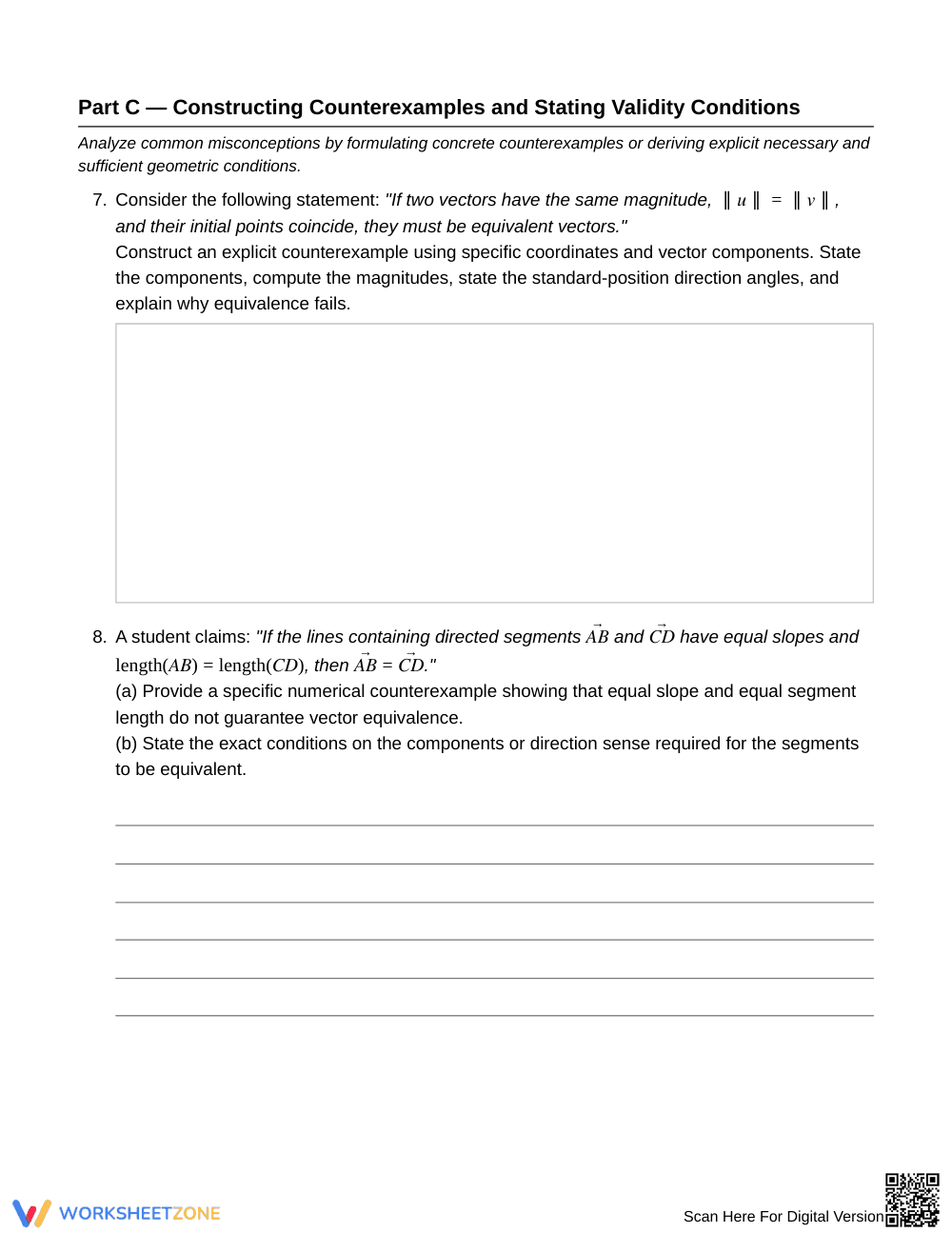
- Independent Practice (Part C, Problems 7–8): Students formulate numerical counterexamples and establish strict validity conditions when analyzing flawed geometric conjectures without scaffolds.
This deliberate sequence reflects the gradual release of responsibility model, guiding students from evaluated claims to autonomous mathematical proofs.
Standards Alignment
This worksheet aligns directly to `HSN-VM.A.1`, which requires students to recognize vector quantities as possessing both magnitude and direction, represent them by directed line segments, and utilize appropriate vector notation. It additionally reinforces supporting standard `HSN-VM.A.3` by challenging learners to solve applied displacement and concurrent force problems. Both standard codes can be copied directly into lesson plans, IEP goals, or district curriculum mapping tools.
How to Use It
Deploy this worksheet after direct instruction on Cartesian components to solidify formal proof techniques, or assign it during vector mechanics units. During group work, observe whether students mistakenly equate line slopes with vector directions in Part C; this formative check pinpoints directional-angle misconceptions. Students typically complete the 8 problems in 45 to 60 minutes.
Who It's For
This resource is designed for Grade 12 Precalculus and introductory Physics classrooms mastering formal vector representations. For differentiated support, pair this activity with a coordinate vector reference chart, while advanced learners can extend Part B by testing dot product equivalence in three dimensions.
Under Common Core standard `HSN-VM.A.1`, secondary mathematics students must recognize vectors by both magnitude and direction, representing displacement and force through directed line segments. Justifying vector equivalence requires students to transcend superficial perceptual matching by systematically applying coordinate differences, trigonometric angle measurements, and geometric proofs. Grounded in the instructional frameworks identified by Fisher & Frey (2014), this curriculum resource structures rigorous mathematical inquiry through a sequenced gradual release model that transitions students from evaluating authentic claims to constructing independent geometric proofs and algebraic counterexamples. By verifying displacement congruency across Cartesian components, unit vector dot products, and resultant force equilibriums, Grade 12 Precalculus learners build durable conceptual foundations vital for collegiate linear algebra, multivariable calculus, and classical mechanics. The accompanying 4-page answer key provides complete analytical verifications, supporting precise formative assessment and mathematical discourse across all high school learning environments.


