
































Proven Sequence Correspondence Worksheet | Grade 10 Geometry

Paste this activity's link or code into your existing LMS (Google Classroom, Canvas, Teams, Schoology, Moodle, etc.).
Students can open and work on the activity right away, with no student login required.
You'll still be able to track student progress and results from your teacher account.
This geometry worksheet equips Grade 10 students to determine geometric correspondence under sequences of rigid transformations. High school learners analyze coordinate movements, identify invariant side lengths and angle measures, verify orientation changes, and formulate exact congruence statements across 18 multi-step mathematical problems.
At a Glance
- Grade: 10 · Subject: Geometry
- Standard:
HSG-CO.B.6— Use geometric descriptions of rigid motions to transform figures and predict correspondence- Skill Focus: Determine Correspondence Under a Sequence
- Format: 5 pages · 18 problems · Answer key included · PDF
- Best For: High school transformation and congruence units
- Time: 45–60 minutes
What's Inside
The 5-page worksheet includes 18 rigorous problems organized into three structured tiers, accompanied by a foundational reference header reviewing orientation rules and composite reflections. Students engage with coordinate plane figures, algebraic congruence equations, multi-step sequence descriptions, and analytical proofs. A comprehensive 4-page answer key provides step-by-step coordinate tracking, transformation compositions, and final values.
Skill Progression
- Guided practice (Part A, Items 1–4): Focuses on foundational single-step and two-step coordinate transformations, testing orientation preservation and distance invariance with reference support.
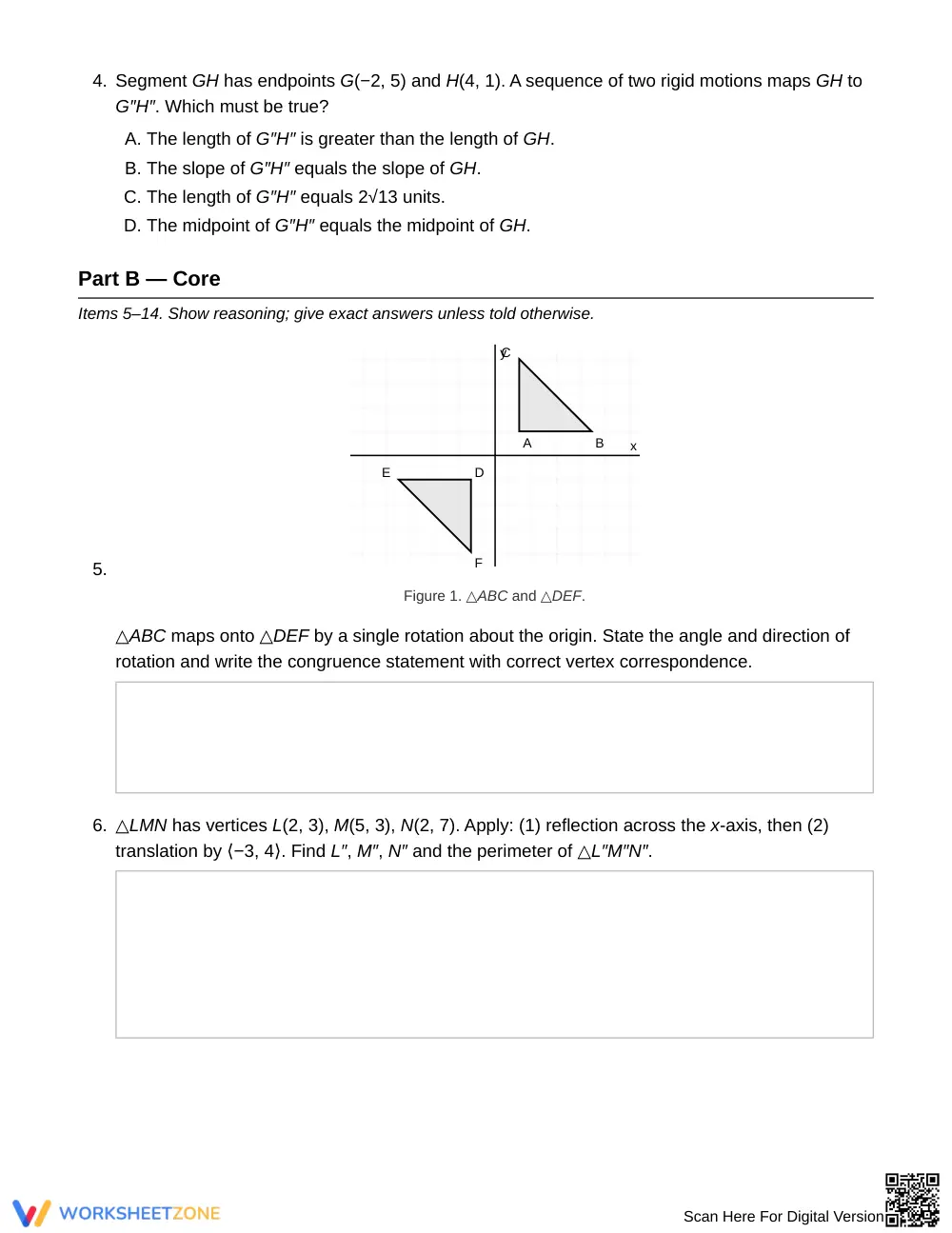
- Supported practice (Part B, Items 5–14): Expands into core coordinate compositions, reverse mapping from graphic figures, parallel reflection theorems, and verifying algebraic correspondences across multi-step figures.
- Independent practice (Part C, Items 15–18): Challenges learners with glide reflection equations, non-origin rotations, and algebraic proofs tracking general point mappings under composite transformations.
This three-part structure embodies the gradual-release model, transitioning students from scaffolded coordinate tracking to unassisted geometric proof.
Standards Alignment
This resource aligns directly with `HSG-CO.B.6`: Use geometric descriptions of rigid motions to transform figures and predict correspondence, deciding if two figures are congruent. As a supporting standard, `HSG-CO.A.5` guides students to specify transformational sequences mapping figures onto one another. Both standard codes can be copied directly into lesson plans, IEP goals, or district curriculum mapping tools.
How to Use It
Deploy this worksheet after direct instruction on composite transformations or as a mid-unit mastery check before formal proof units. During independent work, monitor whether students check orientation before selecting reflection combinations. Expect completion in 45 to 60 minutes across one extended period or split over two consecutive days.
Who It's For
This activity serves Grade 10 Geometry students building conceptual fluency with transformational geometry. It offers natural scaffolding for on-level learners and challenging extensions for honors students. Pair this worksheet with an interactive coordinate geometry applet or dynamic transformation demonstration.
According to Fisher & Frey (2014), purposeful instructional design relies on structured cognitive progression, moving learners methodically from foundational teacher modeling to completely unassisted mathematical problem-solving. This high school geometry resource operationalizes that architecture to address standard HSG-CO.B.6, guiding students through determining geometric correspondence under sequences of rigid transformations. Secondary learners evaluate coordinate translations, reflections, and rotations across 18 targeted tasks, directly observing how distance preservation and angle invariance govern polygon congruence. By systematically isolating orientation reversals, composing multi-step mappings on coordinate planes, and deriving generalized algebraic rules for composite transformations, the material translates abstract congruence definitions into rigorous analytic procedures. High school classroom educators can rely on this sequenced practice to diagnose misconceptions in transformation logic, verify essential prerequisite skills, and reinforce lasting spatial reasoning ahead of formal geometric proof units.


