
































Proven Rigid Motion Mapping Worksheet | Grade 10 Geometry

Paste this activity's link or code into your existing LMS (Google Classroom, Canvas, Teams, Schoology, Moodle, etc.).
Students can open and work on the activity right away, with no student login required.
You'll still be able to track student progress and results from your teacher account.
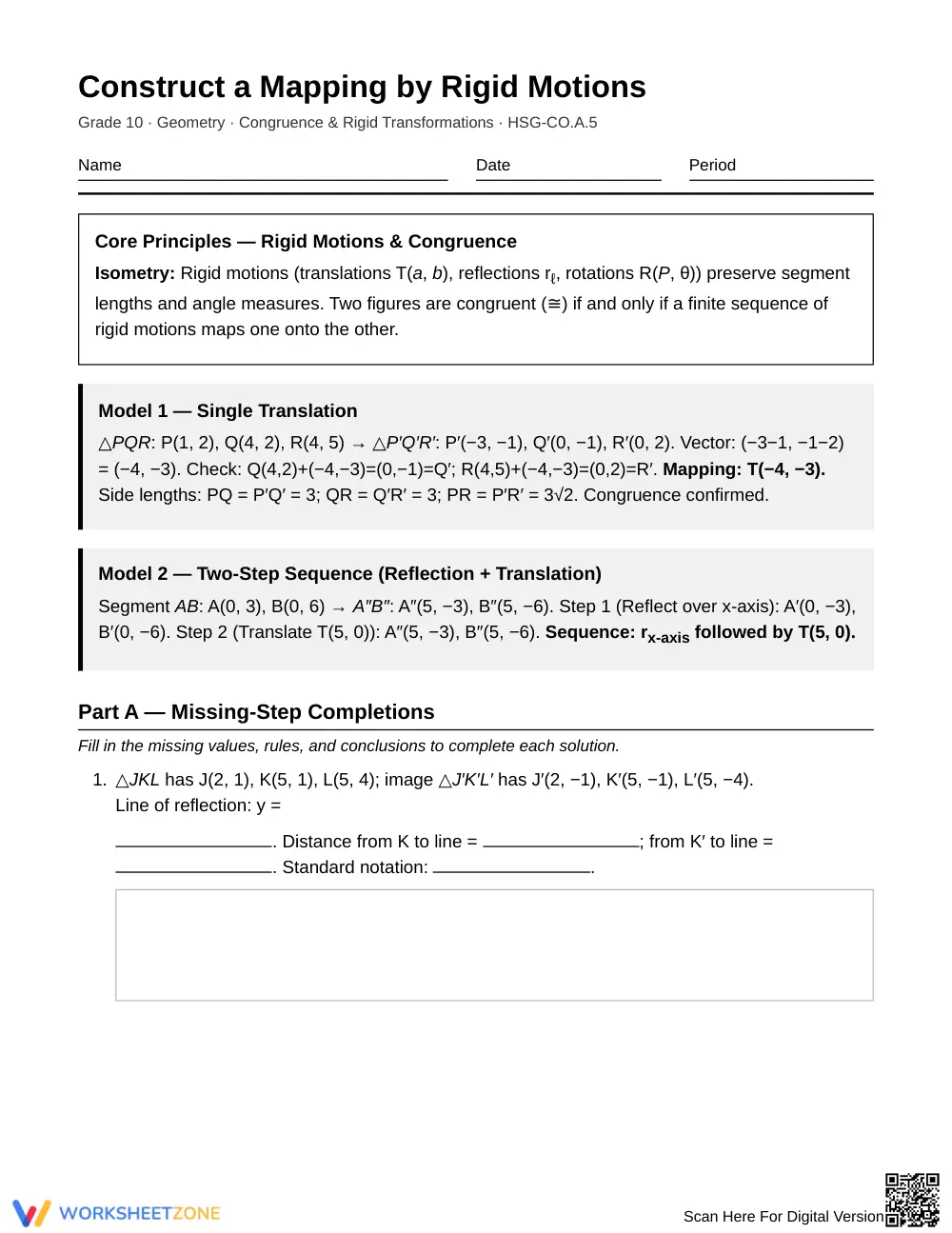
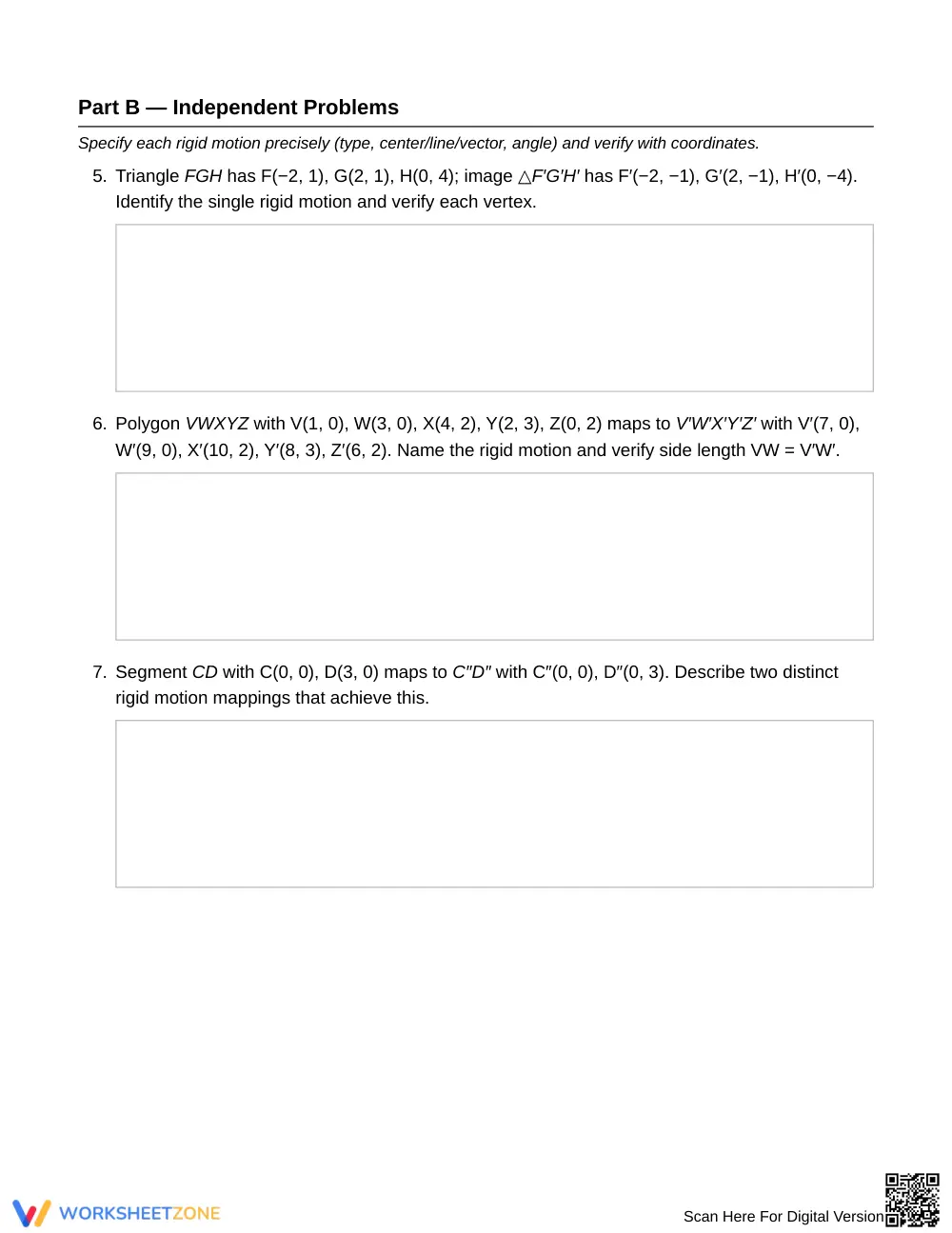
This Grade 10 Geometry worksheet guides students to specify and verify rigid motion transformations that prove geometric congruence. Learners analyze translations, reflections, and rotations across coordinate planes to map pre-images onto target figures. Through 12 structured problems, students master coordinate notation and strengthen geometric arguments with algebraic verification.
At a Glance
- Grade: 10 · Subject: Geometry
- Standard:
HSG-CO.A.5— Given a geometric figure, specify rigid transformation sequences that map it onto another- Skill Focus: Construct a Mapping by Rigid Motions
- Format: 5 pages · 12 problems · Answer key included · PDF
- Best For: High school geometry rigid motion skills practice
- Time: 40–50 minutes
This 5-page worksheet includes two worked reference models, 12 coordinate-based problems, and a 3-page answer key. The opening defines isometry and models translations alongside reflection-translation sequences. Students complete missing-step frames, construct independent mappings for various polygons, and evaluate transformation claims through error analysis.
Skill Progression
- Guided practice (Problems 1–4): Scaffolded missing-step tasks guide students to find reflection lines, rotation angles, and translation vectors.
- Supported practice (Problems 5–8): Independent single-motion items require students to name rigid motions and verify preserved side lengths.
- Independent practice (Problems 9–12): Multi-step glide reflections and error-analysis tasks require students to evaluate claims and justify corrections.
This structure follows the gradual-release model, advancing learners from guided coordinate identification to independent transformation analysis.
Standards Alignment
This worksheet aligns with primary standard `HSG-CO.A.5`: Specify a sequence of transformations that will carry a given figure onto another. It also supports `HSG-CO.B.6` by using rigid motions to establish geometric congruence through preserved side lengths and angle measures. Both standard codes can be copied directly into lesson plans, IEP goals, or district curriculum mapping tools.
How to Use It
Use this resource after introducing rigid motions or during exam review. Walk through the worked models before assigning Part A in pairs (15 minutes). For formative assessment, inspect Part C explanations to check whether students identify coordinate sign rules accurately. Students typically complete the 12 problems in 40 to 50 minutes.
Who It's For
This worksheet supports Grade 10 Geometry students building coordinate fluency. Scaffolding in Part A assists learners requiring step-by-step guidance, while the error analysis in Part C challenges advanced students. Pair this activity with coordinate grid whiteboards or transformation software for dynamic visual reinforcement.
Mastering geometric congruence through rigid motion mapping is a foundational objective of high school mathematics under Common Core standard HSG-CO.A.5. Rather than relying solely on static congruence criteria, current standards require tenth-grade students to specify sequences of translations, reflections, and rotations that carry one figure onto another while preserving distance and angle measure. According to research on structured instruction by Fisher & Frey (2014), student achievement accelerates when learning progresses through an intentional gradual-release framework, advancing from guided coordinate completion to independent problem solving and error analysis. This 5-page Geometry worksheet provides 12 targeted tasks that build spatial reasoning and algebraic verification skills. By prompting students to calculate transformation vectors, verify reflection lines, and evaluate flawed mathematical claims, the resource ensures deep conceptual understanding and durable mastery of transformation geometry across secondary mathematics curricula.


