































Proven Probability Error Analysis Worksheet | Grade 7 Math

Paste this activity's link or code into your existing LMS (Google Classroom, Canvas, Teams, Schoology, Moodle, etc.).
Students can open and work on the activity right away, with no student login required.
You'll still be able to track student progress and results from your teacher account.
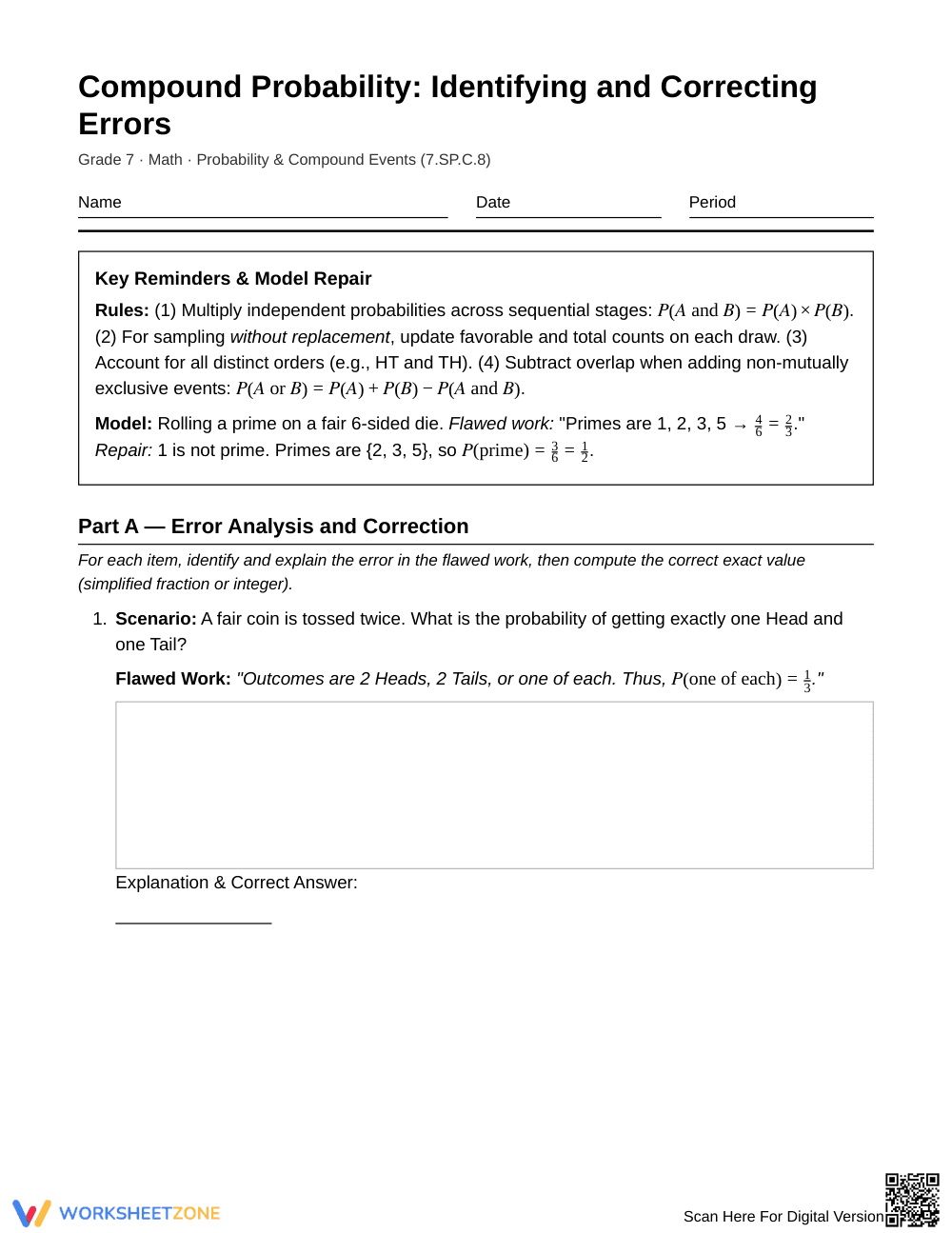
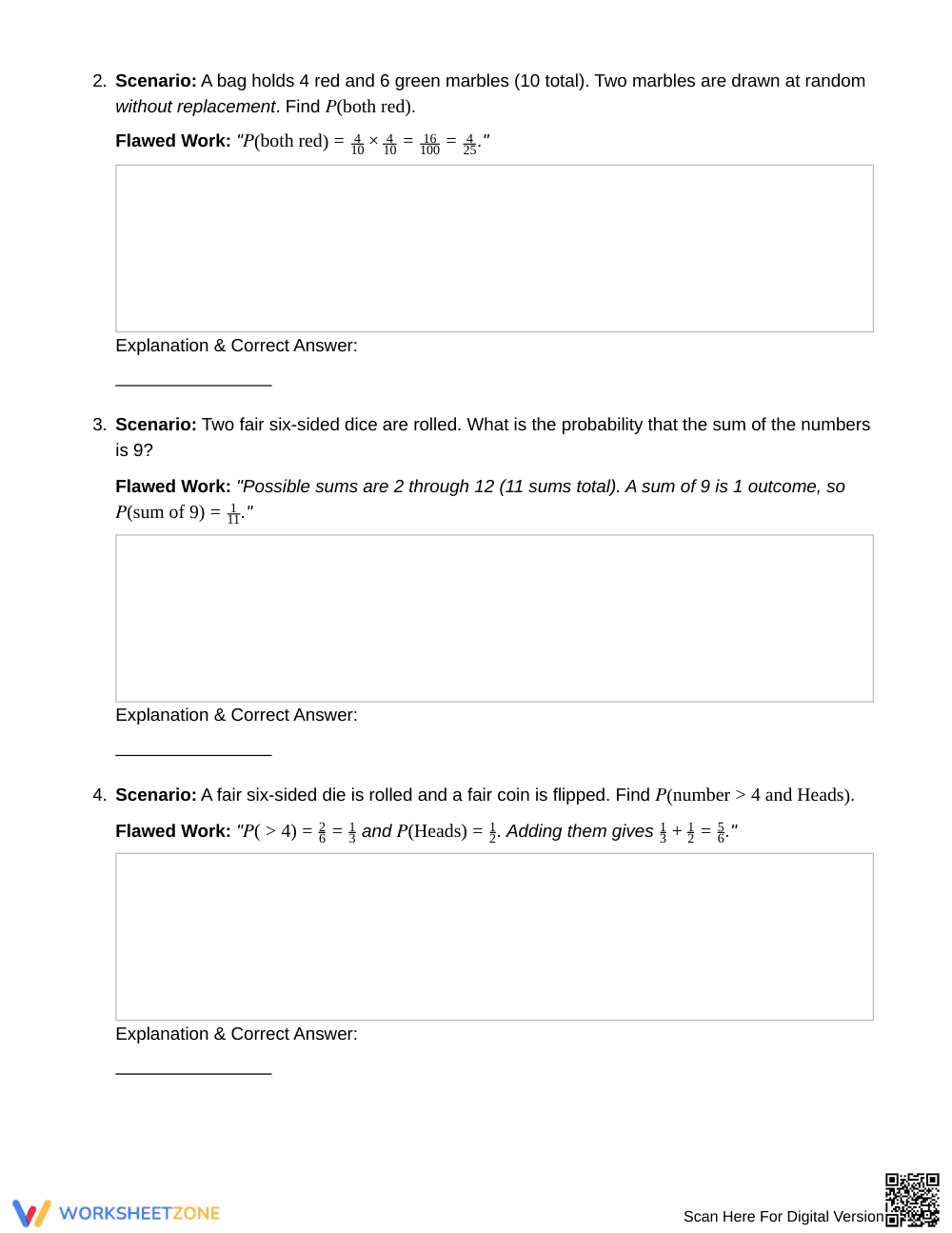
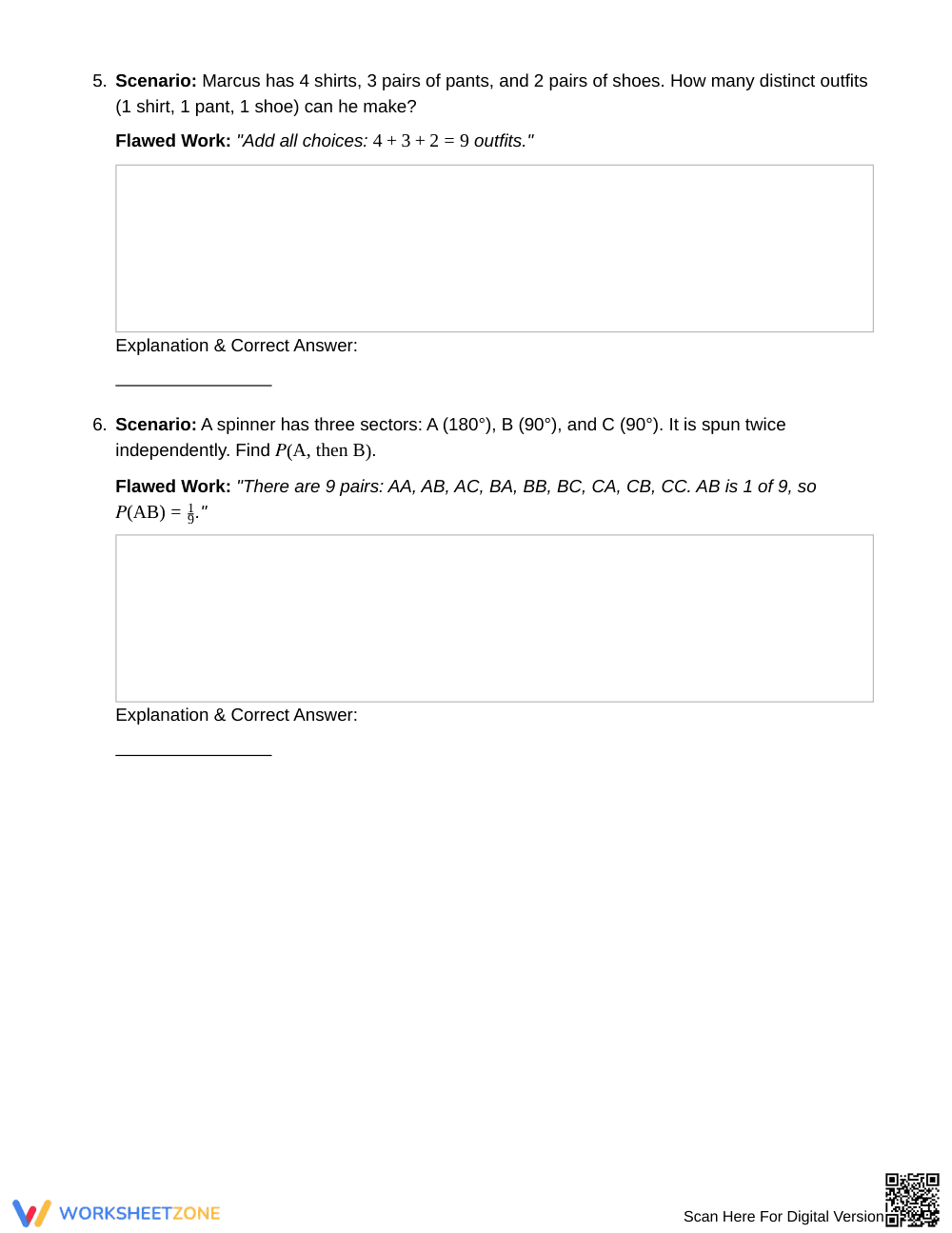
This Grade 7 math worksheet targets common misconceptions in compound probability, prompting students to analyze and correct 10 realistic calculation errors. By evaluating flawed reasoning regarding independent events, non-replacement sampling, order permutations, and sample spaces, learners build critical critique skills and computational accuracy.
At a Glance
- Grade: 7 · Subject: Math
- Standard:
7.SP.C.8— Find probabilities of compound events using organized lists, tables, and tree diagrams- Skill Focus: Correct Counting and Independence Errors
- Format: 5 pages · 10 problems · Answer key included · PDF
- Best For: Error analysis and formative review
- Time: 30–45 minutes
What's Inside
This 5-page resource provides a rule summary box, a worked error-repair model, 10 error-analysis tasks, and a 2-page answer key. Each problem pairs a scenario with flawed student reasoning, challenging learners to identify misconceptions in independence or replacement before finding the correct fraction.
Skill Progression
- Guided Practice (Model & Tasks 1–3): Students use four core probability rules and a model repair to correct errors in coin tosses, marble draws, and dice sums.
- Supported Practice (Tasks 4–7): Scaffolds fade as learners solve multi-step independent events, clothing combinations, spinner sectors, and muffin draws without replacement.
- Independent Practice (Tasks 8–10): Students independently evaluate gambler's fallacy logic, card deck overlaps, and sequential token draws.
This sequence implements the gradual-release model, moving students from guided critique to independent mastery.
Standards Alignment
This worksheet aligns directly with `7.SP.C.8` for compound probability and supports `7.RP.A.3` for ratio reasoning. Both standard codes can be copied directly into lesson plans, IEP goals, or district curriculum mapping tools.
How to Use It
Assign this worksheet after direct instruction on compound events. During independent work, observe whether students reduce total counts on non-replacement problems. This activity works well as a partner review or individual check, taking 30 to 45 minutes.
Who It's For
Designed for Grade 7 math students and Grade 8 intervention groups. Support visual learners by providing sample space grids, and pair this worksheet with a compound probability anchor chart.
According to Fisher & Frey (2014), engaging middle school students in explicit error analysis strengthens metacognitive monitoring and deepens procedural fluency during complex mathematical problem-solving. This Grade 7 math resource directly supports standard `7.SP.C.8` by challenging learners to identify, explain, and correct misconceptions in compound probability calculations. Rather than simply executing rote multiplication algorithms, students evaluate flawed student work involving dependent sampling without replacement, gambler's fallacy logic, mutually exclusive event overlap, and multi-stage counting principles. By diagnosing faulty reasoning across 10 authentic scenarios, students develop a grounded conceptual understanding of sample space structure and independent versus dependent events. The included reference rules and step-by-step model repair establish clear performance benchmarks, while the comprehensive 2-page answer key provides exact fractional solutions. Consequently, this worksheet offers educators an evidence-based tool for diagnosing persistent mathematical misconceptions and fostering rigorous mathematical discourse.


