
































Proven Perpendicular Bisector Worksheet | Grade 10 Geometry

Paste this activity's link or code into your existing LMS (Google Classroom, Canvas, Teams, Schoology, Moodle, etc.).
Students can open and work on the activity right away, with no student login required.
You'll still be able to track student progress and results from your teacher account.
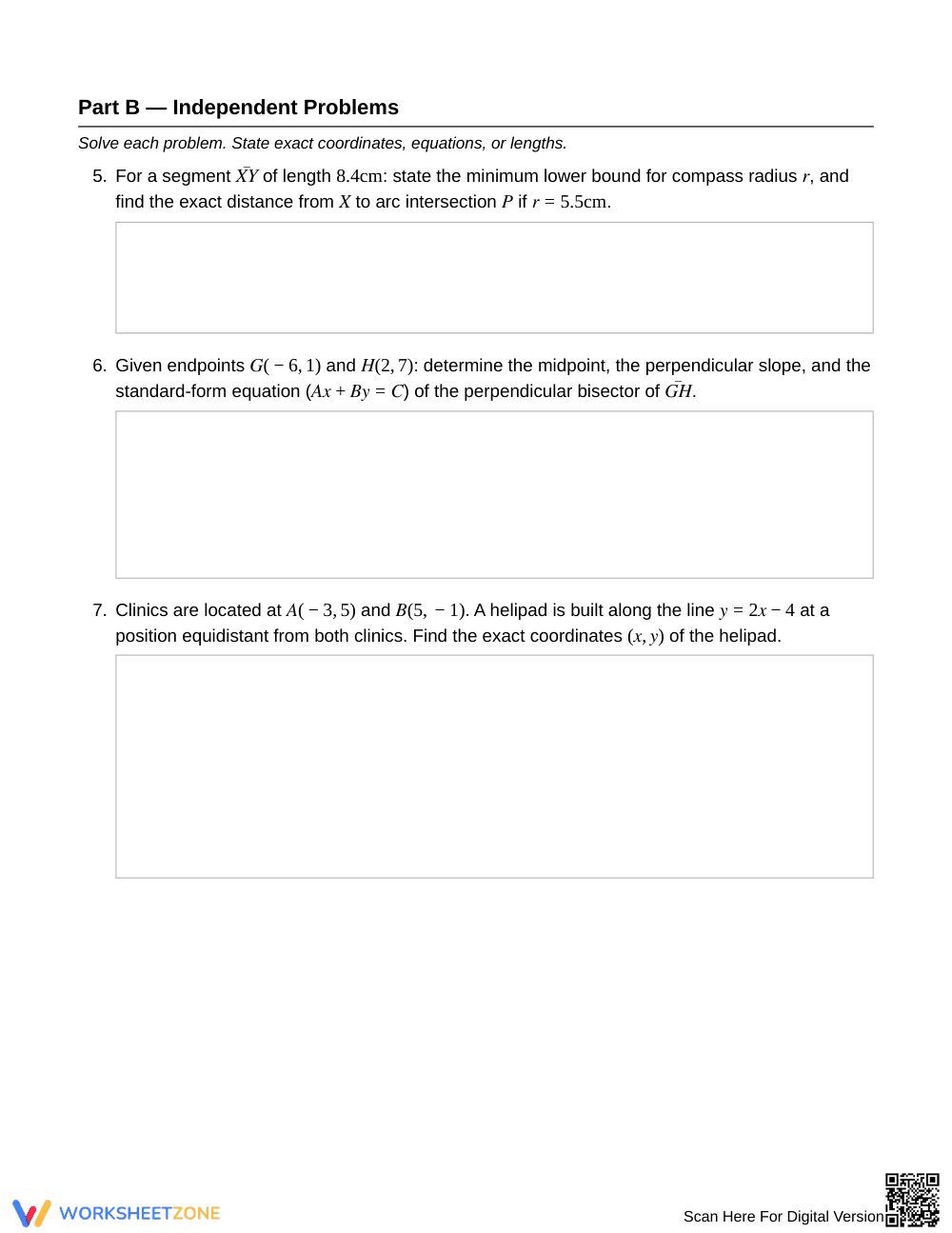
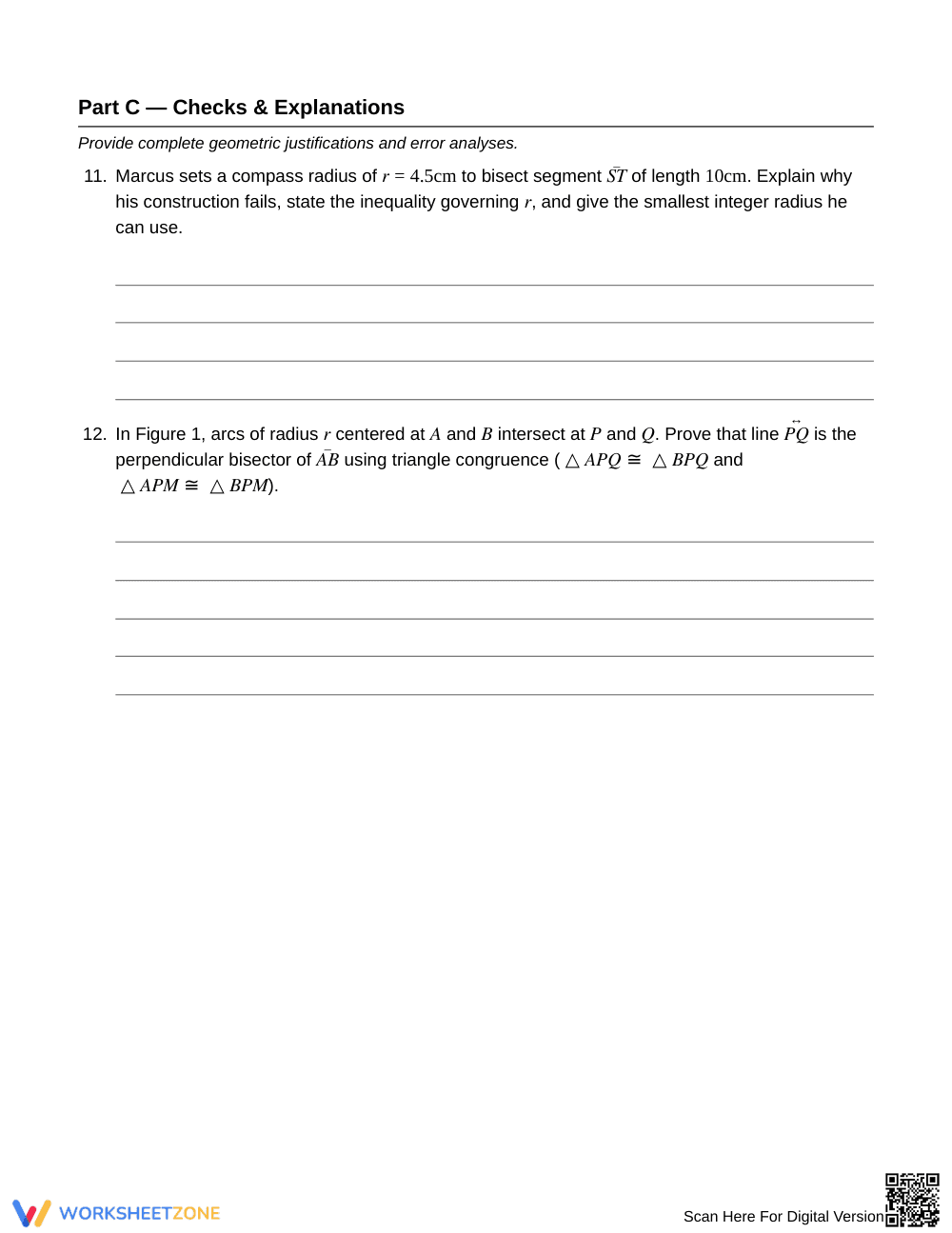
This geometry worksheet provides focused practice on constructing perpendicular bisectors using compass-and-straightedge techniques and coordinate geometry. Students learn to determine geometric midpoints, verify equidistant relationships, calculate perpendicular slopes, and formulate triangle congruence proofs. Through rigorous tasks, Grade 10 learners solidify spatial reasoning and master formal Euclidean constructions.
At a Glance
- Grade: 10 · Subject: Geometry
- Standard:
HSG-CO.D.12— Make formal geometric constructions with a variety of tools and methods- Skill Focus: Construct a Perpendicular Bisector
- Format: 5 pages · 12 problems · Answer key included · PDF
- Best For: High school geometry construction practice
- Time: 45–60 minutes
The resource spans 5 pages and features 12 structured tasks across three sections. It begins with two modeled solutions illustrating classical arc intersections and algebraic verification. Structural scaffolds include core definitions, the radius rule inequality, and labeled figures. A complete 2-page answer key provides step-by-step solutions and proofs.
Skill Progression
- Guided practice (Part A, 4 tasks): Students complete missing procedural steps, evaluate radius boundary conditions, and identify rhombus diagonal properties with direct scaffolded cues.
- Supported practice (Part B, 6 tasks): Learners independently solve multi-step coordinate problems, finding perpendicular bisector equations, real-world clinic locations, and circle chord lengths.
- Independent practice (Part C, 2 tasks): Students engage in error analysis and construct a deductive two-column triangle congruence proof without scaffolding.
This structured progression follows the gradual-release model, bridging concrete drafting with abstract proof.
Standards Alignment
This worksheet aligns directly with high school standard HSG-CO.D.12: Make formal geometric constructions with a variety of tools and methods, specifically bisecting a segment. It also supports HSG-GPE.B.5 by requiring students to compute perpendicular slopes. Both standard codes can be copied directly into lesson plans, IEP goals, or district curriculum mapping tools.
How to Use It
Use this resource as an in-class investigation following direct instruction on compass methods, or as a post-lesson formative check. During work time, observe whether students check the radius rule inequality before striking arcs. The 12-task packet is designed for a standard 45–60 minute instructional block or paired collaborative stations.
Who It's For
This worksheet is designed for Grade 10 Geometry students learning Euclidean constructions and coordinate geometry. Scaffolded prompts and diagrams support developing learners, while multi-step problems and formal proofs challenge advanced students. Pair this activity with an interactive compass demonstration or coordinate graphing anchor chart.
According to Fisher & Frey (2014), structured instructional frameworks that transition students from modeled examples to independent problem-solving significantly enhance procedural accuracy and conceptual retention in secondary mathematics. This 5-page Grade 10 geometry worksheet operationalizes that research by providing 12 rigorous tasks targeting standard HSG-CO.D.12 for constructing perpendicular bisectors. Students begin with modeled compass and coordinate techniques before moving into guided step completion, real-world equidistant modeling, and formal triangle congruence proofs. By synthesizing compass-and-straightedge geometric constructions with algebraic coordinate slopes and deductive reasoning, the material reinforces key spatial relationships and satisfies high school curriculum expectations. The resource includes comprehensive diagrams, scaffolded prompts, and a full 2-page answer key, ensuring educators can evaluate student mastery efficiently. As Fisher & Frey (2014) demonstrate, intentional scaffolds paired with analytical proof tasks foster deep geometric proficiency and enduring mathematical reasoning.


