































Proven Percent Composition Worksheet | Grades 9-12 Science

Paste this activity's link or code into your existing LMS (Google Classroom, Canvas, Teams, Schoology, Moodle, etc.).
Students can open and work on the activity right away, with no student login required.
You'll still be able to track student progress and results from your teacher account.
This comprehensive chemistry worksheet guides high school students through the core concepts of percent composition, molar mass, and the law of definite proportions. Learners define key terms, calculate percent by mass using atomic masses, evaluate student misconceptions, and analyze chemical decomposition data across 23 targeted tasks designed to build strong quantitative reasoning.
At a Glance
- Grade: Grades 9–12 · Subject: Science
- Standard: Calculate percent composition and apply the law of definite proportions to chemical compounds
- Skill Focus: Percent composition foundations and vocabulary
- Format: 4 pages · 23 problems · Answer key included · PDF
- Best For: First-time instruction and guided calculation practice
- Time: 45–55 minutes
What's Inside
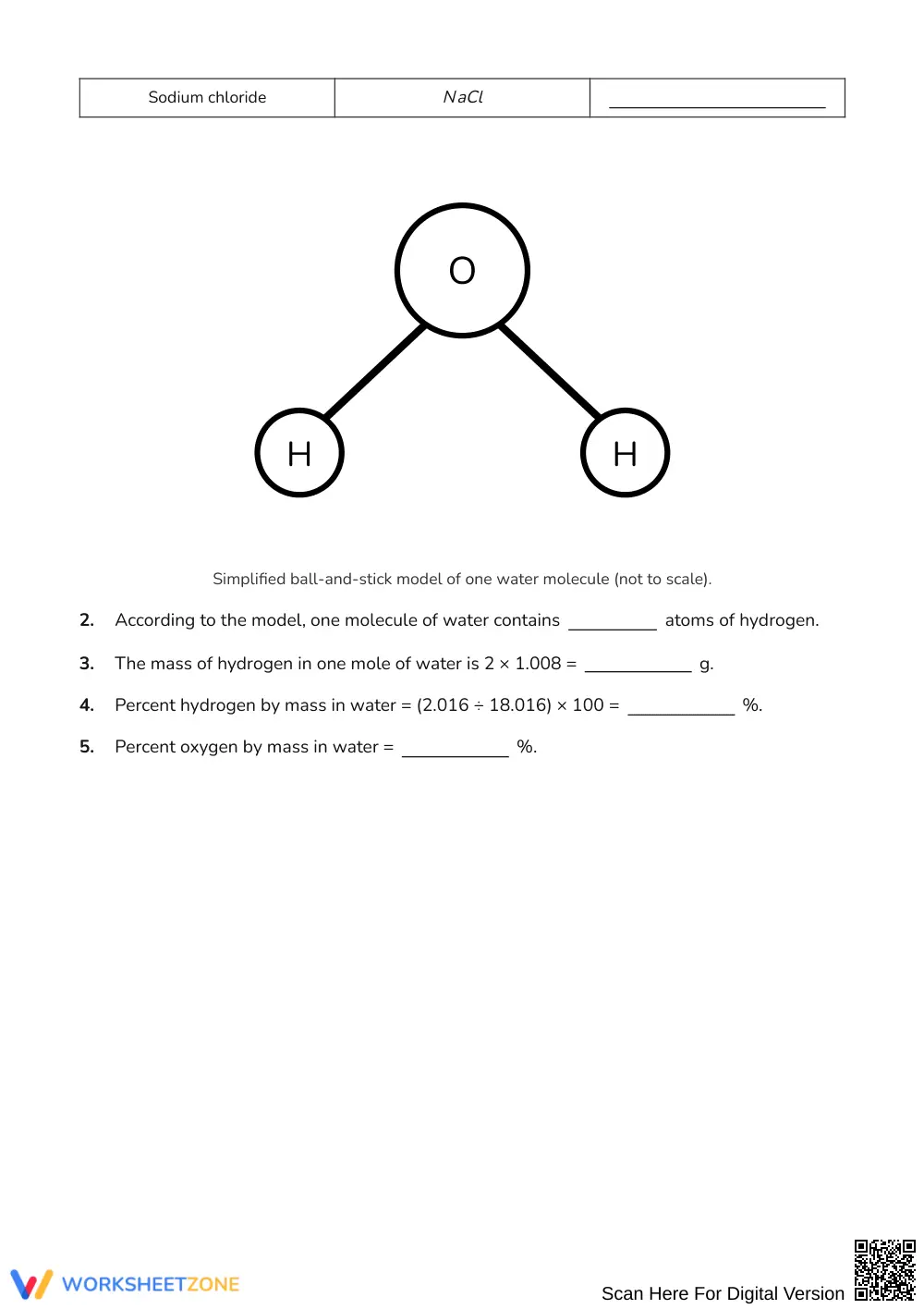
The four-page printable worksheet includes an introductory vocabulary matching drill, a reference table of atomic masses, ball-and-stick molecular models, graphic representations of mass distribution, and authentic reaction scenarios. A complete four-page teacher answer key provides worked-out mathematical steps, percentage calculations rounded to two decimal places, and exemplar explanations for conceptual prompts.
Skill Progression
- Guided practice (Parts A & B): Students define foundational terms like molar mass and subscript, identify valid percent composition statements, and follow step-by-step calculations for water, carbon dioxide, and sodium chloride with provided formulas.
- Supported practice (Parts C & D): Students interpret carbon dioxide mass data to predict values for varying sample sizes and analyze a common misconception that confuses atom counts with mass percentages.
- Independent practice (Part E): Learners apply mass proportions to the electrolysis decomposition of water and contrast water with hydrogen peroxide to demonstrate how multiple compounds obey the law of definite proportions.
This structured progression follows the gradual-release instructional model, moving learners from conceptual definitions to complex chemical problem-solving.
Standards Alignment
This resource aligns with high school physical science standards addressing the conservation of matter, chemical formula interpretation, and quantitative stoichiometry calculations. Students examine how compounds maintain constant proportions by mass regardless of sample scale. Both standard codes can be copied directly into lesson plans, IEP goals, or district curriculum mapping tools.
How to Use It
Introduce this activity during direct instruction immediately after teaching chemical formulas and atomic mass lookups. During the misconception check in Part D, conduct a quick formative pulse check by having students signal whether atom ratios equal mass ratios before they write their explanations. Most students complete the full 23-task sequence in 45 to 55 minutes.
Who It's For
This resource serves high school chemistry and physical science students entering quantitative stoichiometry units. It supports visual learners through molecular diagrams and data charts while offering structured calculation formulas for emerging problem solvers. Pair this worksheet directly with a periodic table reference chart and a hands-on molecular modeling lab.
According to Fisher & Frey (2014), scaffolded instructional sequences that integrate explicit vocabulary acquisition with corrective feedback significantly enhance conceptual transfer in secondary STEM disciplines. High school chemistry students frequently struggle to distinguish the number of individual atoms in a chemical formula from their respective contributions to overall molecular mass. By systematically coupling atomic mass lookups with ratio calculations and data interpretation, this 23-task resource builds durable quantitative reasoning. Students evaluate student dialogue claims, correct flawed mathematical reasoning, and apply proportional thinking to chemical decomposition scenarios. The structured transition from guided mass calculations to independent chemical justifications grounds student understanding in foundational physical principles, preparing learners for advanced stoichiometry calculations and empirical formula derivations.


