
































Proven Percent Composition Worksheet | Grade 9-12 Science

Paste this activity's link or code into your existing LMS (Google Classroom, Canvas, Teams, Schoology, Moodle, etc.).
Students can open and work on the activity right away, with no student login required.
You'll still be able to track student progress and results from your teacher account.
This high school science worksheet trains students to interpret percent composition through molecular models, bar graphs, and empirical data. Across 21 structured tasks, learners calculate mass percentages, evaluate common misconceptions about formula ratios, and analyze hydrate heating data to master quantitative chemical formulas.
At a Glance
- Grade: Grades 9–12 · Subject: Science
- Standard: Chemistry — Calculate percent composition and interpret empirical lab evidence from chemical formulas
- Skill Focus: Percent Composition: Graph or Evidence Interpretation
- Format: 4 pages · 21 problems · Answer key included · PDF
- Best For: Lab follow-up or stoichiometry practice
- Time: 40–50 minutes
What's Inside
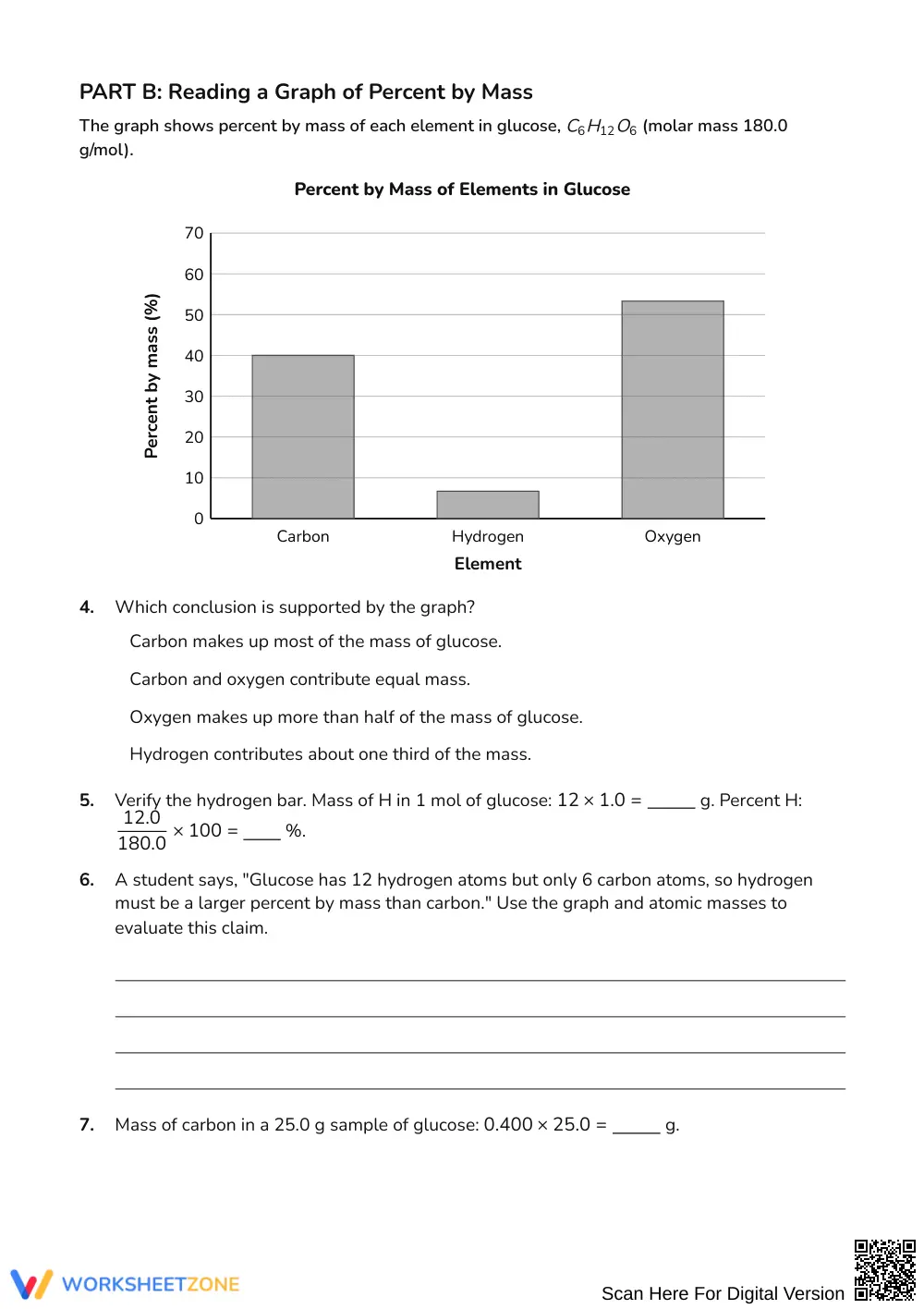
The 4-page worksheet includes structured data tables, elemental mass graphs, laboratory heating results, and claim-evidence-reasoning prompts. Students analyze compounds including water, hydrogen peroxide, carbon dioxide, glucose, and copper(II) sulfate hydrate. A 4-page answer key provides complete solutions, calculations, and exemplar student explanations.
Skill Progression
- Guided practice (Part A): Students use molecular models and reference tables to contrast atom ratios with mass percentages.
- Supported practice (Parts B & C): Students interpret glucose mass graphs and calculate water loss percentages from crucible heating trials.
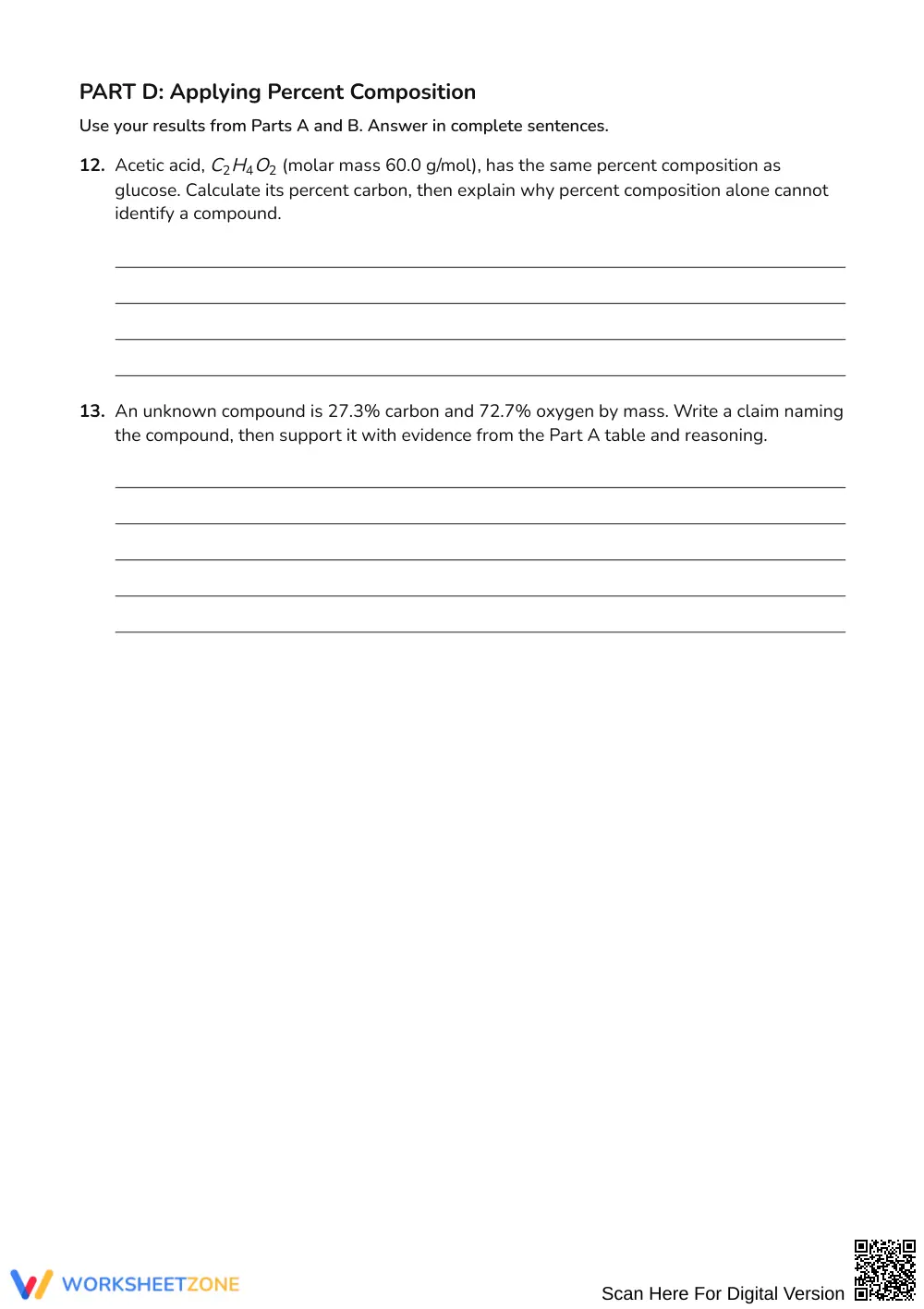
- Independent practice (Part D): Students independently evaluate isomers and write evidence-based claims explaining unknown compound identities.
This structure follows the gradual release of responsibility model, guiding students from initial model analysis to independent chemical reasoning.
Standards Alignment
Aligned with high school chemistry principles of quantitative composition and conservation of mass, this resource prepares students to link formulas to mass ratios. Students evaluate empirical data and thermal reactions to verify chemical formulas. Both standard codes can be copied directly into lesson plans, IEP goals, or district curriculum mapping tools.
How to Use It
Assign this worksheet after direct instruction on molar mass or following a hydrate heating investigation. For formative assessment, review Part B's evaluation prompt to verify that students distinguish between atomic count and atomic mass. The 4-page activity takes 40 to 50 minutes to complete in class or as homework.
Who It's For
This resource targets high school chemistry students mastering quantitative analysis. Given data tables support struggling learners, while graph analysis and error identification challenge advanced students. Pair this practice with an empirical formula laboratory experiment or a mole conversion review sheet.
According to research in Fisher & Frey (2014), structured progressions bridging visual models and written arguments significantly increase high school student mastery of quantitative chemistry. Interpreting percent composition from graphical representations and empirical heating data prevents the common misconception that chemical formula subscripts directly reflect elemental mass proportions. Through 21 scaffolded tasks across 4 pages, learners confront discrepancies between atom counts and molar masses, determine experimental mass loss in hydrates, and construct evidence-based arguments regarding chemical identity. High school science classrooms utilizing systematic problem sets with immediate feedback achieve higher retention on stoichiometry assessments and demonstrate superior data literacy during laboratory investigations. This instructional worksheet bridges formula mass calculations and experimental laboratory analysis by requiring students to justify mathematical findings using conservation of mass principles. Consequently, students gain essential scientific fluency translating between empirical lab evidence and symbolic formulas.


