


























Views
Downloads


Proven Log Transformations Worksheet | Grade 11 Algebra II
Paste this activity's link or code into your existing LMS (Google Classroom, Canvas, Teams, Schoology, Moodle, etc.).
Students can open and work on the activity right away, with no student login required.
You'll still be able to track student progress and results from your teacher account.
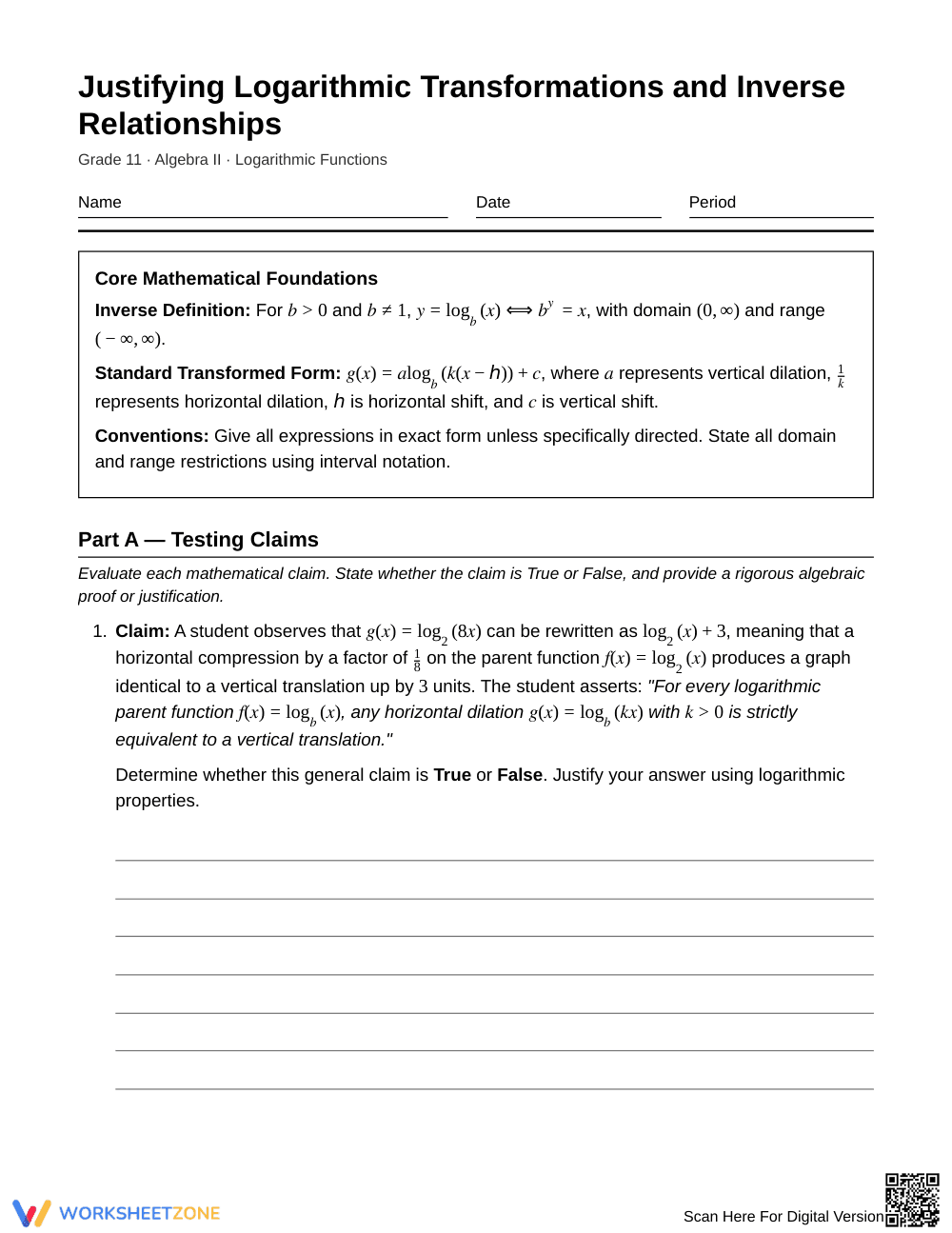
This Grade 11 Algebra II worksheet develops rigorous mathematical reasoning by challenging students to evaluate, prove, and justify logarithmic transformations and inverse relationships. High school learners analyze algebraic claims, establish domain and range restrictions, and verify geometric behaviors using formal logarithmic properties across 8 detailed multi-part exercises.
At a Glance
- Grade: 11 · Subject: Algebra II
- Standard: Justify transformations, vertical asymptotes, and inverse relationships of logarithmic functions
- Skill Focus: Justify a Logarithmic Transformation
- Format: 5 pages · 8 problems · Answer key included · PDF
- Best For: Advanced transformation justification practice
- Time: 45–60 minutes
What's Inside
This comprehensive 5-page student resource includes 8 analytical problems arranged into three specialized sections: evaluating student assertions, justifying algebraic derivations and asymptote behaviors, and constructing counterexamples. It incorporates a foundational reference box detailing inverse definitions and standard transformation forms, accompanied by a 4-page complete step-by-step answer key displaying formal mathematical justifications.
Skill Progression
- Guided practice (Problems 1–2): Students evaluate pre-formulated mathematical claims regarding horizontal dilations versus vertical translations, establishing true or false verdicts through formal algebraic proofs.
- Supported practice (Problems 3–6): Learners derive inverse functions algebraically, justify domain restrictions via horizontal asymptotes, prove vertical dilation properties using the Change of Base Formula, and analyze reciprocal base reflections.
- Independent practice (Problems 7–8): High schoolers independently generate numerical counterexamples and isolate domain validity conditions to expose common algebraic misconceptions.
This structured progression reflects the gradual-release framework, guiding students from guided claim evaluation toward independent proof construction and counterexample generation.
Standards Alignment
This resource aligns with high school advanced algebra standards covering logarithmic functions, function transformations, and inverse relationships. Students analyze the effects of parameter changes on logarithmic graphs, verify asymptotic behaviors, and prove algebraic equivalence across functional representations. These conceptual objectives can be copied directly into lesson plans, IEP goals, or district curriculum mapping tools.
How to Use It
Administer this worksheet after direct instruction on logarithmic properties and graph transformations to solidify conceptual depth. During class practice, conduct formative checks by observing whether students reference the vertical asymptote when proving domain boundaries in Part B. Allow 45 to 60 minutes for individual completion or collaborative peer critique.
Who It's For
Designed for Grade 11 Algebra II and Pre-Calculus students moving beyond rote computation toward formal mathematical argumentation. It provides essential scaffolding for college-preparatory learners and pairs naturally with graphic analysis tasks or dynamic graphing software demonstrations.
According to Fisher & Frey (2014), structured opportunities for students to evaluate mathematical assertions and generate counterexamples cultivate disciplinary literacy and deepen conceptual retention. This Grade 11 Algebra II worksheet applies that instructional design to logarithmic transformations and inverse functions. By requiring high school learners to substantiate claims with definitions rather than procedural rules alone, the resource develops authentic mathematical reasoning. Students examine 8 multi-part prompts that target persistent misconceptions, including domain validity constraints and horizontal dilation properties. As documented in secondary mathematics research, asking students to construct counterexamples solidifies structural understanding and prevents common notation errors during advanced function analysis. The accompanying 4-page answer key provides clear, reproducible verification criteria that help educators measure whether pupils can articulate why algebraic transformations behave predictably across different functional bases.


