




























Views
Downloads




Proven Invertible Domains Worksheet | Grade 12 Precalculus

Paste this activity's link or code into your existing LMS (Google Classroom, Canvas, Teams, Schoology, Moodle, etc.).
Students can open and work on the activity right away, with no student login required.
You'll still be able to track student progress and results from your teacher account.
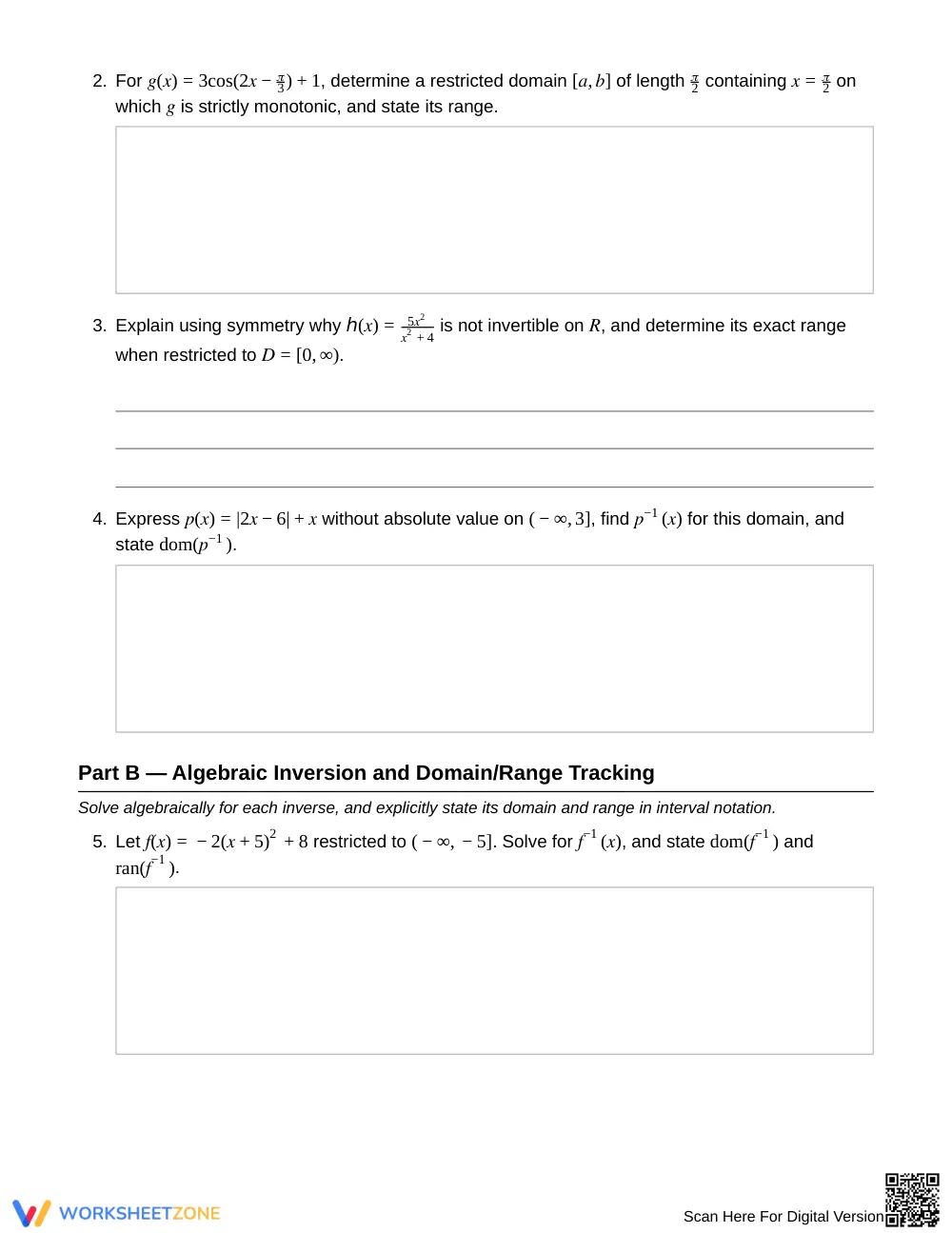
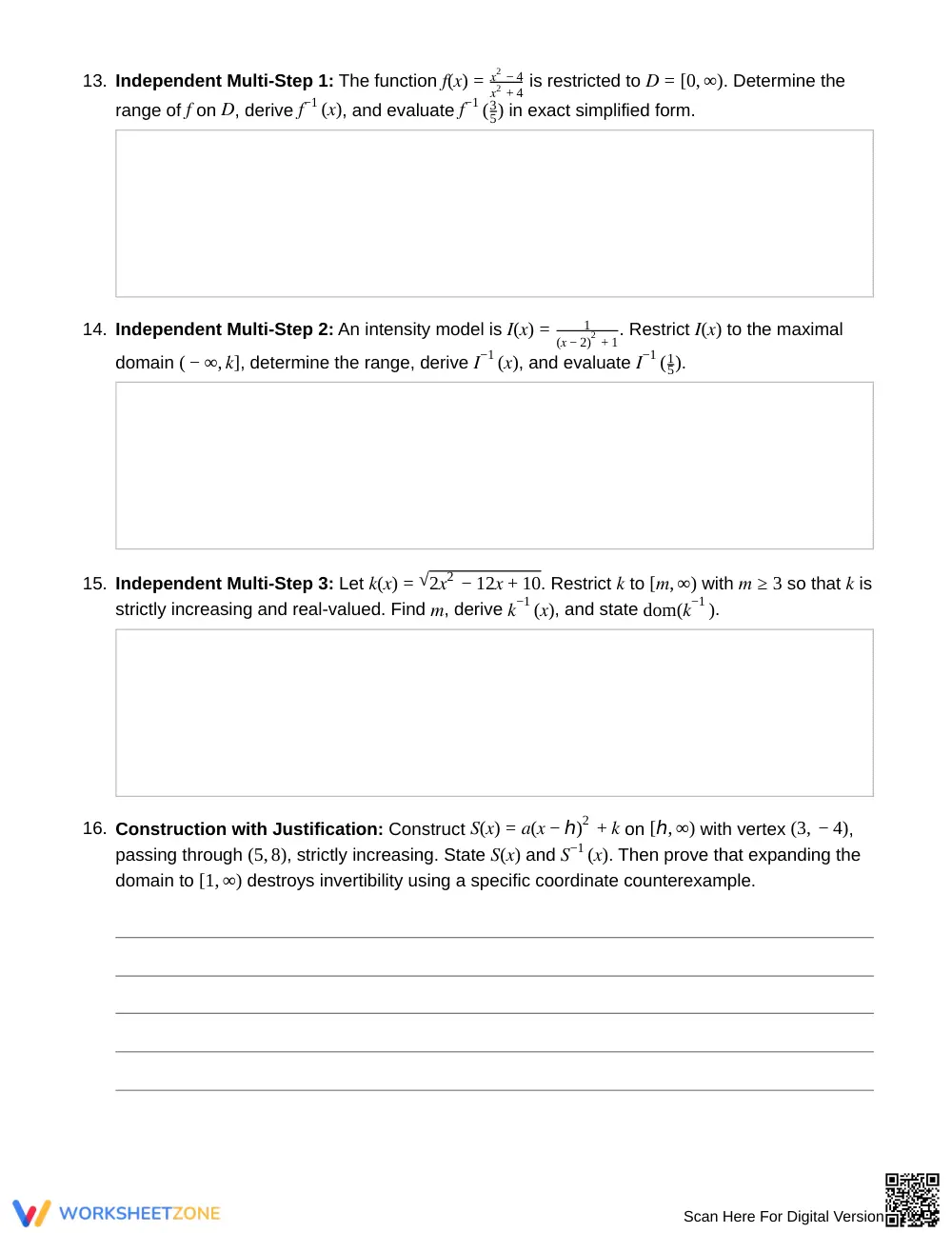
Mastering domain restrictions allows advanced mathematics students to establish invertibility on non-monotonic relations. This five-page Precalculus worksheet provides 16 rigorous analytical problems that guide students through identifying intervals of strict monotonicity, finding algebraic inverses, verifying identities through function composition, and solving real-world kinematic constraints.
At a Glance
- Grade: 12 · Subject: Precalculus
- Standard:
HSF-BF.B.4— Restrict function domains to construct invertible functions and find inverse values- Skill Focus: Choose a Domain That Makes a Function Invertible
- Format: 5 pages · 16 problems · Answer key included · PDF
- Best For: Advanced functions practice and assessment
- Time: 45–60 minutes
What's Inside
This resource features 16 rigorous multi-part problems spanning four dedicated sections: graphical monotonicity analysis, algebraic inversion with domain tracking, composition verification, and applied kinematic optimization. The packet includes a complete three-page worked answer key displaying algebraic derivations, interval notations, and coordinate justifications for efficient evaluation.
Skill Progression
- Guided Practice: Tasks 1–4 build foundational conceptual understanding using polynomial graphs, trigonometric curves, and rational functions to isolate maximal intervals of strict monotonicity.
- Supported Practice: Tasks 5–10 require algebraic inversion of quadratic, rational, and radical expressions while explicitly tracking domain restrictions and verifying compositions.
- Independent Practice: Tasks 11–16 present non-routine constraint models, including projectile descent phases, intensity formulations, and formal invertibility proofs.
This structure reflects a gradual-release instructional model, moving systematically from graphical identification to independent multi-step algebraic derivation.
Standards Alignment
This worksheet directly aligns with HSF-BF.B.4: Find inverse functions, solve an equation of the form f(x) = c for a simple function f that has an inverse, and write an expression for the inverse. It also reinforces high school modeling standards by contextualizing restricted inverses within physical systems. Both standard codes can be copied directly into lesson plans, IEP goals, or district curriculum mapping tools.
How to Use It
Deploy this activity after direct instruction on function monotonicity and one-to-one mapping. For targeted intervention, use Tasks 1–4 during guided small-group instruction before assigning the remaining problems as independent homework. During work time, check whether students flip inequality signs when taking roots of negative domain intervals. Expect completion in 45 to 60 minutes.
Who It's For
This worksheet serves Grade 12 Precalculus and AP Precalculus students preparing for differential calculus. It offers built-in scaffolding for learners transitioning from basic algebra to rigorous function analysis. Pair this practice directly with an interactive graphing utility or a monotonicity anchor chart.
According to Fisher & Frey (2014), purposeful scaffolding through the gradual release of responsibility enables students to master abstract algebraic transformations with greater retention. This Precalculus worksheet implements this evidence-based framework to address standard HSF-BF.B.4, which tasks learners with restricting non-monotonic function domains to construct invertible functions. By guiding students from graphical inspection of extrema to algebraic inversion and real-world kinematic modeling, the resource builds deep conceptual fluency. Learners systematically analyze local behavior, trace interval constraints through function compositions, and resolve domain-dependent sign choices in radical expressions. The integrated structure ensures that 12th-grade mathematicians do not merely execute memorized algorithms, but instead internalize how domain boundaries dictate range viability and mapping reversibility. Teachers can utilize the included three-page worked solution set to monitor student progress, address common domain misconceptions, and provide targeted feedback during advanced function analysis.


