































Proven Inference Conditions Worksheet | Grade 12 Statistics

Paste this activity's link or code into your existing LMS (Google Classroom, Canvas, Teams, Schoology, Moodle, etc.).
Students can open and work on the activity right away, with no student login required.
You'll still be able to track student progress and results from your teacher account.
This Grade 12 statistics worksheet equips students to evaluate and justify validity conditions for one-sample proportion inference. Students analyze Random sampling, the 10% condition, and Large Counts across eight multi-part problems, building the precision needed to construct valid confidence intervals and execute significance tests.
At a Glance
- Grade: 12 · Subject: Statistics
- Standard: Advanced Statistics — Justify Random, 10%, and Large Counts conditions for proportions
- Skill Focus: Justify Conditions for an Inference Method
- Format: 4 pages · 8 problems · Answer key included · PDF
- Best For: AP Statistics exam review
- Time: 45–60 minutes
What's Inside
The 4-page worksheet includes a reference summary table of core conditions followed by three distinct sections. Students evaluate sample scenarios in Part A, perform complete hypothesis tests with condition checks in Part B, and solve algebraic sample size thresholds in Part C. A detailed 2-page answer key provides complete justifications.
Skill Progression
- Guided practice (Part A, Problems 1–4): Students verify conditions in scaffolded prompts, identifying failures and contrasting sample versus null proportion checks.
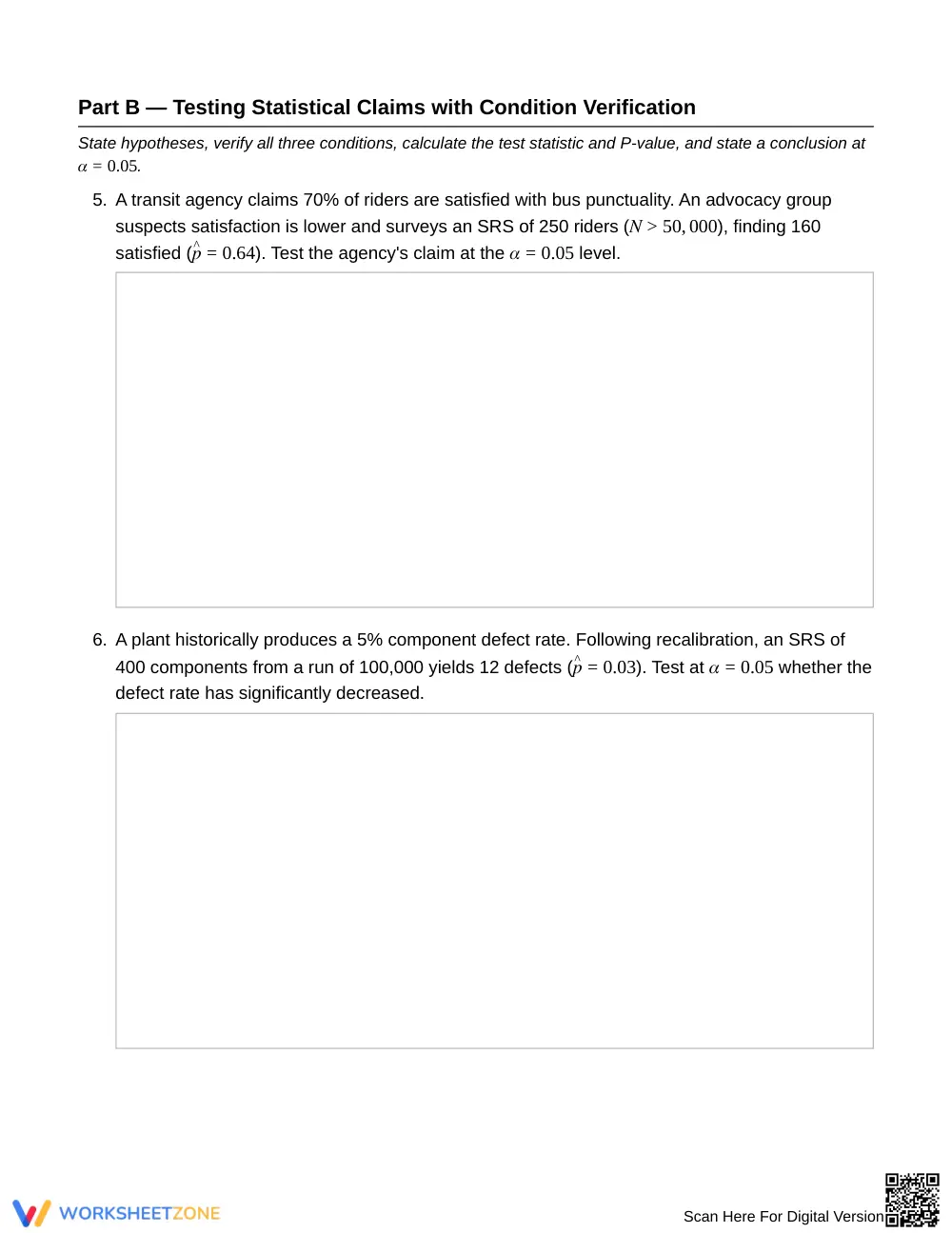
- Supported practice (Part B, Problems 5–6): Students extract information from applied contexts to verify conditions and complete one-sample z-tests.
- Independent practice (Part C, Problems 7–8): Students calculate minimum sample size boundaries algebraically and write statistical arguments regarding bias.
This progression follows the gradual-release model, advancing learners from guided checks to complex conceptual evaluations.
Standards Alignment
This resource aligns with advanced high school statistics standards for categorical inference. Students verify random sampling, assess independence via the 10% condition, and check sampling distribution normality with Large Counts. Both standard codes can be copied directly into lesson plans, IEP goals, or district curriculum mapping tools.
How to Use It
Assign this worksheet following direct instruction on one-sample proportion procedures for independent or partner practice. During class, formatively check whether students use the null proportion rather than the sample proportion when verifying Large Counts for significance tests. Expect completion within 45 to 60 minutes.
Who It's For
This worksheet is designed for Grade 12 AP Statistics and advanced mathematics students. Provide the introductory reference table to support struggling learners, and assign the algebraic threshold derivations to challenge advanced students. Pair this activity with an interactive sampling distribution simulation.
According to Fisher & Frey (2014), structured condition justification bridges the gap between rote statistical calculation and authentic conceptual reasoning. When students systematically verify the Random, 10%, and Large Counts conditions for one-sample proportion inference, they develop metacognitive awareness regarding why specific inferential formulas remain valid. High school statistics curricula frequently observe that learners memorize computational test statistics without understanding the mathematical necessity of normality or independence assumptions. By confronting realistic boundary scenarios—such as oversampling a finite senior class or evaluating voluntary response bias—students learn to diagnose methodological flaws before computing confidence intervals or P-values. Research demonstrates that integrating explicit condition verification routines into guided classroom practice significantly reduces error rates on free-response statistical assessments. This instructional resource provides the structured problem progression and rigorous conceptual prompts needed to establish deep, lasting mastery of inferential validity criteria in secondary mathematics.


