
































Proven Geometric Invariants Worksheet | Grade 10 Geometry

Paste this activity's link or code into your existing LMS (Google Classroom, Canvas, Teams, Schoology, Moodle, etc.).
Students can open and work on the activity right away, with no student login required.
You'll still be able to track student progress and results from your teacher account.
This Grade 10 geometry worksheet helps students master Euclidean construction rules and geometric invariants across 16 structured problems. High schoolers differentiate permitted straightedge and compass actions from measurement drawings, justify perpendicular bisector and angle bisector methods, and apply triangle congruence theorems to prove why constructions maintain constant geometric properties.
At a Glance
- Grade: 10 · Subject: Geometry
- Standard:
HSG-CO.D.12— Make formal geometric constructions using compass and straightedge methods- Skill Focus: Permitted Construction Steps and Invariants
- Format: 4 pages · 16 problems · Answer key included · PDF
- Best For: High school geometry concept mastery
- Time: 45–60 minutes
What's Inside
The 4-page worksheet includes a Euclidean Construction Rules reference box defining straightedge, compass, and intersection operations. Students complete 4 concept distinction items, 8 diagram-based application problems analyzing bisectors and parallel lines, and 4 in-depth justification tasks connecting constructions to coordinate geometry. A 2-page answer key provides step-by-step proofs.
Skill Progression
- Guided Practice (Part A, Problems 1–4): Multiple-choice and conceptual prompts identify valid compass-and-straightedge actions, radius constraints, and invariant locus definitions.
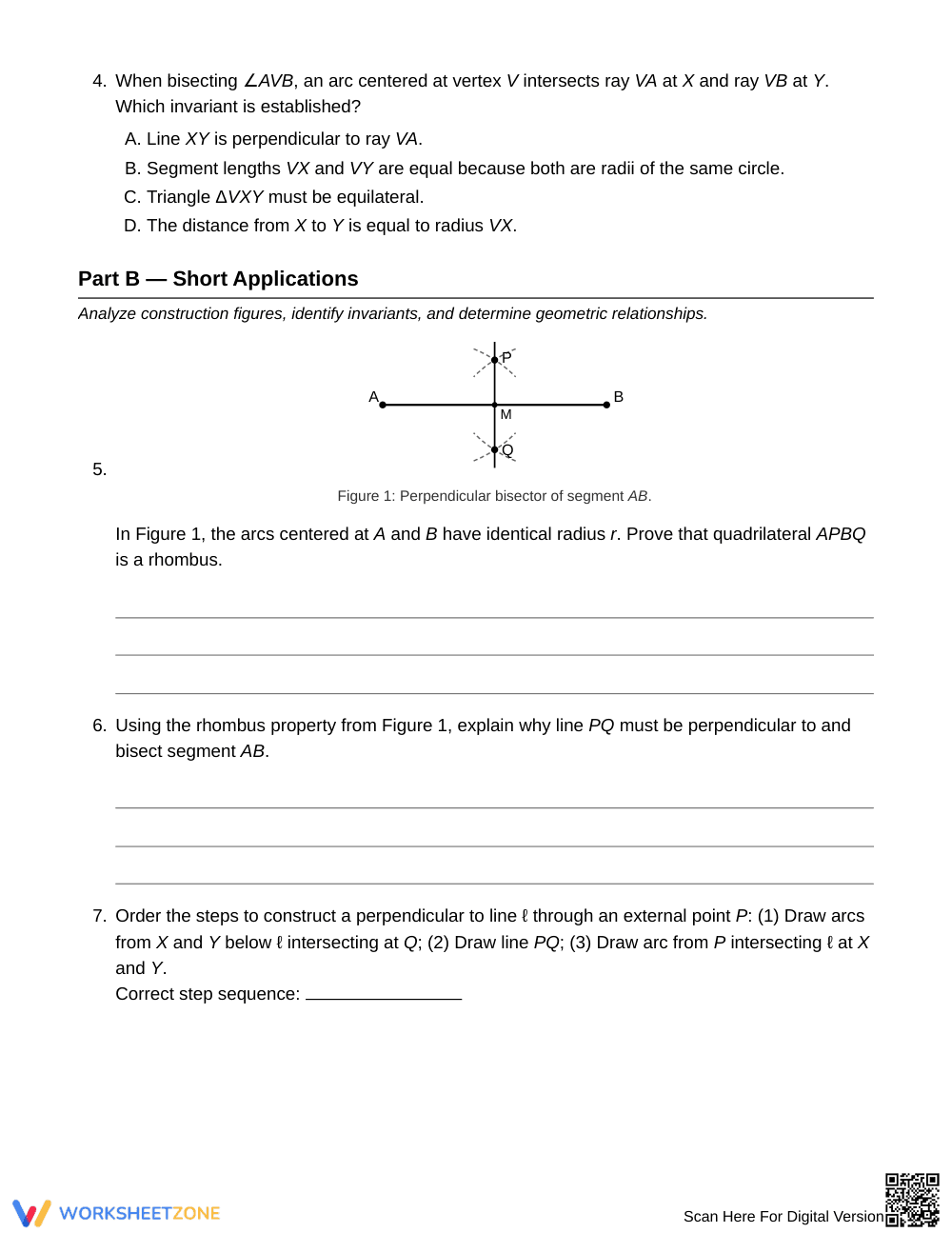
- Supported Practice (Part B, Problems 5–12): Diagram analysis and step-ordering tasks require students to identify congruent radii, apply SSS congruence, and justify parallel lines.
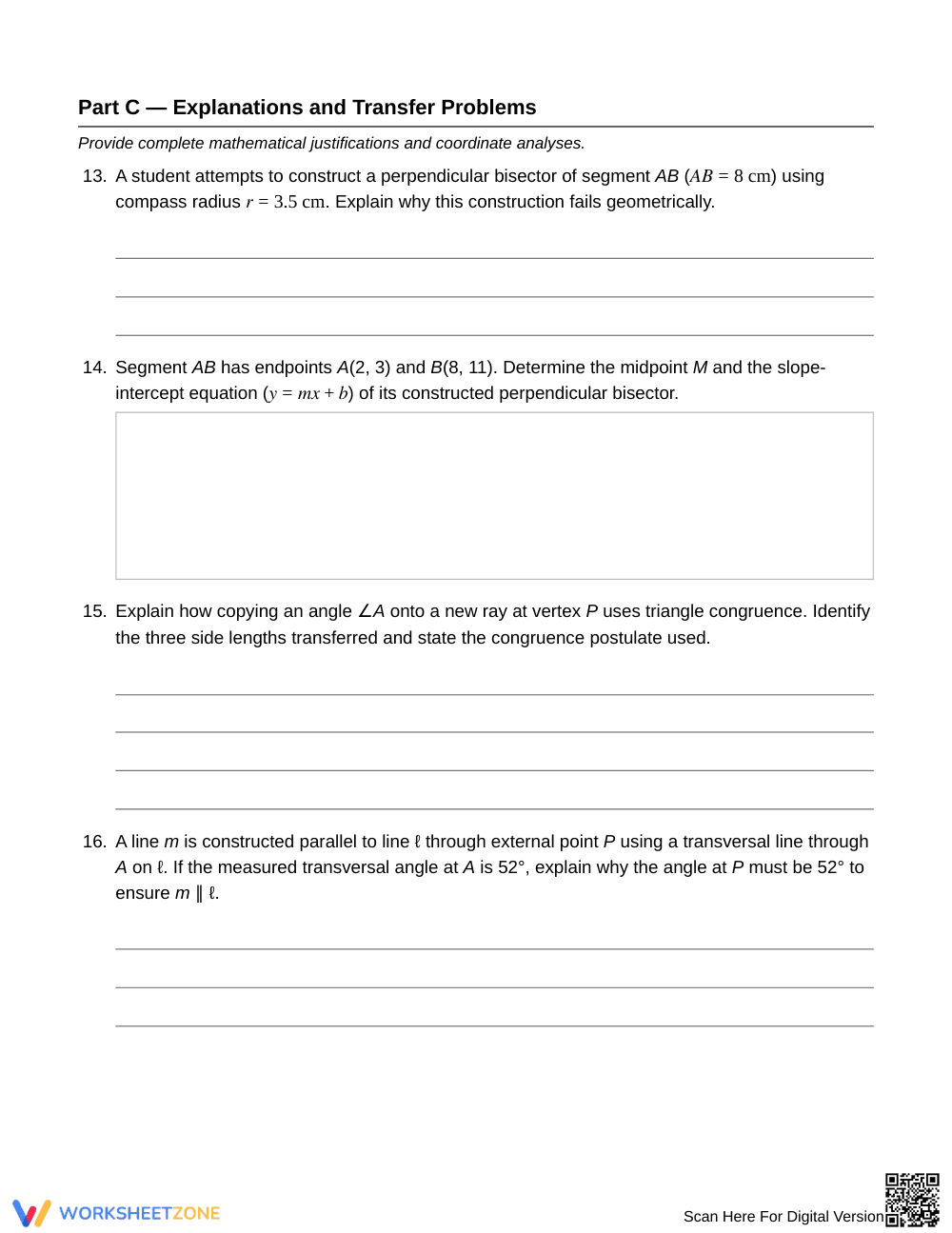
- Independent Practice (Part C, Problems 13–16): Open-response proof and coordinate tasks challenge learners to explain construction limits, write bisector equations, and verify angle copies.
This sequence follows a gradual-release instructional model transitioning from Euclidean definitions to deductive proof.
Standards Alignment
This resource aligns directly with `HSG-CO.D.12`: Make formal geometric constructions with a variety of tools and methods, including copying segments, bisecting angles, and constructing parallel lines. It also supports `HSG-CO.C.9` by proving theorems about lines and angles. Both standard codes can be copied directly into lesson plans, IEP goals, or district curriculum mapping tools.
How to Use It
Deploy this worksheet after direct instruction on classical compass-and-straightedge techniques as targeted practice, or during review stations before a geometric proof assessment. For formative assessment, check student explanations in Part C to verify whether they recognize equal circle radii as the core invariant underlying segment congruence. Expected completion time is 45 to 60 minutes.
Who It's For
This activity is designed for Grade 10 Geometry students learning deductive proof and constructions. Structured diagrams support visual learners, while analytical questions challenge advanced students. Pair this worksheet with hands-on physical compass practice or dynamic geometry software demonstrations.
According to research by Fisher & Frey (2014) on the gradual release of responsibility, structured progression from foundational tool constraints to multi-step proof significantly improves secondary students' ability to transfer mathematical principles. This Grade 10 Geometry worksheet operationalizes that framework for standard HSG-CO.D.12, guiding learners through permitted Euclidean construction steps and geometric invariants. By distinguishing classical compass-and-straightedge operations from empirical measurement, students develop deductive reasoning skills essential for formal geometry. The 16 problems systematically transition from identifying radius relationships to constructing coordinate equations and justifying triangle congruence criteria like SSS and SAS. Teachers can use this resource to pinpoint student misconceptions regarding circle properties and locus definitions. Designed for high school classrooms, the resource provides rigorous, standards-aligned practice that strengthens geometric reasoning, structural analysis, and mathematical communication across all 4 pages of instructional content.


