
































Proven Free Body Diagram Worksheet | Grades 8-12 Science

Paste this activity's link or code into your existing LMS (Google Classroom, Canvas, Teams, Schoology, Moodle, etc.).
Students can open and work on the activity right away, with no student login required.
You'll still be able to track student progress and results from your teacher account.
This physics resource targets persistent student errors regarding net force, normal force, and motion. Students analyze flawed peer statements, recalculate incorrect force tables, and write evidence-based corrections using Newton's laws. Through targeted error analysis, learners transform surface-level formula memorization into rigorous, scientifically grounded conceptual mastery across varied mechanical scenarios.
At a Glance
- Grade: Grades 8–12 · Subject: Science / Physics
- Standard: Newton's Laws of Motion — Analyze force systems and resolve conceptual errors in free-body diagrams
- Skill Focus: Misconception diagnosis and scientific justification
- Format: 4 pages · 15 problems · Answer key included · PDF
- Best For: Formative review or post-lab error analysis
- Time: 40–55 minutes
What's Inside
The four-page printable packet features 15 targeted analytical tasks divided into distinct conceptual challenges. Students inspect realistic student claims featuring common physics errors, evaluate multiple-choice diagnostic stems, calculate balanced and unbalanced vector totals, and craft extended written justifications. A thorough four-page teacher answer key provides explicit step-by-step vector breakdowns and sample correction responses for straightforward grading.
Skill Progression
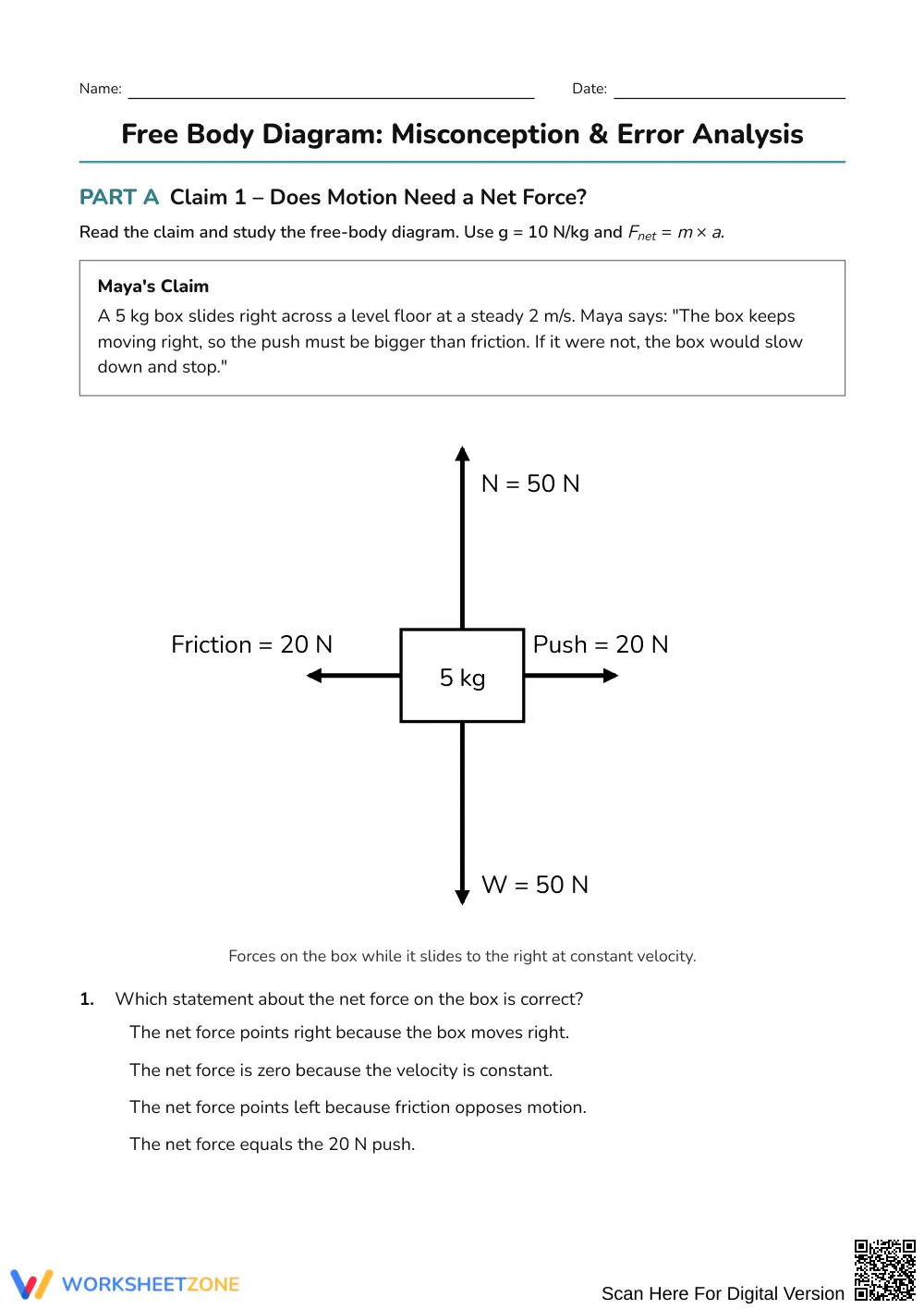
- Guided Practice (Part A): Students examine Maya's claim regarding motion requiring sustained net force, selecting the correct force balance statement and writing a structured refutation using Newton's first law (tasks 1–3).
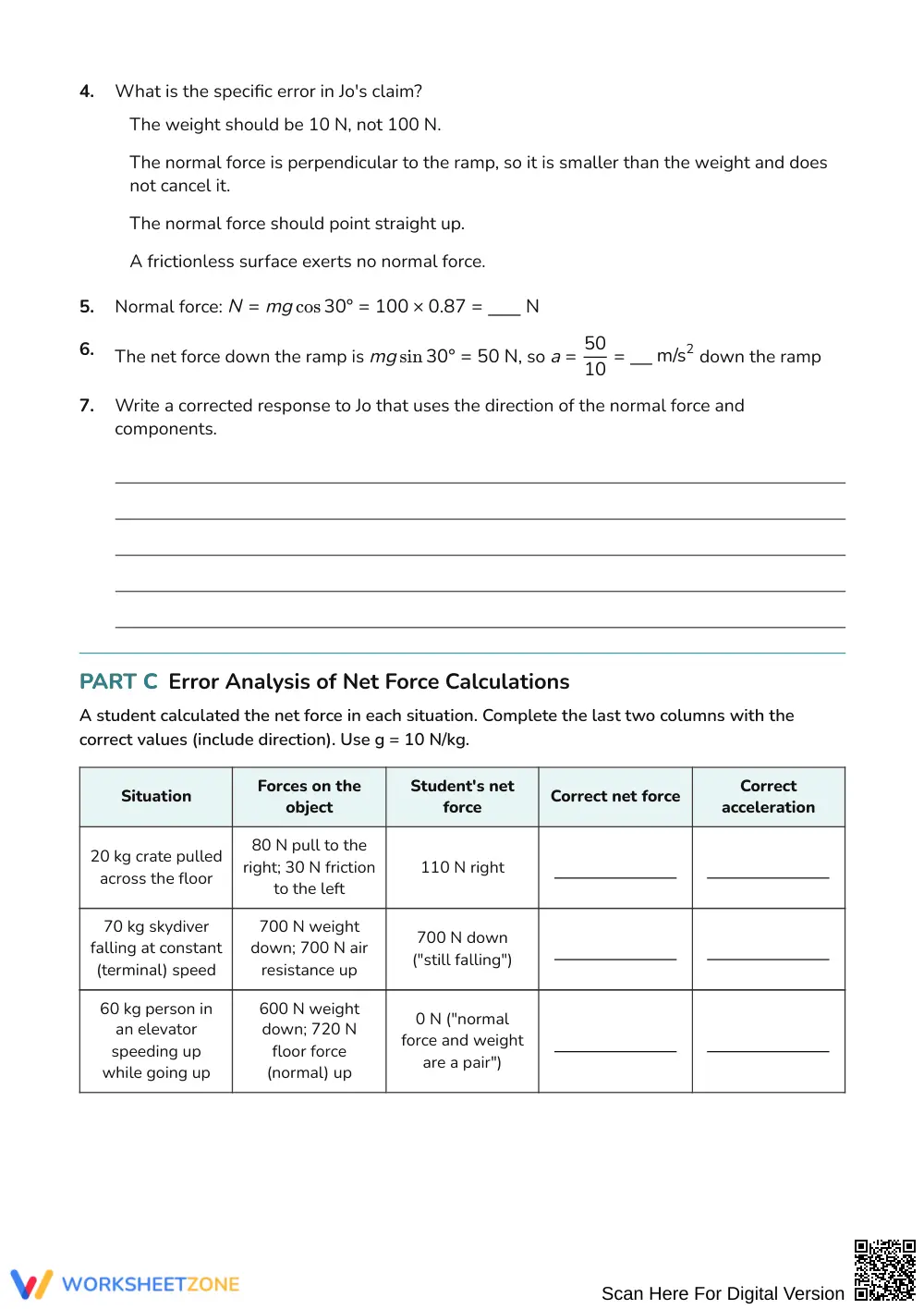
- Supported Practice (Part B): Learners critique Jo's claim on an inclined plane, resolving weight components with trigonometric values to explain why the normal force does not balance gravitational load (tasks 4–6).
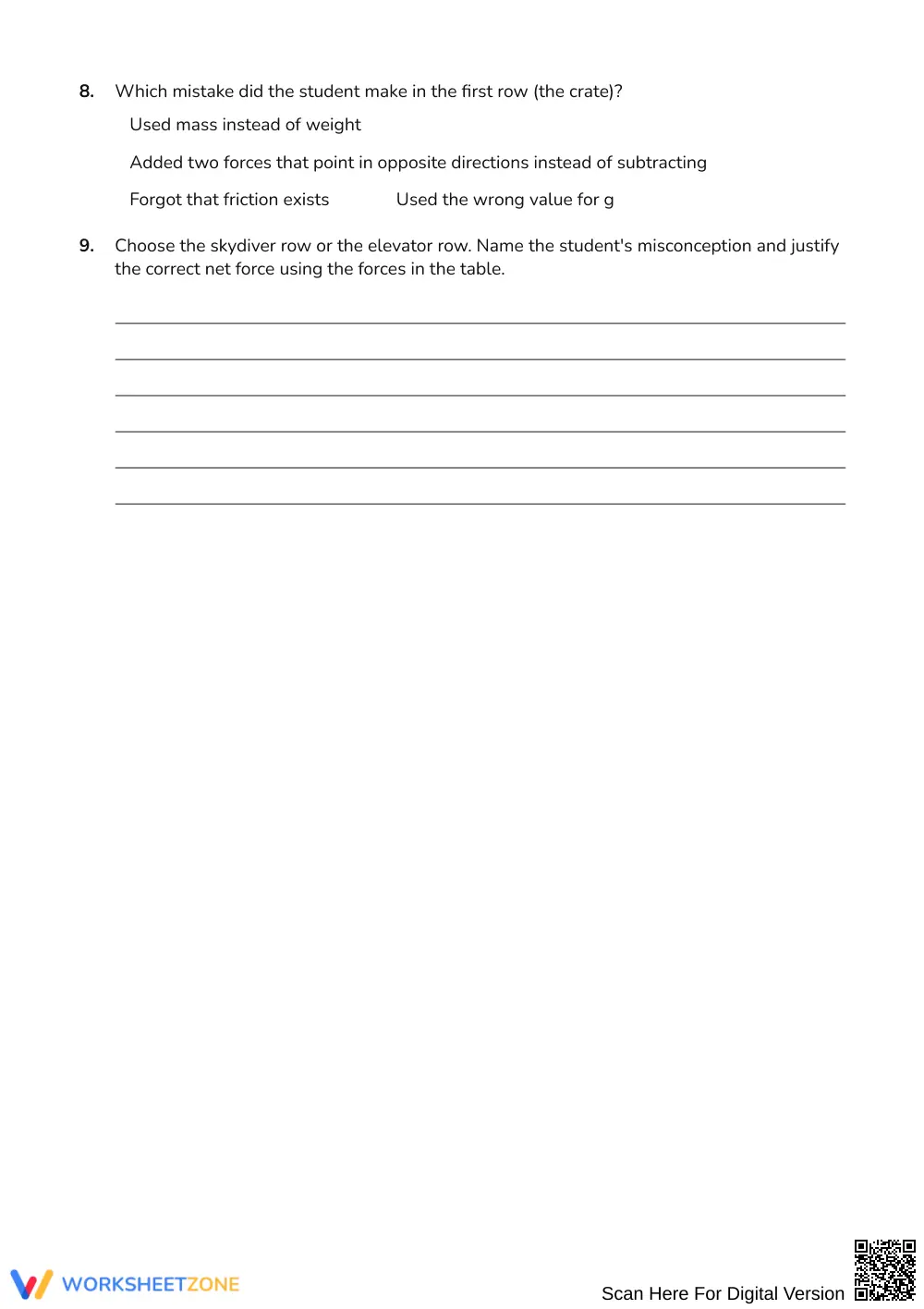
- Independent Practice (Part C): Working through multi-column calculation tables, students audit flawed peer solutions for crates, skydivers, and accelerating elevators before providing independent written justifications (tasks 7–15).
This structured sequence follows the gradual release of responsibility framework (Fisher & Frey, 2014), moving students from assisted conceptual critique to self-directed mathematical and theoretical justification.
Standards Alignment
This worksheet directly aligns with physical science standards governing forces and interactions. Students analyze scenarios where balanced forces yield zero acceleration and unbalanced forces cause directional acceleration according to F = ma. Both standard benchmarks and conceptual learning goals can be copied directly into lesson plans, IEP goals, or district curriculum mapping tools.
How to Use It
Administer this worksheet after direct instruction on Newton's laws or following an introductory laboratory on friction and ramps. During class, monitor how students approach Part C; students who mistakenly add opposing vectors in the crate scenario reveal a gap in directional sign convention that warrants immediate whiteboard intervention. Expect completion to take between 40 and 55 minutes in a standard class period.
Who It's For
Designed for physical science and high school physics students, this activity supports learners transitioning from basic vector drawing to formal force analysis. Scaffolded component breakdowns assist developing learners, while open-ended written explanations challenge advanced students. Pair this activity directly with a hands-on spring scale lab or inclined plane demonstration.
Educational research from Fisher & Frey (2014) demonstrates that structured error analysis accelerates conceptual acquisition by prompting metacognitive evaluation of common intuitive misconceptions. When high school physics students examine non-examples—such as the persistent belief that constant velocity requires a continuous forward net force—they reconcile intuitive fallacies with empirical physical principles. By working through 15 focused tasks across 4 pages, learners systematically deconstruct faulty peer assertions and justify correct vector dynamics using formal scientific language. This approach shifts classroom instruction from rote algebraic computation to robust reasoning, ensuring students not only calculate net force accurately but also comprehend the mechanical relationships governing objects in equilibrium and directional acceleration.


