


























Views
Downloads


Proven Force-Acceleration Data Worksheet | Grade 12 Physics
Paste this activity's link or code into your existing LMS (Google Classroom, Canvas, Teams, Schoology, Moodle, etc.).
Students can open and work on the activity right away, with no student login required.
You'll still be able to track student progress and results from your teacher account.
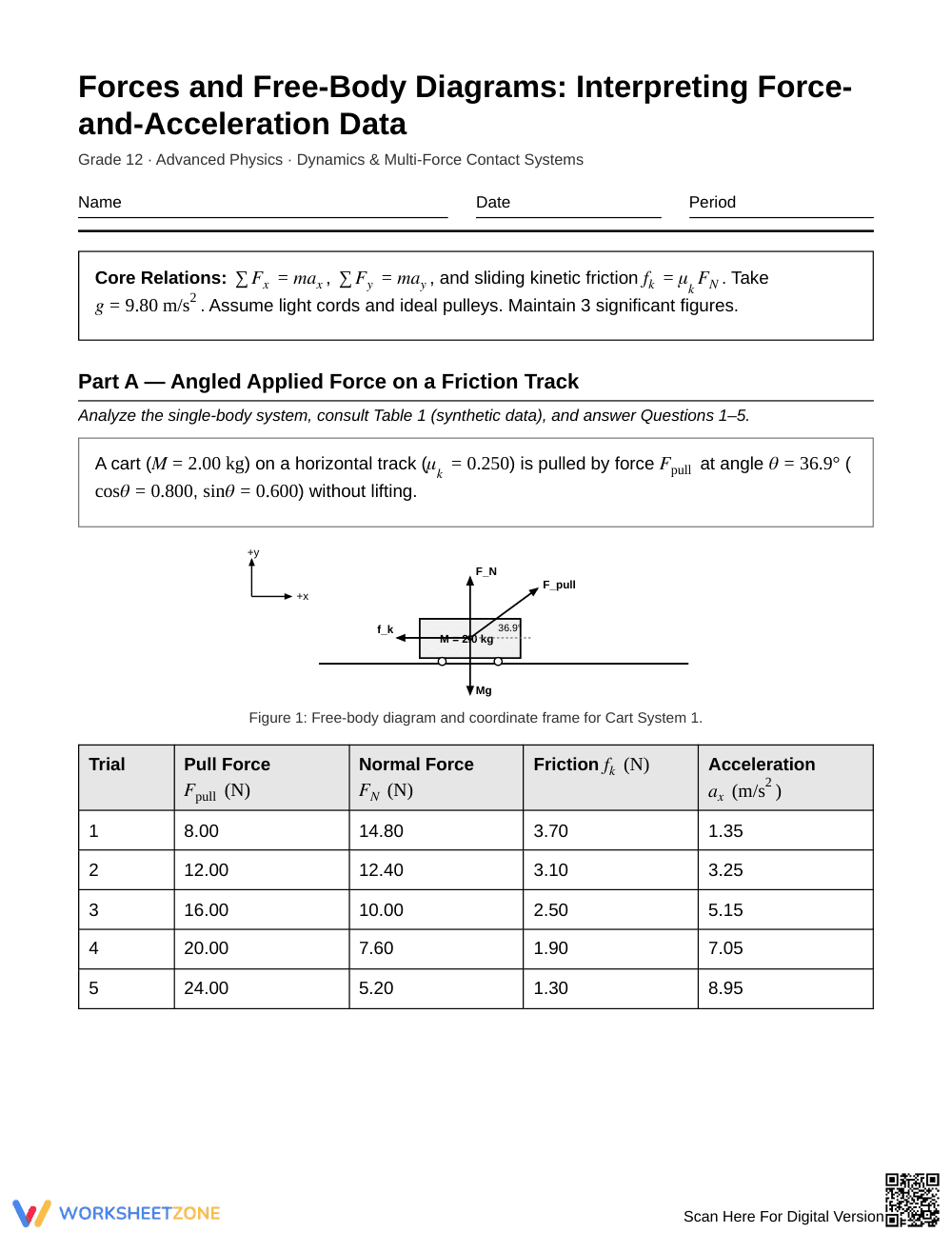
This Grade 12 physics worksheet equips students to quantitatively analyze multi-force contact systems using empirical acceleration tables and free-body diagrams. Learners verify coefficient of friction values, derive theoretical equations of motion, calculate critical lift-off thresholds, and investigate acceleration limits in coupled systems, developing the rigorous data literacy required for advanced mechanics.
At a Glance
- Grade: 12 · Subject: Physics
- Standard: Advanced Physics Mechanics — Analyze multi-force contact dynamics and evaluate experimental acceleration datasets
- Skill Focus: Interpret Force-and-Acceleration Data
- Format: 4 pages · 10 problems · Answer key included · PDF
- Best For: Advanced mechanics lab data analysis practice
- Time: 45–60 minutes
What's Inside
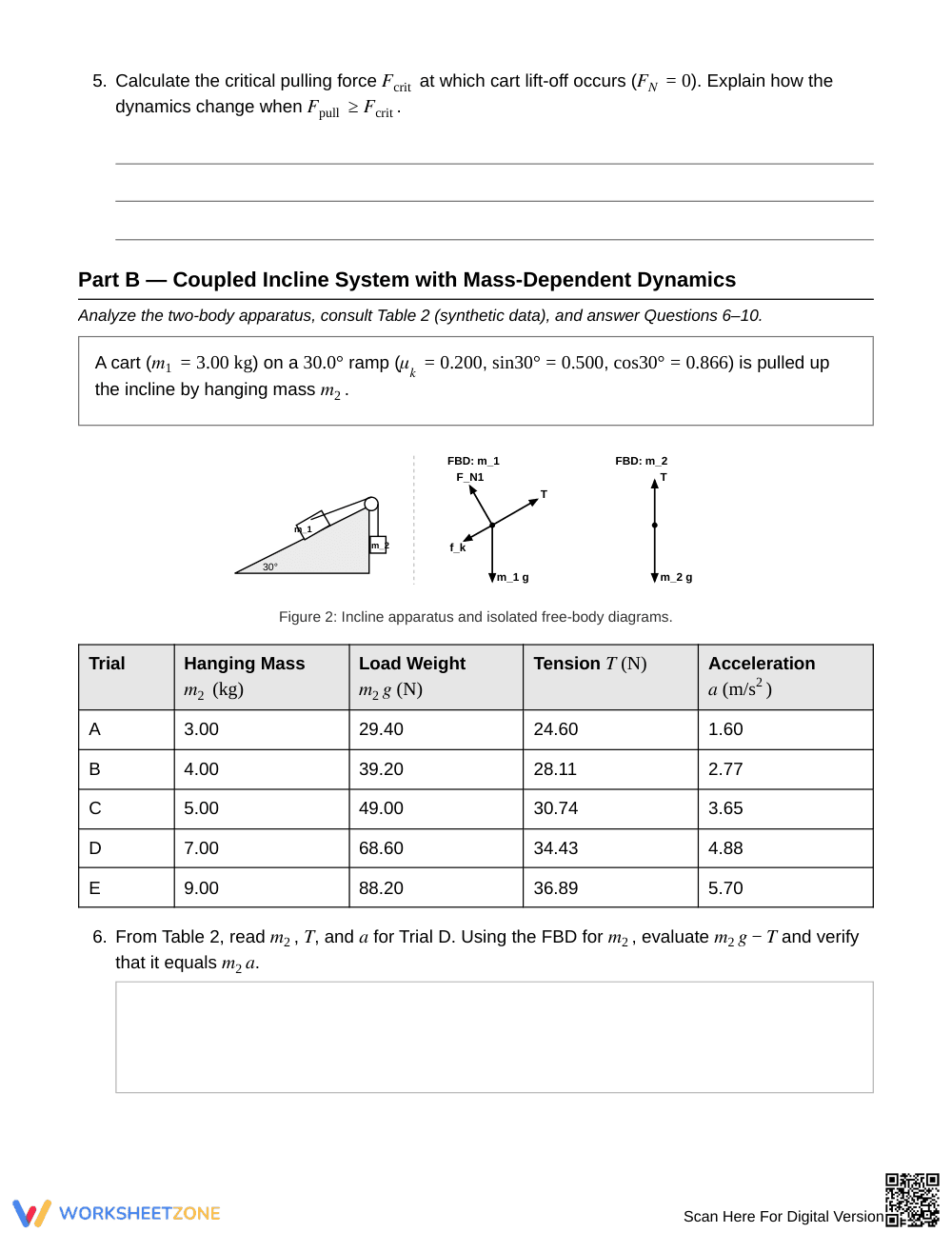
This 4-page student activity contains 10 rigorous, multi-step analytical problems divided across two authentic experimental setups: an angled pulling force on a horizontal friction track and a coupled incline apparatus. The resource provides complete data tables, coordinate frames, and isolated free-body diagrams, supported by a 3-page step-by-step answer key displaying algebraic derivations and unit evaluations.
Skill Progression
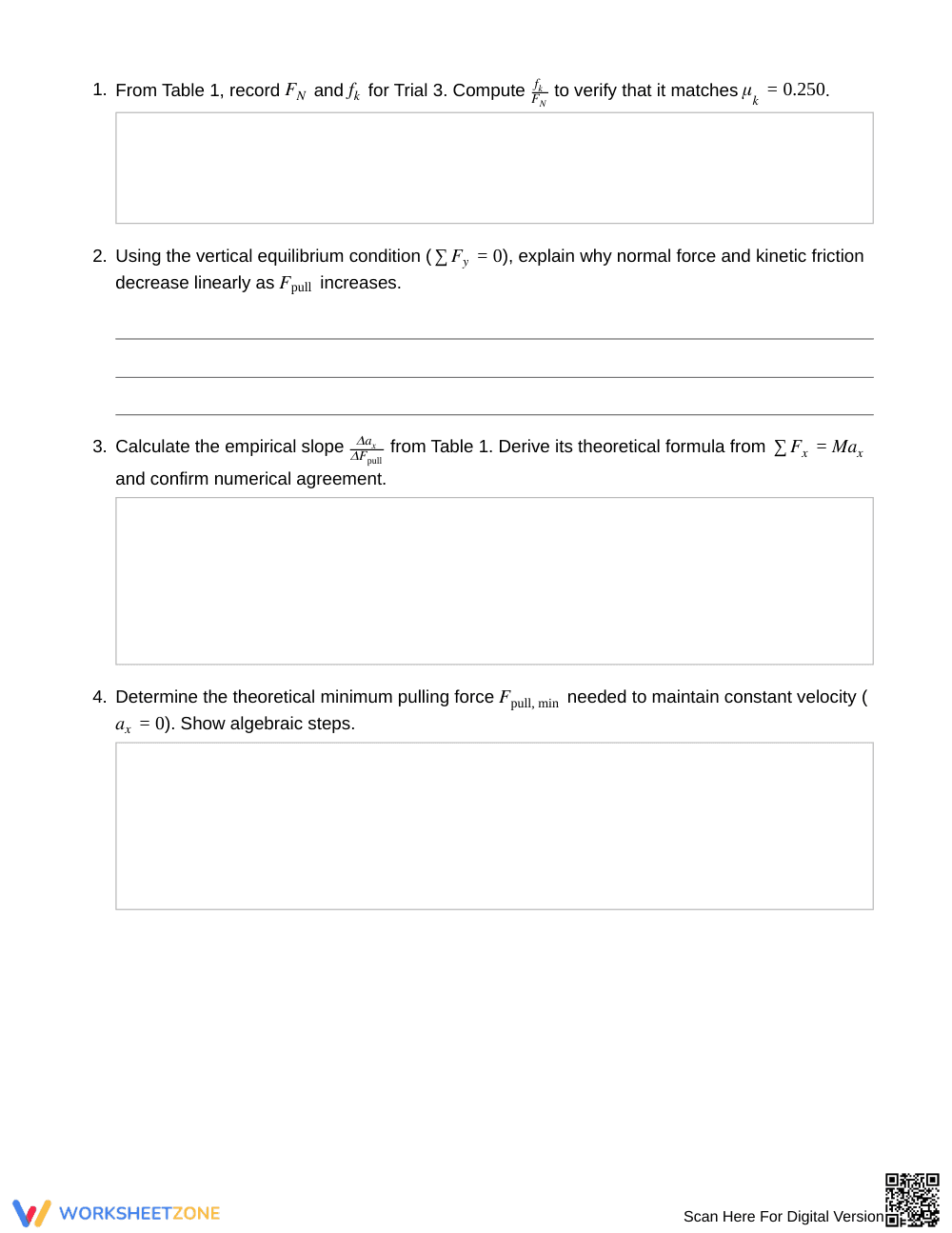
- Guided Practice (Questions 1–3 & 6): Students extract empirical data pairs from synthetic lab tables, verify kinetic friction ratios, and confirm Newton's Second Law expressions for individual trials.
- Supported Practice (Questions 4, 7, & 9): Learners calculate minimum applied forces for dynamic equilibrium, contrast constant versus variable normal forces, and derive system acceleration equations.
- Independent Practice (Questions 5, 8, & 10): Students evaluate asymptotic acceleration limits as hanging mass approaches infinity, determine critical cart lift-off boundaries, and diagnose systematic error sources in physical pulley systems.
This sequence establishes a gradual release of responsibility, guiding students from tabular verification to independent algebraic modeling.
Standards Alignment
This resource aligns with advanced physics standards for dynamics and Newton's Second Law: students analyze planar motion, resolve contact forces into orthogonal vector components, and interpret relationships among net force, mass, and acceleration across coupled systems. These standard descriptions can be copied directly into lesson plans, IEP goals, or district curriculum mapping tools.
How to Use It
Assign this worksheet immediately following direct instruction on multi-body dynamics or as a post-lab theoretical verification activity. During seatwork, circulate to check Question 3 to verify whether students recognize that the slope represents the inverse effective mass scaled by geometric factors. Most Grade 12 physics students complete all 10 problems in 45 to 60 minutes.
Who It's For
This material is designed for Grade 12 AP Physics, IB Physics, or advanced honors physics students mastering vector dynamics and experimental error analysis. Pair this practice with an inclined plane lab or an interactive Atwood machine simulation to bridge theoretical mechanics and physical measurement.
Empirical data analysis in advanced physics builds conceptual mastery by anchoring abstract equations of motion in concrete observations. According to Fisher & Frey (2014), structured problem sets that progress from targeted data verification to independent algebraic derivations significantly improve student autonomy in complex STEM domains. This worksheet provides 10 scaffolded tasks targeting force-and-acceleration data interpretation across horizontal tracks and inclined planes. By calculating critical thresholds, evaluating asymptotic mass limits, and troubleshooting real-world apparatus discrepancies, students bridge mathematical vector modeling and physical lab phenomena. The comprehensive 3-page solution guide supports efficient grading and targeted intervention, making this resource an effective tool for high school mechanics mastery.


