


























Views
Downloads



Proven Domain Restrictions Worksheet | Grade 11 Algebra II
Paste this activity's link or code into your existing LMS (Google Classroom, Canvas, Teams, Schoology, Moodle, etc.).
Students can open and work on the activity right away, with no student login required.
You'll still be able to track student progress and results from your teacher account.
This Grade 11 Algebra II worksheet equips students to analytically justify domain restrictions, distinguish algebraic bounds from contextual physical limits, and classify discontinuities. Through 8 proof-oriented tasks, learners build conceptual mastery by evaluating mathematical claims, analyzing complex expressions, and formulating counterexamples using rigorous interval notation.
At a Glance
- Grade: 11 · Subject: Algebra II
- Standard:
HSF-IF.B.5— Relate the algebraic domain of a function to quantitative relationships and physical contexts- Skill Focus: Justify a Domain Restriction
- Format: 5 printable student pages · 8 rigorous problems · 4-page step-by-step answer key included · PDF
- Best For: In-depth rational function conceptual mastery practice
- Time: 45–60 instructional minutes
What's Inside
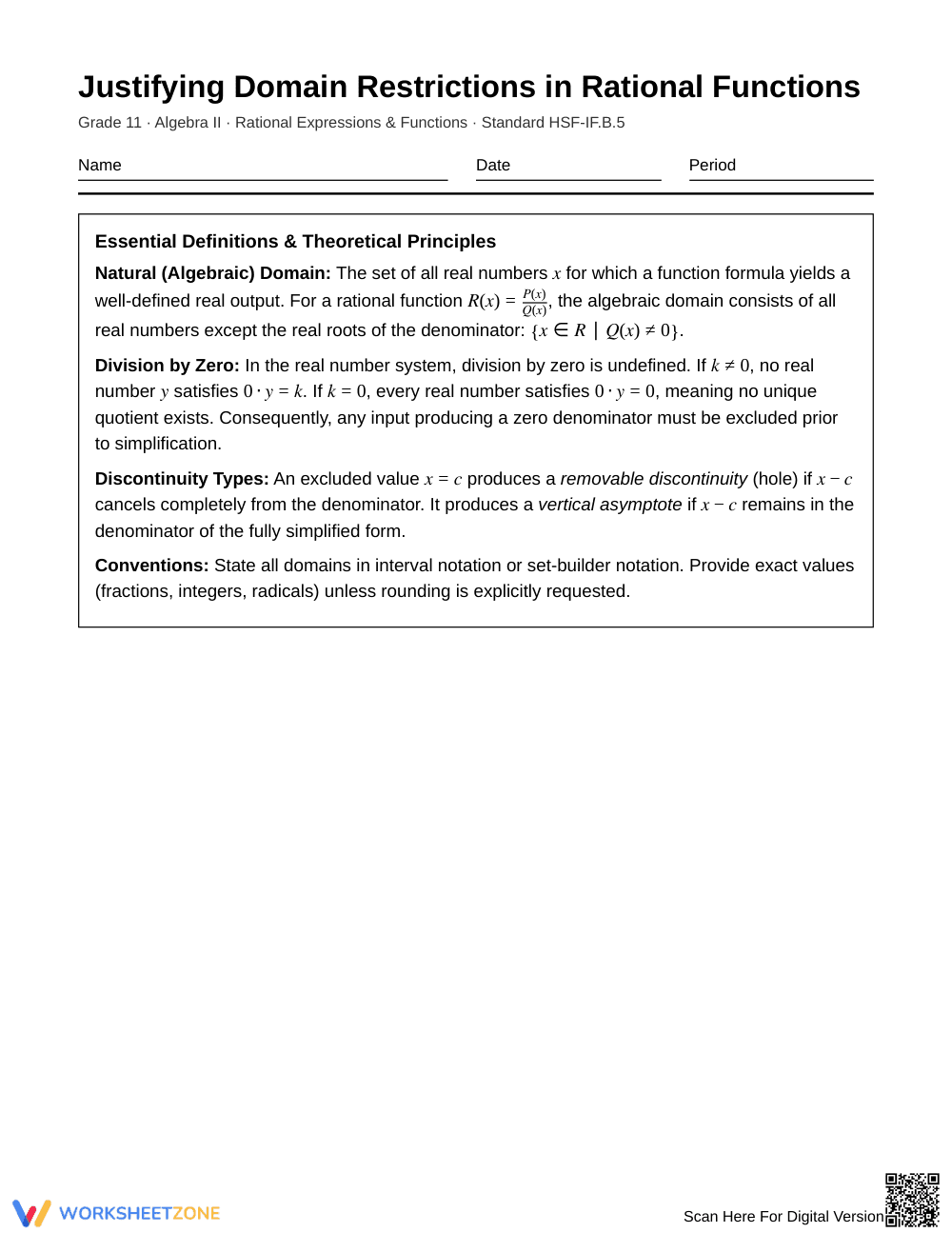
This 5-page worksheet opens with a theoretical reference frame defining algebraic domains, undefined division, and discontinuity types before presenting 8 analytical exercises. Across three parts, students evaluate mathematical claims on simplified functions and biomedical models, justify analytical procedures for complex fractions, and construct counterexamples against false generalizations. An exhaustive 4-page answer key provides complete proofs, interval notation, and graphical classifications.
Skill Progression
- Guided Practice (Part A, 2 tasks): Students critique mathematical assertions, using reference definitions to evaluate domain preservation during rational cancellation and contrast algebraic formulas with physical boundaries.
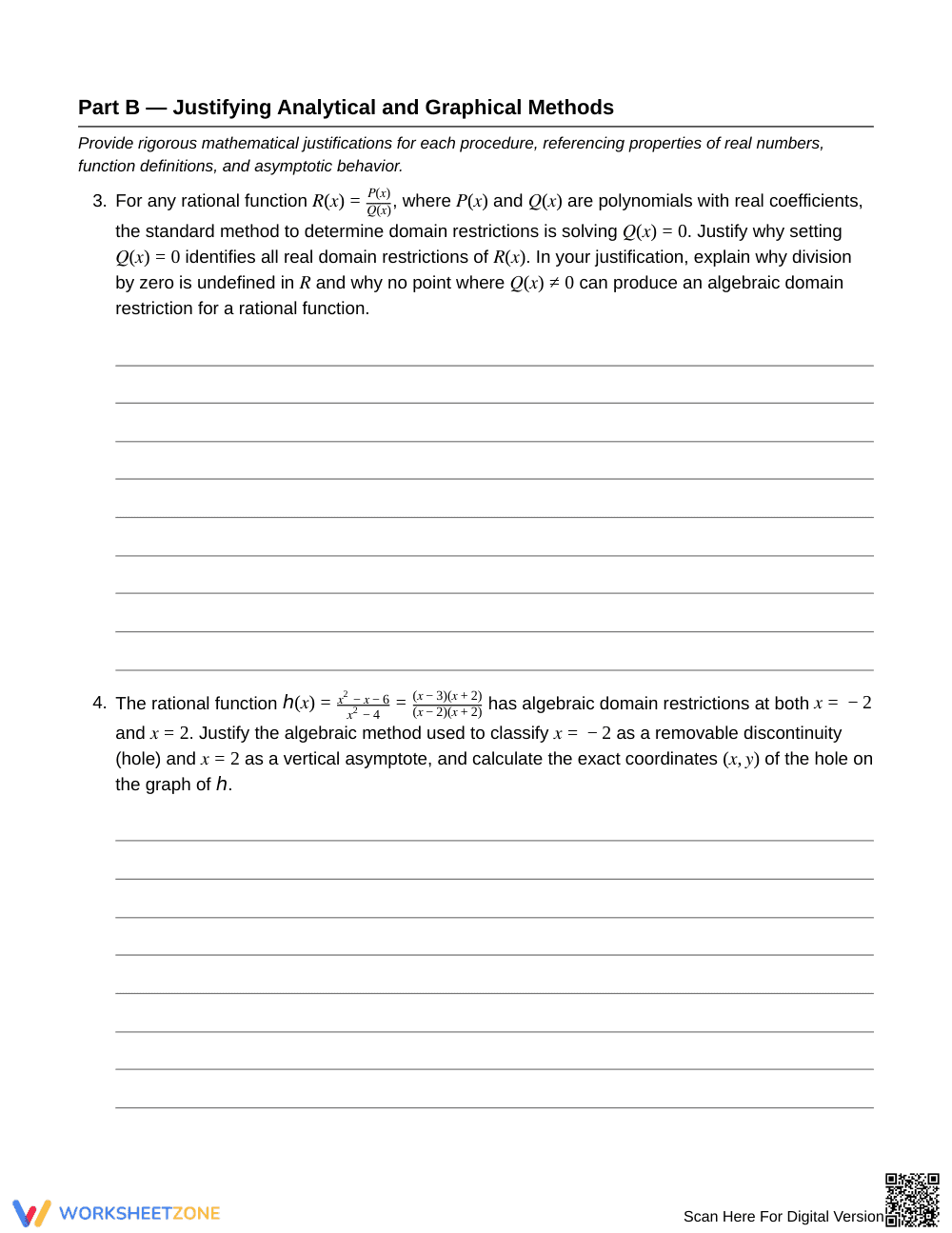
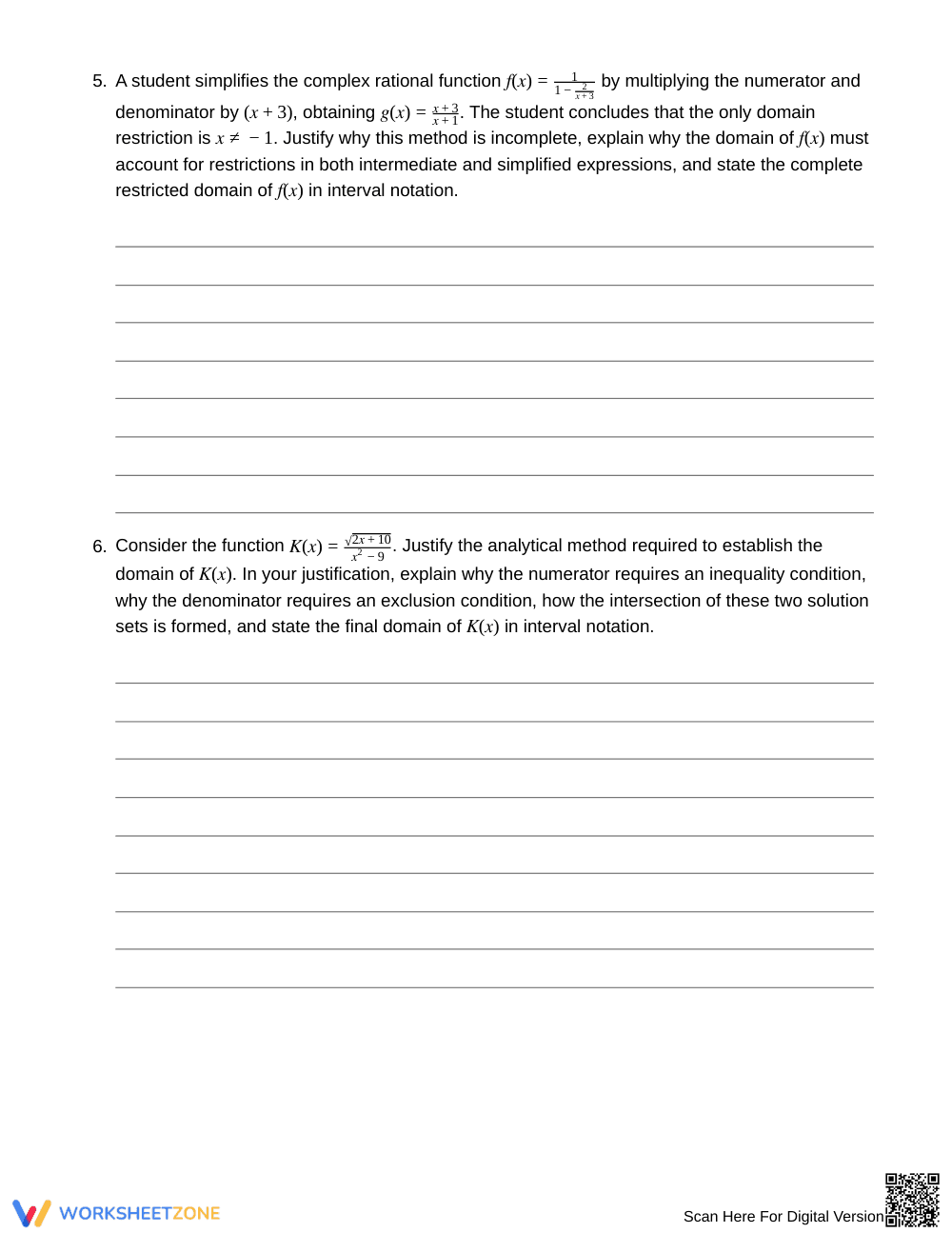
- Supported Practice (Part B, 4 tasks): Students justify analytical methods across complex structures, calculating hole coordinates, isolating intermediate restrictions in compound fractions, and intersecting radical conditions with polynomial zeros.
- Independent Practice (Part C, 2 tasks): Students operate without scaffolds to disprove quadratic denominator claims via counterexamples and formulate algebraic conditions for domain equivalence.
This sequence embodies the gradual-release framework, moving learners from guided critique to independent mathematical justification.
Standards Alignment
This worksheet aligns directly to HSF-IF.B.5: Relate the domain of a function to its graph and, where applicable, to the quantitative relationship it describes. It also supports HSA-APR.D.6 as students rewrite rational expressions while tracking domain restrictions. Both standard codes can be copied directly into lesson plans, IEP goals, or district curriculum mapping tools.
How to Use It
Deploy this worksheet after direct instruction on rational graphs. Use Part A as a collaborative check for understanding immediately following your lecture on discontinuities; listen for students who assume algebraic simplification removes an excluded value. Next, assign Parts B and C as an intensive 45–60 minute synthesis session where pairs analyze compound fractions and construct counterexamples before unit exams.
Who It's For
This resource is designed for Grade 11 Algebra II, Pre-Calculus, and advanced mathematics students preparing for higher-level calculus concepts. For emerging learners, pair this worksheet with a visual anchor chart illustrating vertical asymptotes versus holes; for advanced students, use Part C as a bridge to formal limit proofs.
Aligned with standard HSF-IF.B.5, this Grade 11 mathematics resource emphasizes justifying domain restrictions in rational functions through rigorous algebraic proof, contextual modeling, and counterexample construction. According to research on structured disciplinary literacy and mathematical discourse by Fisher & Frey (2014), providing learners with structured opportunities to evaluate analytical claims and justify non-executable operations substantially deepens conceptual retention over repetitive procedural calculation. Students examine unsimplified rational expressions, evaluate medical dosage formulas against real-world domain limitations, determine removable versus essential discontinuities, and resolve compound fraction restrictions. By requiring exact set-builder and interval notation alongside formal written justifications, the 8 tasks cultivate analytical precision and diagnostic reasoning necessary for collegiate calculus coursework. Teachers receive a comprehensive 4-page reference answer key detailing theoretical principles, full algebraic steps, and coordinate classifications, establishing an evidence-based instructional foundation for secondary STEM mathematics pathways.


