




























Proven Dilation Similarity Worksheet | Grade 10 Geometry
Paste this activity's link or code into your existing LMS (Google Classroom, Canvas, Teams, Schoology, Moodle, etc.).
Students can open and work on the activity right away, with no student login required.
You'll still be able to track student progress and results from your teacher account.
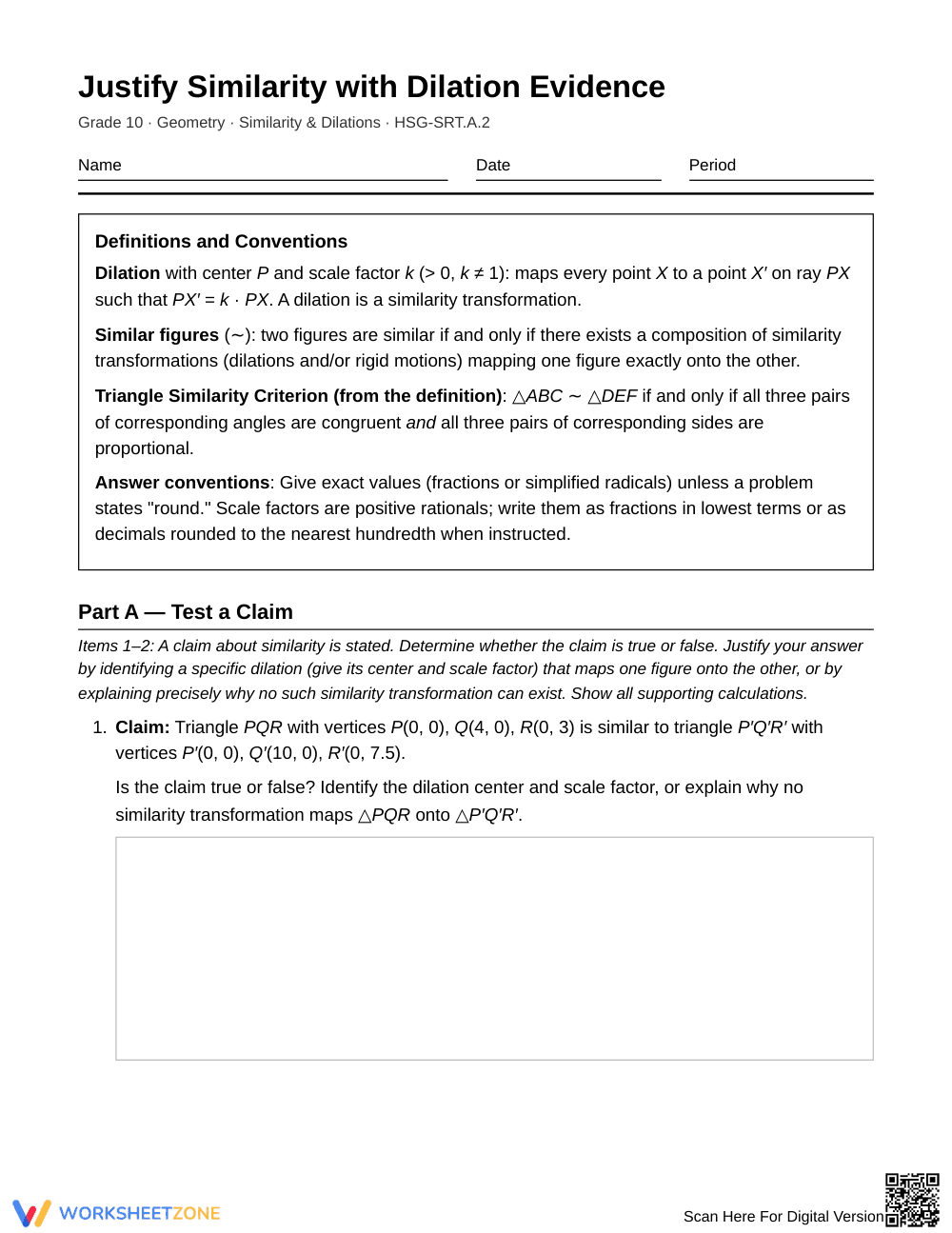
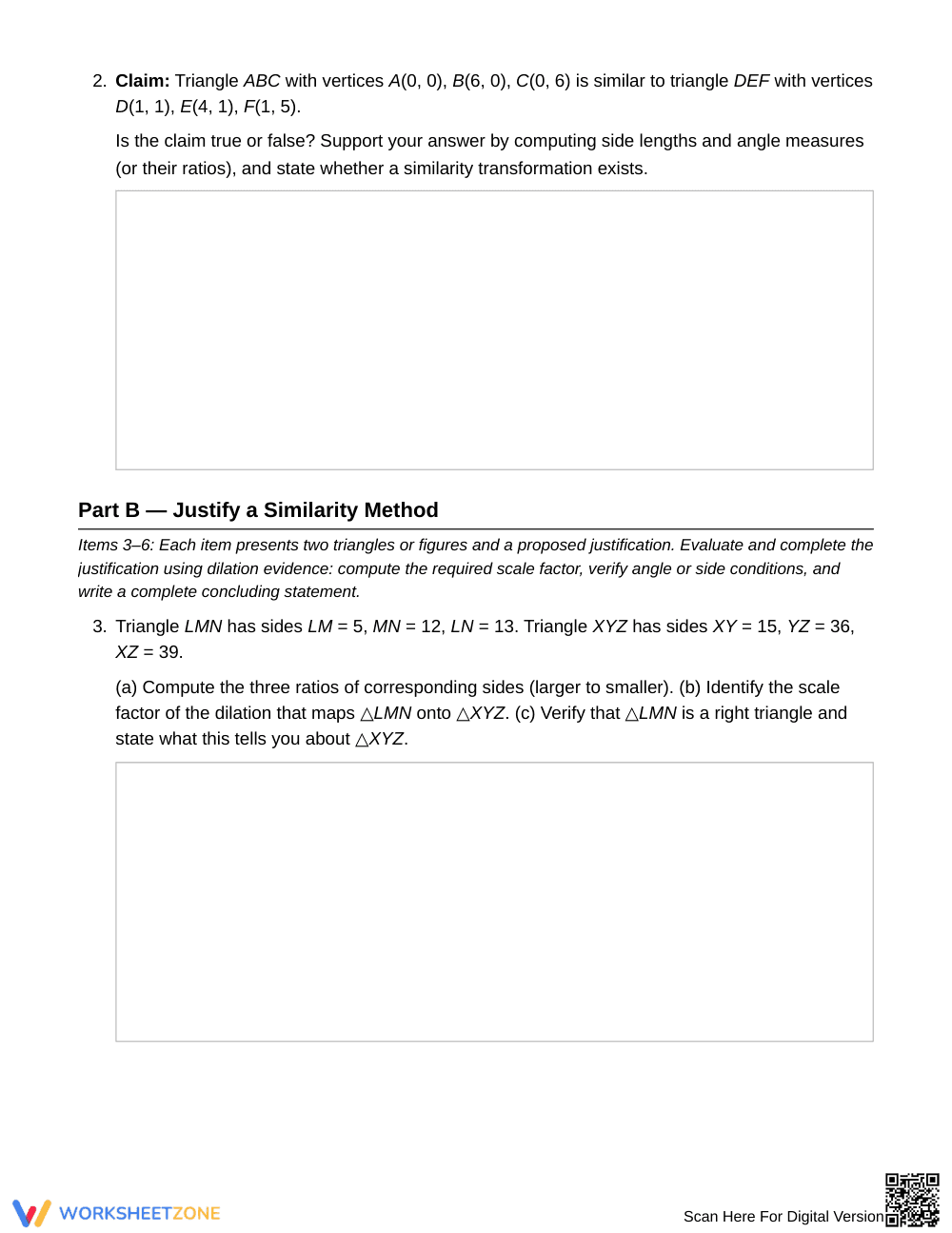
This high school geometry worksheet equips students to justify geometric similarity using precise dilation evidence and transformation sequences. Learners evaluate similarity claims, calculate scale factors from coordinates and parallel segments, and formulate geometric counterexamples to master similarity criteria beyond basic angle-angle shortcuts.
At a Glance
- Grade: 10 · Subject: Geometry
- Standard:
HSG-SRT.A.2— Decide whether two figures are similar by verifying dilation scale factors and angle congruence- Skill Focus: Justify Similarity with Dilation Evidence
- Format: 5 student pages · 8 multi-part problems · Complete answer key included · Printable PDF
- Best For: Secondary geometry similarity proof and reasoning practice
- Time: 45–60 minutes
What's Inside
This 5-page PDF contains 8 multi-part problems across three structured parts. A reference box defines dilations and similarity criteria at the top of page one. Students test claims on coordinate planes, justify similarity in split triangles and rectangles, and build counterexamples. A 5-page answer key provides step-by-step solutions.
Skill Progression
- Guided practice (Items 1–2): High scaffolds; students use the reference box to verify coordinate similarity claims and find dilation centers.
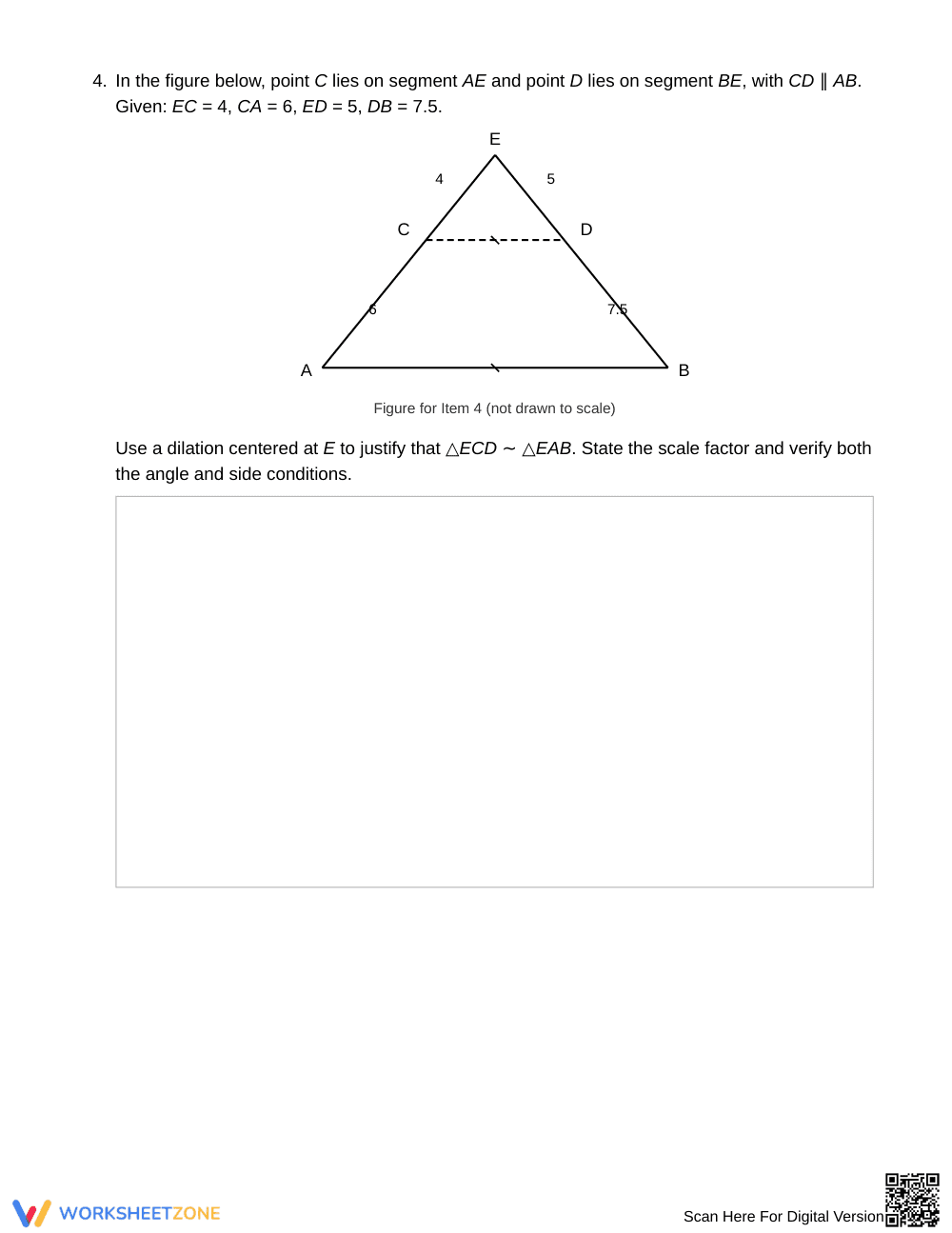
- Supported practice (Items 3–6): Medium scaffolds; learners evaluate side proportionality and angle conditions across parallel segments and rectangles.
- Independent practice (Items 7–8): Low scaffolds; students formulate deductive proofs and construct numerical counterexamples.
This structure follows the gradual-release model to advance learners from guided claim-testing to independent proof construction.
Standards Alignment
This worksheet directly targets `HSG-SRT.A.2` by requiring students to use definitions of similarity transformations to decide if figures are similar and establish proportional side relationships. It also supports `HSG-SRT.A.1` through explicit dilation scale factor and center verification. Both standard codes can be copied directly into lesson plans, IEP goals, or district curriculum mapping tools.
How to Use It
Use this worksheet after direct instruction on similarity transformations. Have student pairs complete Parts A and B during a 45- to 60-minute collaborative practice block, then assign Part C as an individual formative exit ticket. As an observation tip, check whether students verify both side proportionality and angle congruence on Item 5, rather than assuming equal angles ensure similarity.
Who It's For
This resource serves Grade 10 Geometry students learning transformation-based similarity. The reference box aids developing learners, while counterexample prompts challenge advanced thinkers. Pair this worksheet with an anchor chart detailing coordinate dilation rules.
According to Fisher & Frey (2014), structured cognitive apprenticeship models that transition learners from explicit definitions to evaluative justification significantly improve high school students' retention of complex geometric concepts. This 5-page Grade 10 geometry resource operationalizes that research by targeting standard HSG-SRT.A.2, requiring students to justify geometric similarity through dilation evidence rather than relying solely on procedural shortcuts. Across 8 rigorous tasks, students establish dilation centers, calculate scale factors, and test conditions of angle congruence and side proportionality. Furthermore, by prompting learners to formulate explicit counterexamples in disproving invalid geometric assertions, the worksheet fosters higher-order analytical critique. The complete answer key and scaffolded progression ensure educators can readily diagnose misconception patterns in coordinate transformations and proportional reasoning, providing an empirically grounded instrument that bridges foundational definitions with formal geometric proof and rigorous mathematical argumentation.


