































Proven Coordinate Congruence Worksheet | Grade 10 Geometry

Paste this activity's link or code into your existing LMS (Google Classroom, Canvas, Teams, Schoology, Moodle, etc.).
Students can open and work on the activity right away, with no student login required.
You'll still be able to track student progress and results from your teacher account.
This high school geometry worksheet equips students to verify geometric congruence across coordinate planes using transformations and metric formulas. Learners calculate transformed coordinates, evaluate composite isometric motions, and justify distance preservation across real-world coordinate design scenarios ranging from CNC milling to robotic placement.
At a Glance
- Grade: 10 · Subject: Geometry
- Standard:
HSG-CO.B.6— Use rigid motions to decide if two figures are congruent- Skill Focus: Verify Congruence in a Coordinate Design
- Format: 5 pages · 10 problems · Answer key included · PDF
- Best For: Geometry skill practice and coordinate verification
- Time: 45–60 minutes
What's Inside
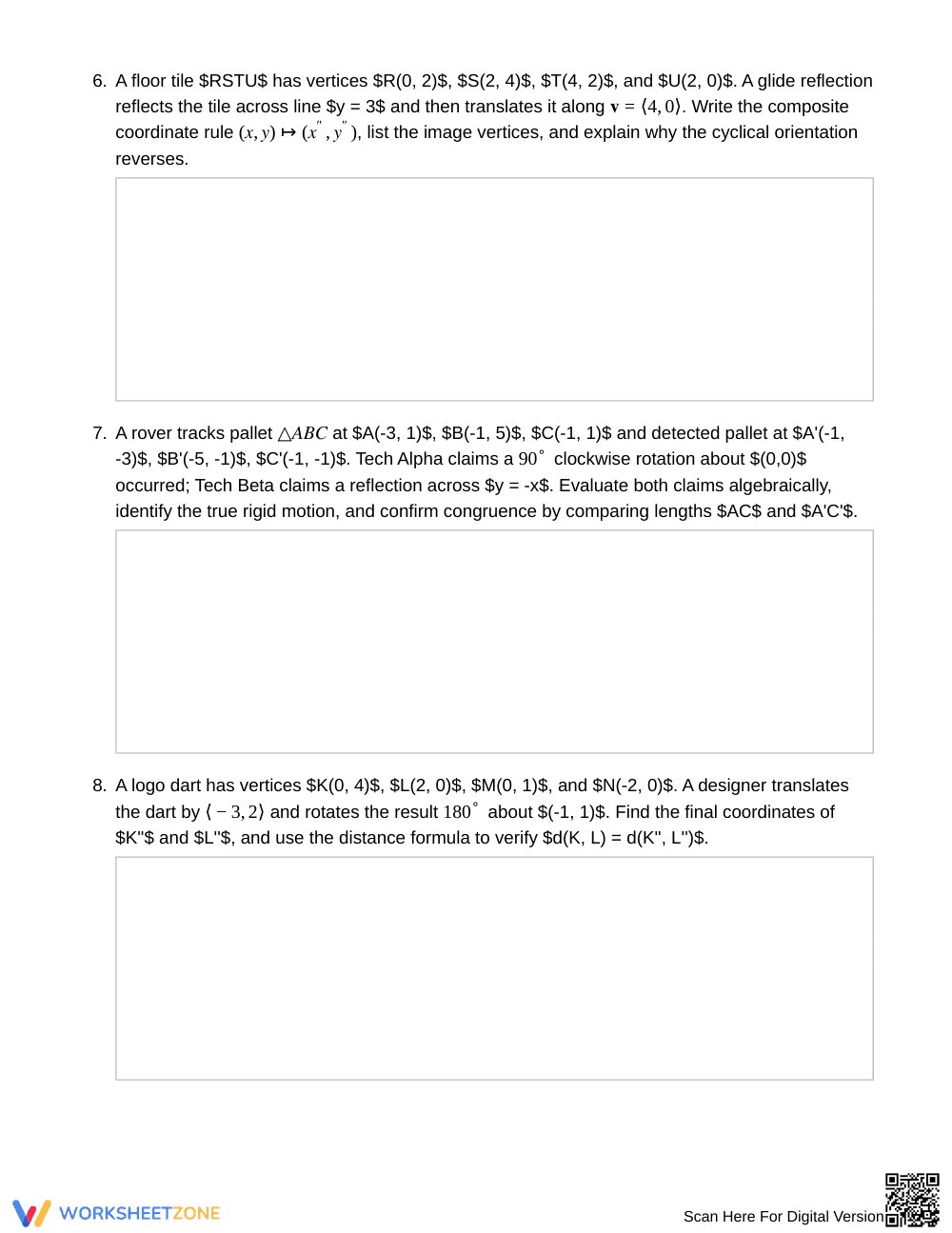
This 5-page instructional resource contains 10 rigorous geometry problems structured across three progressive sections. Students interact with a modeled example of direct isometry, followed by multi-step coordinate challenges involving rotations, reflections, translations, glide reflections, and vector operations. A complete 3-page answer key provides step-by-step coordinate derivations, algebraic proofs, and distance calculations for immediate feedback.
Skill Progression
- Guided practice (Part A — 2 problems): Direct modeling tasks where students establish composite transformation rules, calculate mapped vertices, and apply the distance formula to confirm segment congruence with visual diagram support.
- Supported practice (Part B — 6 problems): Multi-step coordinate applications requiring students to identify unknown rigid motions, compute perpendicular bisectors to find centers of rotation, calculate perimeter and area invariance, and resolve conflicting algebraic claims.
- Independent practice (Part C — 2 problems): Advanced design decisions under physical constraints, requiring students to evaluate candidate footprints for robotic placement and verify valid isometric transformations.
This structured progression follows a gradual-release instructional model, advancing students from foundational coordinate proofs to complex spatial problem-solving.
Standards Alignment
This resource aligns directly to `HSG-CO.B.6`: Use geometric descriptions of rigid motions to transform figures and to predict the effect of a given rigid motion on a given figure; given two figures, use the definition of congruence in terms of rigid motions to decide if they are congruent. It also supports `HSG-CO.A.5` by requiring students to specify sequences of transformations that carry a figure onto another. Both standard codes can be copied directly into lesson plans, IEP goals, or district curriculum mapping tools.
How to Use It
Deploy this worksheet after direct instruction on rigid transformations and coordinate rules. In a whole-class setting, walk through the modeled case before assigning Part A in pairs and Parts B and C independently. During practice, check whether students correctly distinguish reflections from rotations by inspecting orientation preservation. Plan for 45 to 60 minutes of active student work.
Who It's For
This worksheet is tailored for Grade 10 Geometry students mastering coordinate geometry and transformational proof. It serves general education classes, honors geometry enrichment, and targeted intervention for high schoolers needing structured practice with composite mappings. Pair this resource with coordinate grid whiteboards or an interactive transformation demonstration lesson.
According to Fisher & Frey (2014), purposeful gradual-release frameworks significantly enhance high school students' ability to transfer abstract mathematical concepts into applied problem-solving contexts. Under standard HSG-CO.B.6, tenth-grade learners must move beyond visual intuition to prove figure congruence using rigid motions, coordinate algebra, and distance preservation. This worksheet operationalizes those research-backed principles across 10 multi-step engineering and design problems. Students systematically establish composite mapping functions, calculate side lengths using the distance formula, determine lines of reflection and centers of rotation, and evaluate geometric constraints in applied coordinate systems. The integrated progression from modeled examples to constraint-based decision analysis ensures rigorous alignment to state standards while providing teachers with reliable formative assessment data.


