


























Views
Downloads




Proven Conic Classification Worksheet | Grade 11 Algebra II
Paste this activity's link or code into your existing LMS (Google Classroom, Canvas, Teams, Schoology, Moodle, etc.).
Students can open and work on the activity right away, with no student login required.
You'll still be able to track student progress and results from your teacher account.
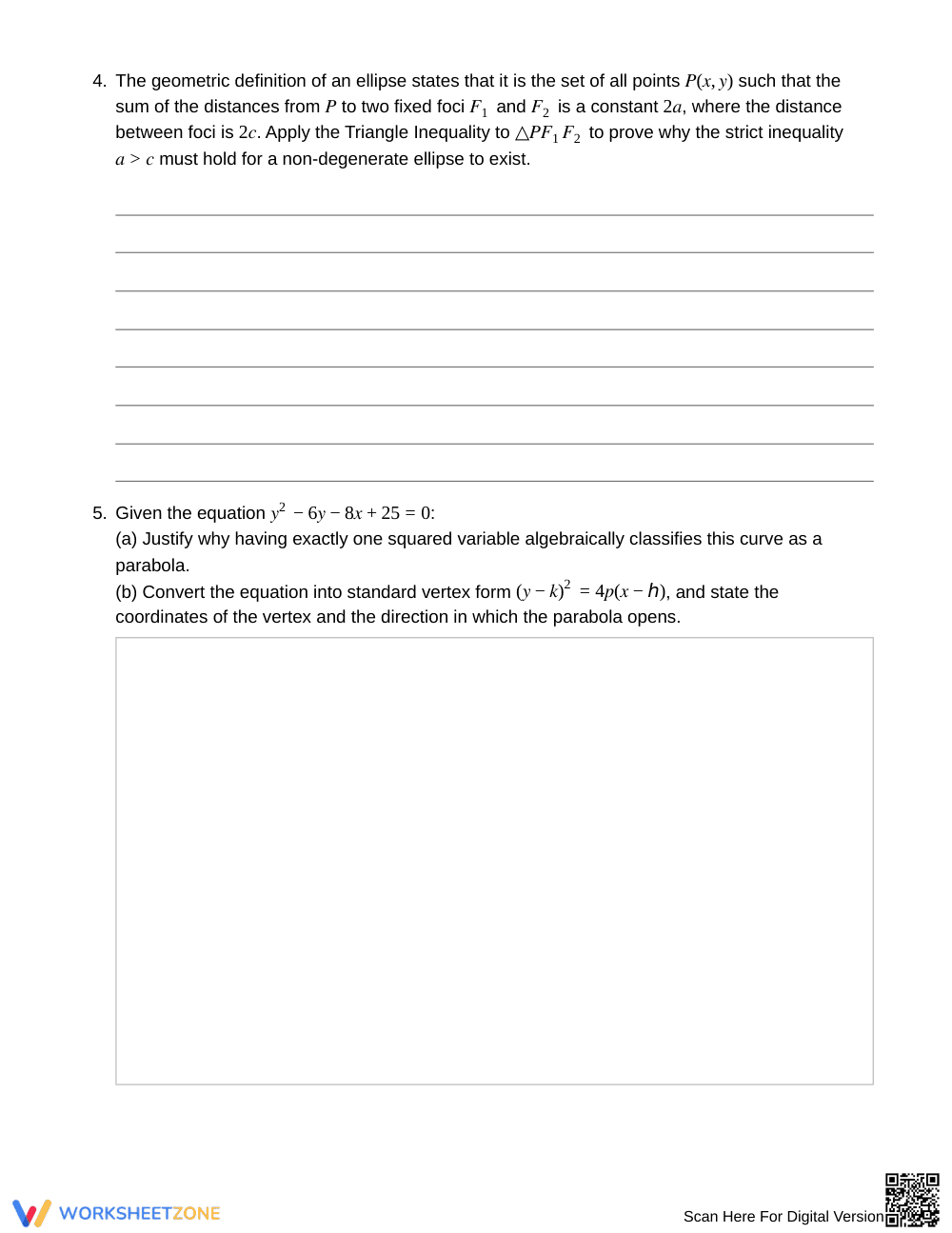
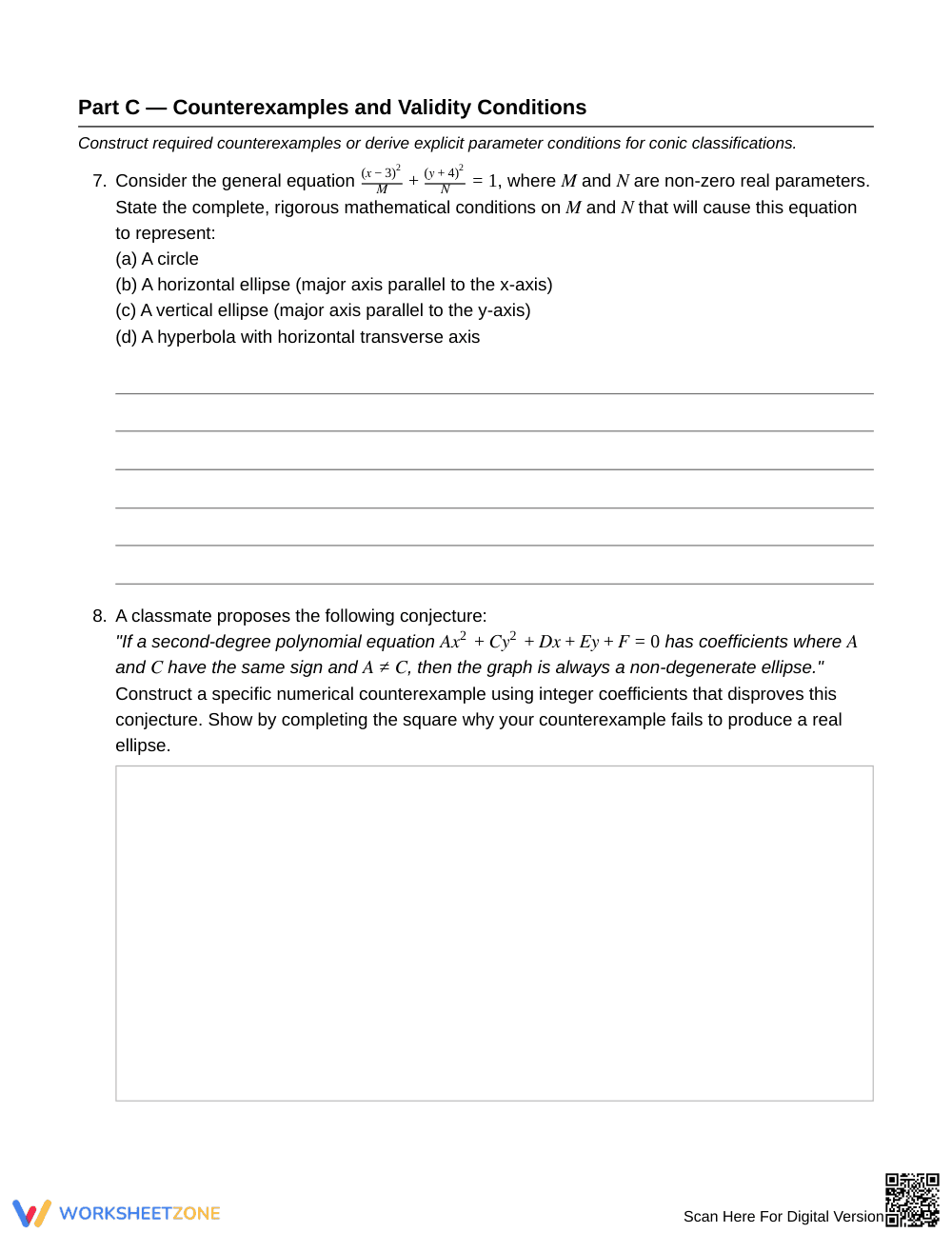
This advanced analytic geometry resource strengthens students' ability to classify second-degree polynomial equations and justify conic locus properties. Through completing the square and geometric proofs, learners analyze circles, ellipses, hyperbolas, and parabolas while constructing counterexamples and establishing parameter boundary conditions for degenerate and non-degenerate curves.
At a Glance
- Grade: 11 · Subject: Algebra II
- Standard: Conic Sections — Classify conic sections and justify geometric locus properties algebraically
- Skill Focus: Justify a Conic Classification
- Format: 5 pages · 8 problems · Answer key included · PDF
- Best For: Analytic geometry mastery practice
- Time: 45–60 minutes
The 5-page worksheet features 8 multi-part analytical problems and a reference header detailing standard forms and locus definitions. Students evaluate mathematical claims, complete the square to identify vertices and centers, apply the Triangle Inequality to focal distances, and derive parameter constraints. A 4-page answer key provides complete algebraic derivations and geometric proofs.
Skill Progression
- Guided practice (Part A — 2 tasks): Students evaluate claims about circle loci and hyperbola parameters, identifying whether statements are universally true, conditionally true, or false with algebraic justification.
- Supported practice (Part B — 4 tasks): Learners complete the square, justify vertex and focal orientations, and apply the Triangle Inequality to prove geometric existence conditions for ellipses and parabolas.
- Independent practice (Part C — 2 tasks): Students derive multi-case parameter conditions for general equations and construct numerical counterexamples disproving false geometric conjectures.
This sequence follows the I Do, We Do, You Do gradual-release model, advancing students from claim analysis to independent proof and counterexample construction.
Standards Alignment
This worksheet aligns with high school analytic geometry goals requiring students to derive conic equations, translate between geometric loci and algebraic equations, and complete the square to classify second-degree curves. Both standard codes can be copied directly into lesson plans, IEP goals, or district curriculum mapping tools.
How to Use It
Assign this worksheet after direct instruction on standard conic forms as a rigorous synthesis activity or collaborative group task. For formative assessment, examine whether students identify degenerate cases in Part A to gauge conceptual understanding of constant term thresholds. Expected completion time is 45 to 60 minutes.
Who It's For
This resource is built for Grade 11 Algebra II and Pre-Calculus students. Provide standard-form reference charts for students needing scaffolding, and challenge advanced learners to evaluate focal-directrix ratios. Pair this lesson with dynamic graphing tools or coordinate geometry demonstrations.
According to empirical educational research highlighted by Fisher & Frey (2014), engaging high school mathematics students in structured justification, error analysis, and mathematical claim evaluation significantly deepens conceptual understanding and long-term retention compared to rote algorithmic computation alone. This 5-page advanced worksheet directly targets high school conic classification skills by requiring learners to translate general second-degree equations into standard form, analyze geometric locus definitions, and construct rigorous counterexamples. When students actively justify why quadratic coefficients determine curve orientation and unbounded branches, they develop robust analytical reasoning that bridges coordinate algebra and synthetic Euclidean geometry. Incorporating multi-step analytical prompts ensures that learners move beyond procedural completing-the-square routines into authentic mathematical verification. By defending their algebraic conclusions through formal geometric proofs, Grade 11 students establish the rigorous analytical habits necessary for success in AP Pre-Calculus, calculus, and college STEM pathways.


