




























Proven Antibiotic Resistance Worksheet | Grade 8-12 Science
Paste this activity's link or code into your existing LMS (Google Classroom, Canvas, Teams, Schoology, Moodle, etc.).
Students can open and work on the activity right away, with no student login required.
You'll still be able to track student progress and results from your teacher account.
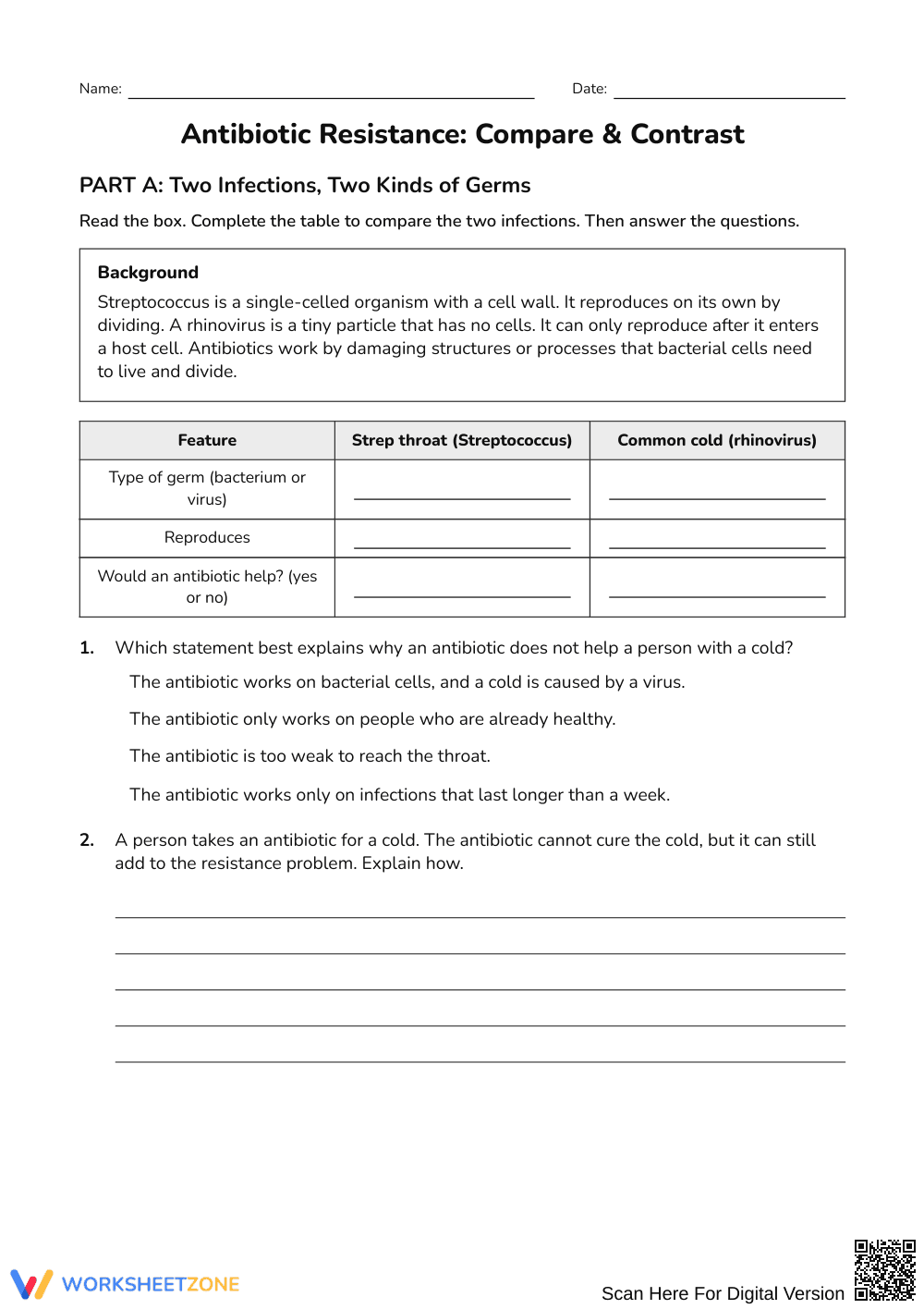
This Grade 8–12 science worksheet provides structured comparative analysis to help students understand the biological mechanisms behind antibiotic resistance. Learners examine cellular structures, evaluate quantitative patient data across a seven-day treatment timeline, and explain how natural selection drives bacterial population shifts, correcting common misconceptions about viral infections and deliberate bacterial mutations.
At a Glance
- Grade: Grades 8–12 · Subject: Science
- Standard: Natural Selection — Model how selective pressure drives population shifts toward resistance
- Skill Focus: Compare and contrast biological mechanisms
- Format: 4 pages · 27 problems · Answer key included · PDF
- Best For: High school biology and life science units
- Time: 40–50 minutes
What's Inside
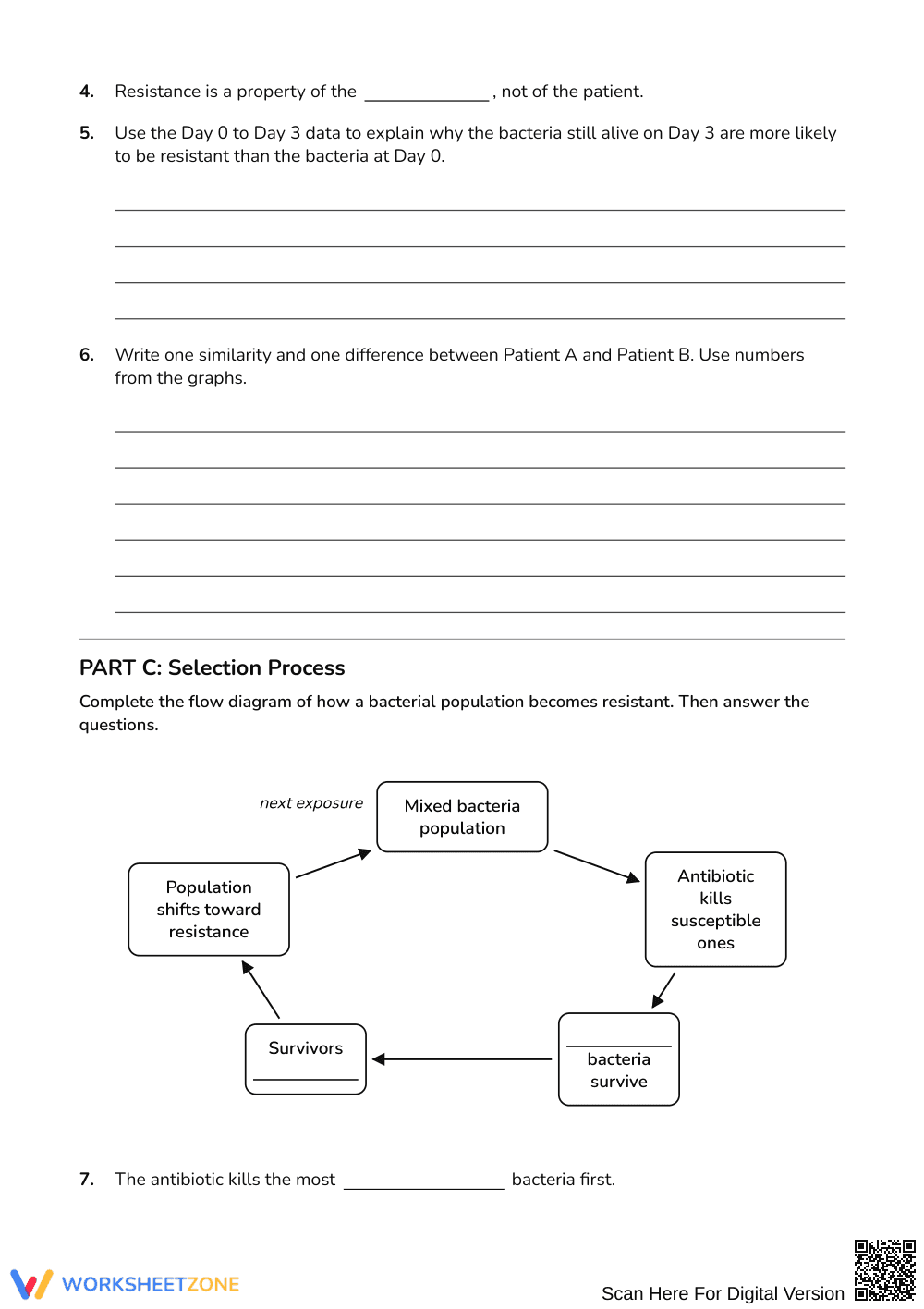
The 4-page worksheet contains 27 focused tasks organized across four clear sections. Students engage with structured comparison tables, a dual-patient line data set measuring bacterial load from Day 0 through Day 7, a multi-step natural selection flow diagram, and evidence-based synthesis questions. A complete 4-page teacher answer key provides full explanations and quantitative benchmarks for rapid scoring.
Skill Progression
- Guided practice (Part A): Students examine provided background text to complete a comparison table distinguishing Streptococcus from rhinovirus, followed by targeted check questions.
- Supported practice (Parts B & C): Learners interpret numerical data tracking bacterial counts across seven days, then complete a flowchart tracing how selection acts on pre-existing variation.
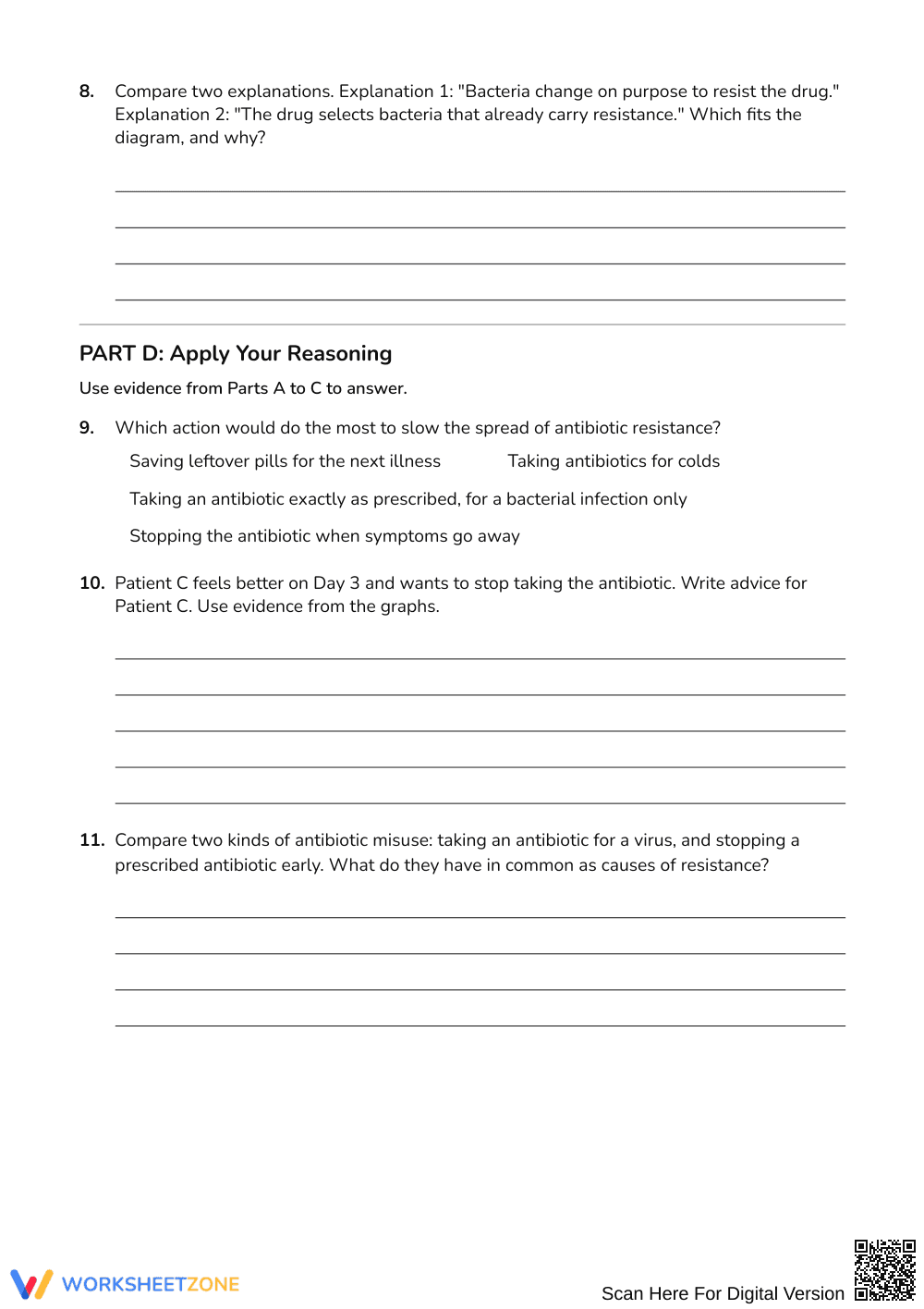
- Independent practice (Part D): Students independently synthesize data to evaluate medical advice scenarios and analyze parallel forms of antibiotic misuse.
This sequence follows a gradual-release model, moving from structured classification to independent biological reasoning.
Standards Alignment
This worksheet aligns directly to secondary life science standards focusing on natural selection, adaptation, and population dynamics under selective environmental pressures. Students analyze quantitative data to explain how genetic variation confers differential survival and shifts overall population genetics over successive generations. Educators can reference these core concepts when drafting lesson plans, IEP goals, and curriculum pacing guides.
How to Use It
Implement this worksheet during mid-unit instruction on natural selection or infectious disease. For paired practice, have students complete Parts A and B together before analyzing Patient B's data as a whole group. During circulation, check whether students recognize resistance as a pre-existing trait rather than an intentional mutation. Expected completion time is 40 to 50 minutes.
Who It's For
This resource supports middle and high school biology, life science, and health science courses. Structured tables provide helpful scaffolds for developing readers, while rigorous data interpretation extends grade-level thinkers. Pair this worksheet with direct instruction on cell structure or an introductory simulation on natural selection.
According to research by Fisher & Frey (2014), structured comparative analysis accelerates conceptual understanding in secondary life science by requiring students to distinguish cause from correlation. This 4-page science resource presents 27 scaffolded tasks that analyze the biological mechanisms driving antibiotic resistance in bacterial populations. Students evaluate cellular distinctions between bacteria and viruses, interpret longitudinal patient data tracking bacterial counts under antibiotic pressure, and sequence the stages of natural selection. By examining how selective environmental pressures systematically eliminate susceptible microorganisms while favoring resistant strains, learners replace widespread misconceptions about deliberate bacterial adaptation with evidence-based evolutionary reasoning. Empirical studies highlighted by Fisher & Frey confirm that guided data analysis combined with direct explanatory prompts substantially strengthens scientific literacy and retention. The resource supplies an explicit four-part framework suitable for formative evaluation, individual remediation, and targeted classroom discourse.


