


























Views
Downloads

Proven Action-Reaction Pairs Worksheet | Grade 12 Physics
Paste this activity's link or code into your existing LMS (Google Classroom, Canvas, Teams, Schoology, Moodle, etc.).
Students can open and work on the activity right away, with no student login required.
You'll still be able to track student progress and results from your teacher account.
Mastering Newton's third law requires students to distinguish reciprocal contact pairs from single-body equilibrium balance. This Grade 12 physics worksheet targets action-reaction placement across multi-body contact mechanics. Students diagnose conceptual errors, isolate interacting pairs across distinct bodies, and calculate exact numerical magnitudes using synthetic experimental data.
At a Glance
- Grade: 12 · Subject: Physics
- Standard: Advanced Physics Mechanics — Identify interaction force pairs between distinct interacting bodies in dynamic acceleration
- Skill Focus: Correct Action-Reaction Pair Placement
- Format: 5 pages · 8 problems · Full answer key included · PDF
- Best For: Advanced mechanics problem solving, conceptual error diagnosis, and AP Physics review
- Time: 45–60 minutes
What's Inside
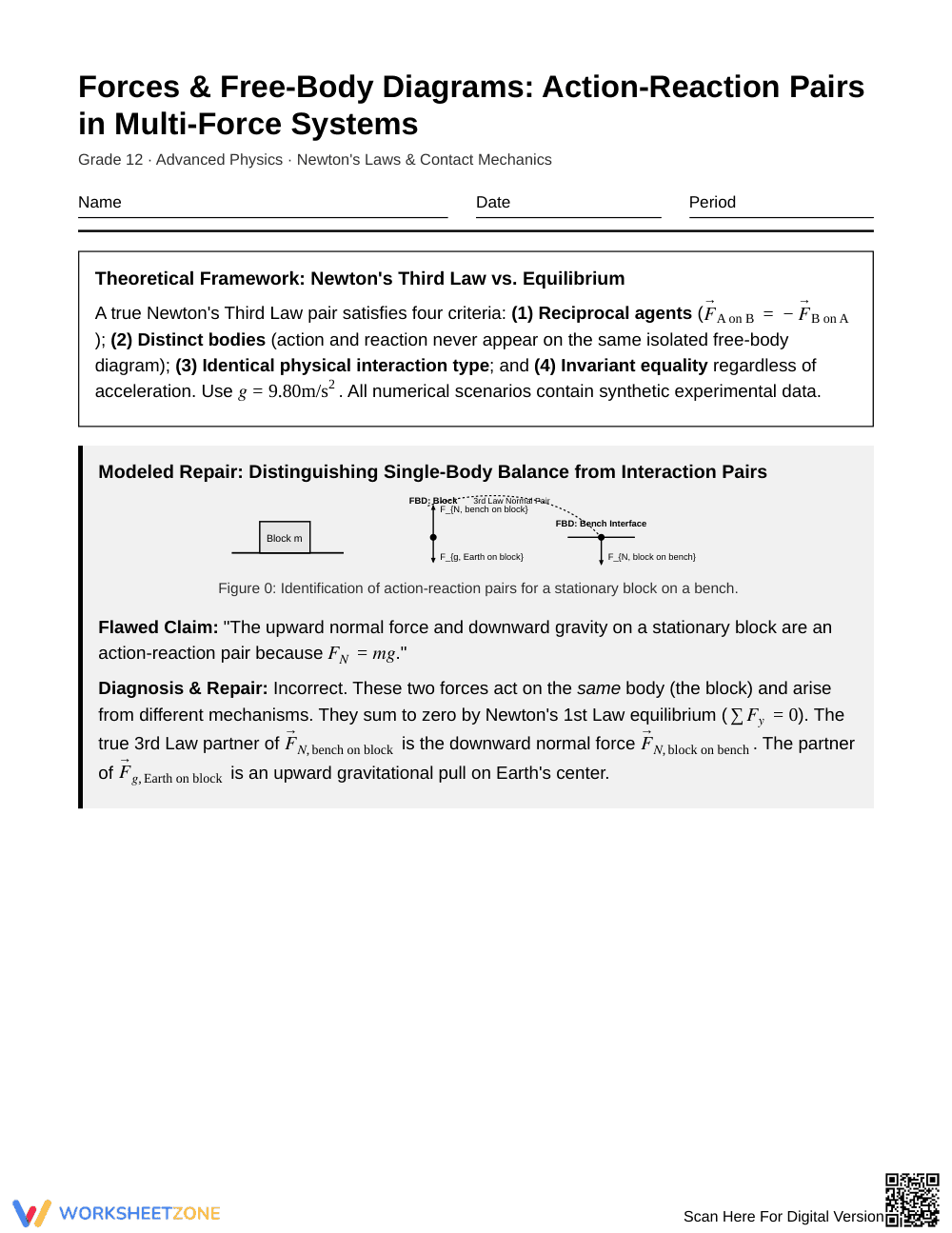
This 5-page instructional worksheet contains eight multi-part physics problems targeting persistent force misconceptions. It features an explicit Theoretical Framework outlining the four criteria of Newton's Third Law and a modeled error repair. Students evaluate flawed statements, determine vector directions, and calculate values including contact forces, scale readings, and ion thruster thrust. A comprehensive 3-page answer key provides complete free-body explanations and mathematical derivations.
Skill Progression
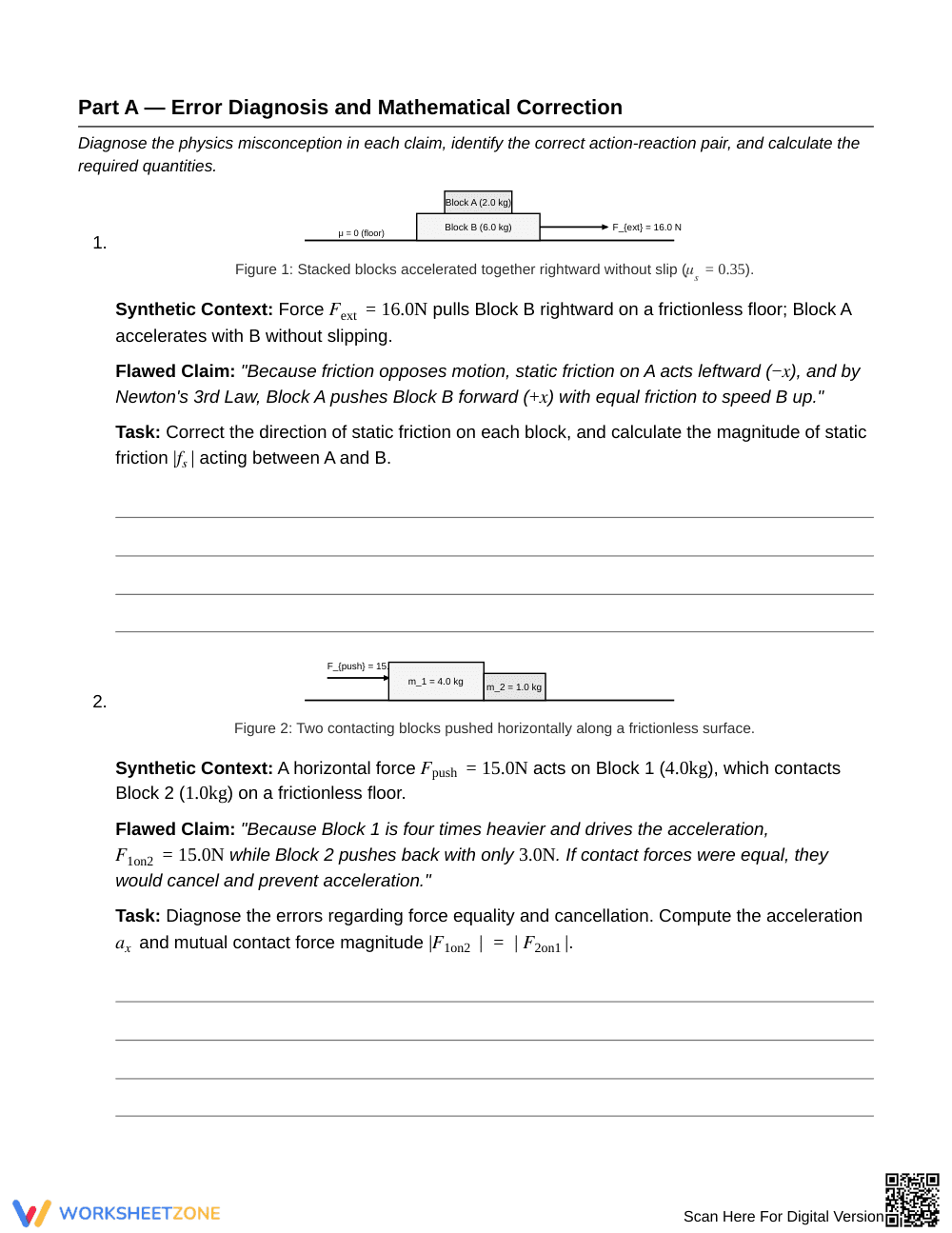
- Guided Practice (Problems 1–2): Students analyze stacked and contacting blocks to identify friction and normal force pairs while computing contact forces.
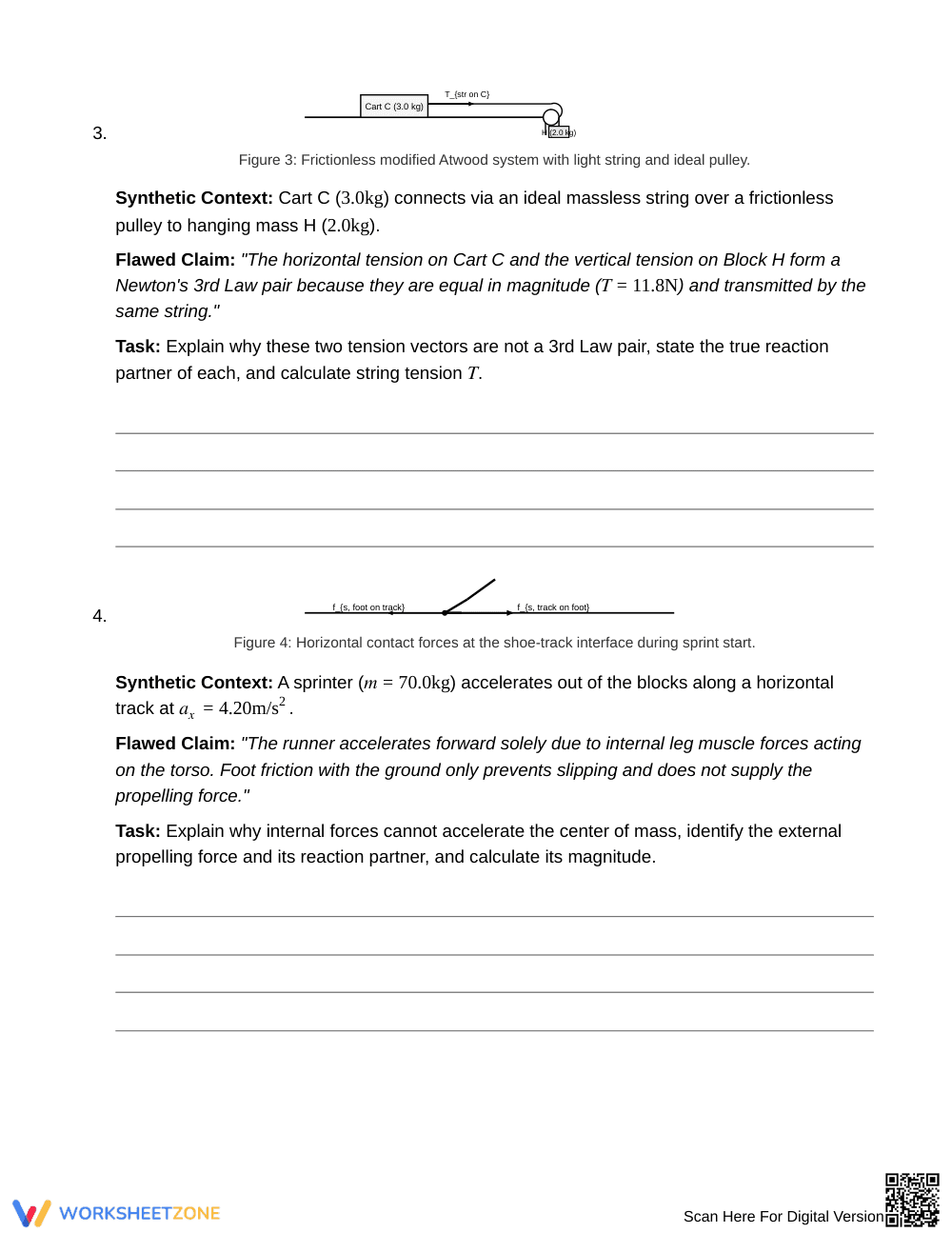
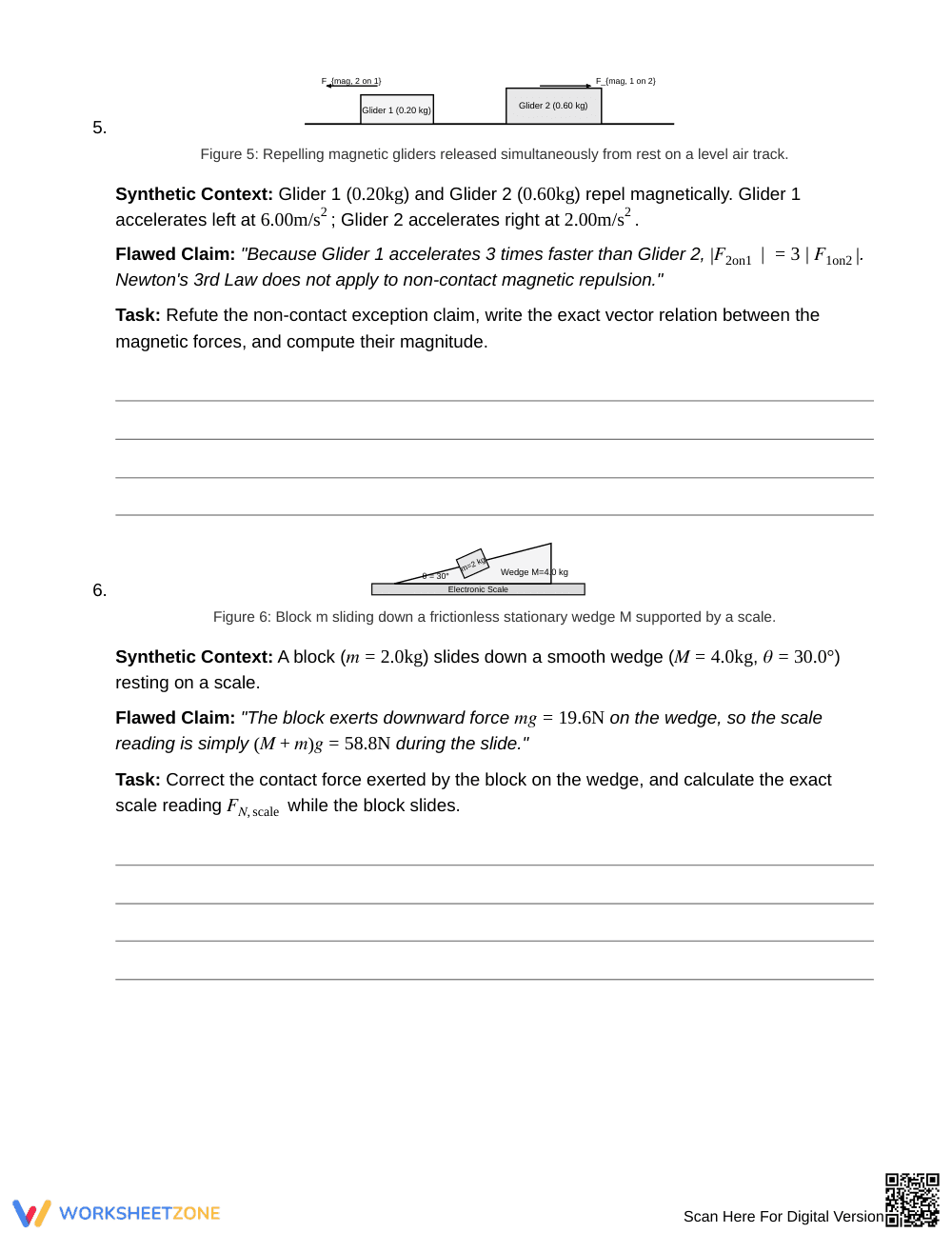
- Supported Practice (Problems 3–5): Scaffolding decreases as students resolve non-adjacent pulley tensions, sprinter propulsion, and non-contact magnetic repulsion.
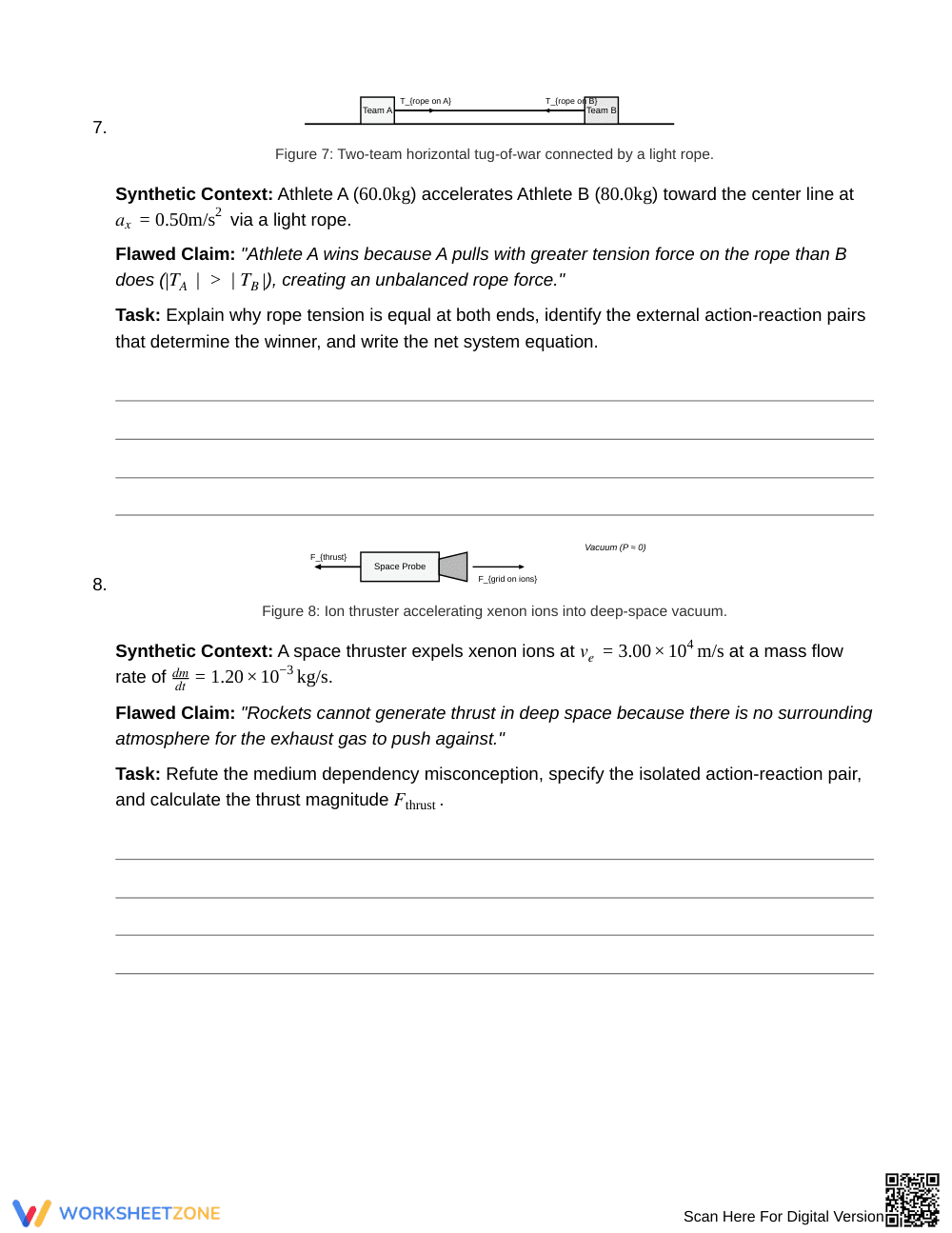
- Independent Practice (Problems 6–8): Students demonstrate mastery on sliding wedges, two-athlete tug-of-war systems, and ion thrusters in vacuum.
This sequence implements a gradual-release model, progressing from scaffolded error diagnosis to autonomous mechanical problem solving.
Standards Alignment
This resource aligns with high school physics standards governing force interactions and Newton's laws. Students evaluate interacting bodies to demonstrate that forces occur in equal, opposite pairs acting on different objects. Supporting mechanics concepts encompass coupled acceleration and net force systems. Both standard codes can be copied directly into lesson plans, IEP goals, or district curriculum mapping tools.
How to Use It
Use this worksheet following direct instruction on Newton's laws or during exam review. In pairs, students diagnose flawed claims before calculating numerical values. During independent practice, observe whether students mistakenly place action-reaction pairs on the same isolated body diagram, prompting them to identify the reciprocal agent. Completion requires approximately 45 to 60 minutes.
Who It's For
This material is designed for Grade 12 physics, honors physics, and AP Physics students mastering multi-body mechanics. For scaffolding, provide isolated free-body templates; for extensions, require symbolic algebraic solutions before numerical substitution. It pairs naturally with a dual-force sensor laboratory experiment or an interactive lecture on coupled systems.
According to research by Fisher & Frey (2014) on guided instruction, cognitive apprenticeship and structured error analysis accelerate conceptual mastery by requiring learners to articulate why intuitive misconceptions fail under physical laws. This Grade 12 physics resource grounds instruction in correct action-reaction pair placement across eight scaffolded multi-body contexts. Students confront pervasive student errors—such as equating normal force with gravity or assuming contact forces cancel across distinct bodies—and resolve them using rigorous vector analysis. By isolating interaction pairs onto separate bodies and computing dynamic responses, students bridge the gap between qualitative understanding and quantitative problem solving. The structured progression from modeled repair to unassisted problem solving reinforces the gradual release of responsibility, ensuring that high school physics students develop durable mechanics schemas capable of transferring to complex multi-force systems and university-level engineering coursework.


