




























Views
Downloads
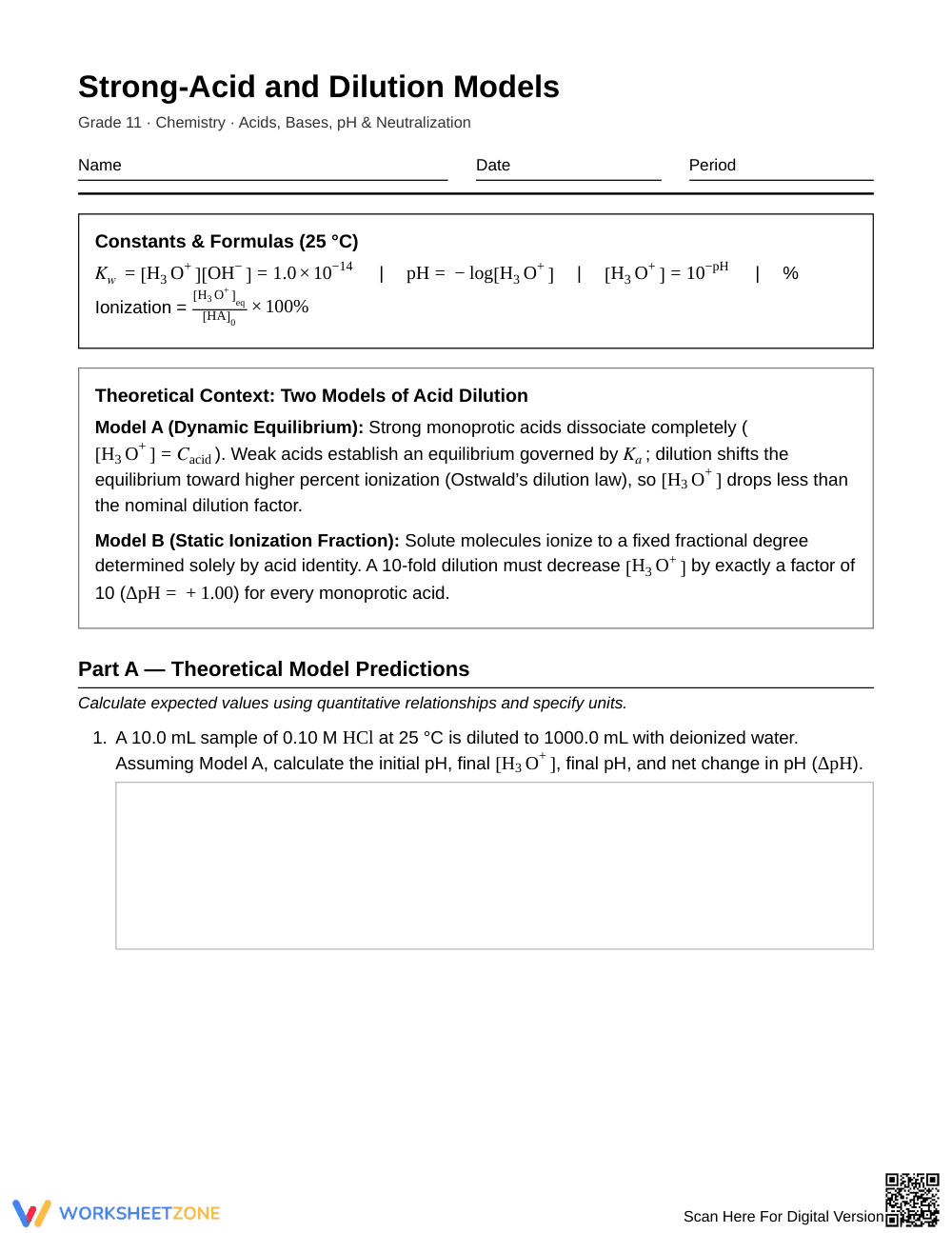


Proven Acid Dilution Models Worksheet | Grade 11 Chemistry

Paste this activity's link or code into your existing LMS (Google Classroom, Canvas, Teams, Schoology, Moodle, etc.).
Students can open and work on the activity right away, with no student login required.
You'll still be able to track student progress and results from your teacher account.
This 11th-grade chemistry worksheet guides students through contrasting dynamic equilibrium with static ionization models of acid dilution. Learners calculate pH shifts, evaluate percent ionization, analyze titration equivalence volumes, and use empirical laboratory data to validate Ostwald’s dilution law and equilibrium principles across 10 rigorous, multi-step analytical problems.
At a Glance
- Grade: 11 · Subject: Chemistry (Advanced High School)
- Standard: High School Physical Sciences — Evaluate dynamic equilibrium and static models of acid dilution and neutralization
- Skill Focus: Compare Strong-Acid and Dilution Models
- Format: 5 pages · 10 structured problems · Detailed 3-page answer key included · PDF
- Best For: Advanced chemical equilibrium practice and post-lab conceptual debrief
- Time: 45–60 minutes of engaged instructional time
What's Inside
This 5-page student packet features 10 structured analytical tasks accompanied by a complete 3-page worked answer key. Students begin with a reference box containing fundamental constants and equilibrium expressions, then progress through quantitative predictions, comparative variable analyses, and two authentic synthetic laboratory datasets measuring dilution series conductivity and titration equivalence thermochemistry.
Skill Progression
- Guided practice (Tasks 1–2): Students apply explicit equilibrium formulas and given constants to compute hydronium concentrations and percent ionization under two competing models.
- Supported practice (Tasks 3–8): Learners work through six multi-faceted scenarios distinguishing acid strength from concentration, evaluating conductivity, buffer response, and water autoionization at raised temperatures.
- Independent practice (Tasks 9–10): Students synthesize empirical evidence from two data tables to refute static ionization models and justify dynamic equilibrium through Le Chatelier’s principle.
This intentional sequence mirrors the gradual-release framework, scaffolding conceptual complexity before asking learners to independently evaluate competing scientific claims.
Standards Alignment
This resource supports state and national high school chemistry standards focusing on chemical equilibrium, acid dissociation, and Le Chatelier’s principle. Students construct scientific arguments supported by quantitative evidence to explain how macroscopic dilution alters microscopic equilibrium distributions. Both standard codes can be copied directly into lesson plans, IEP goals, or district curriculum mapping tools.
How to Use It
Deploy this worksheet after direct instruction on weak acid equilibria (Ka) and Le Chatelier's principle. For an engaging inquiry lesson, have student partner pairs examine the synthetic datasets in Part C to construct scientific arguments before whole-group debriefing. During independent seatwork, monitor Task 8 to formatively assess whether students recognize the limitation of simple logarithmic formulas in ultra-dilute acid solutions. The complete 10-task assignment requires approximately 45 to 60 minutes.
Who It's For
This packet serves Grade 11 General, Honors, and Advanced Placement Chemistry students mastering aqueous solutions and ionic equilibria. Scaffolding notes and provided formulas support developing learners, while multi-step charge balances challenge advanced students. Pair this worksheet directly with an acid-base titration laboratory experiment or an interactive equilibrium simulation.
Comparing strong-acid and dilution models requires high school chemistry students to coordinate mathematical problem-solving with conceptual models of reversible chemical systems. According to Fisher & Frey (2014), structured instructional progressions that guide students from guided calculations to independent evaluation of contrasting scientific models accelerate deeper conceptual mastery and durable retention across complex science disciplines. By challenging learners to test theoretical claims against synthetic empirical data sets, this resource moves beyond rote algorithmic memorization of pH formulas toward genuine evidence-based reasoning. Students directly confront common secondary misconceptions regarding acid strength versus concentration, buffer capacity, and the dynamic behavior of weak electrolytes upon dilution. Grounded in established gradual-release instructional design, the 10-problem sequence provides chemistry educators with reliable diagnostic data on student mastery of aqueous equilibrium dynamics, making it an essential, classroom-tested resource for rigorous standards-aligned secondary science curricula.


