


























Views
Downloads


Essential Proportion Word Problems: Decimals - Grade 7-9
Paste this activity's link or code into your existing LMS (Google Classroom, Canvas, Teams, Schoology, Moodle, etc.).
Students can open and work on the activity right away, with no student login required.
You'll still be able to track student progress and results from your teacher account.
This math worksheet provides rigorous practice in proportional reasoning using decimal values across various real-world contexts. Students calculate rates of work, athletic performance, and dimensions while ensuring accuracy. By translating complex word problems into solvable ratios, learners build the quantitative fluency required for advanced algebraic thinking.
At a Glance
- Grade: 7–9 · Subject: Math
- Standard:
7.RP.A.3— Use proportional relationships to solve multistep ratio and percent problems.- Skill Focus: Multi-step proportions with decimals
- Format: 5 pages · 19 problems · Answer key included · PDF
- Best For: Homework, independent practice, or assessment
- Time: 45–60 minutes
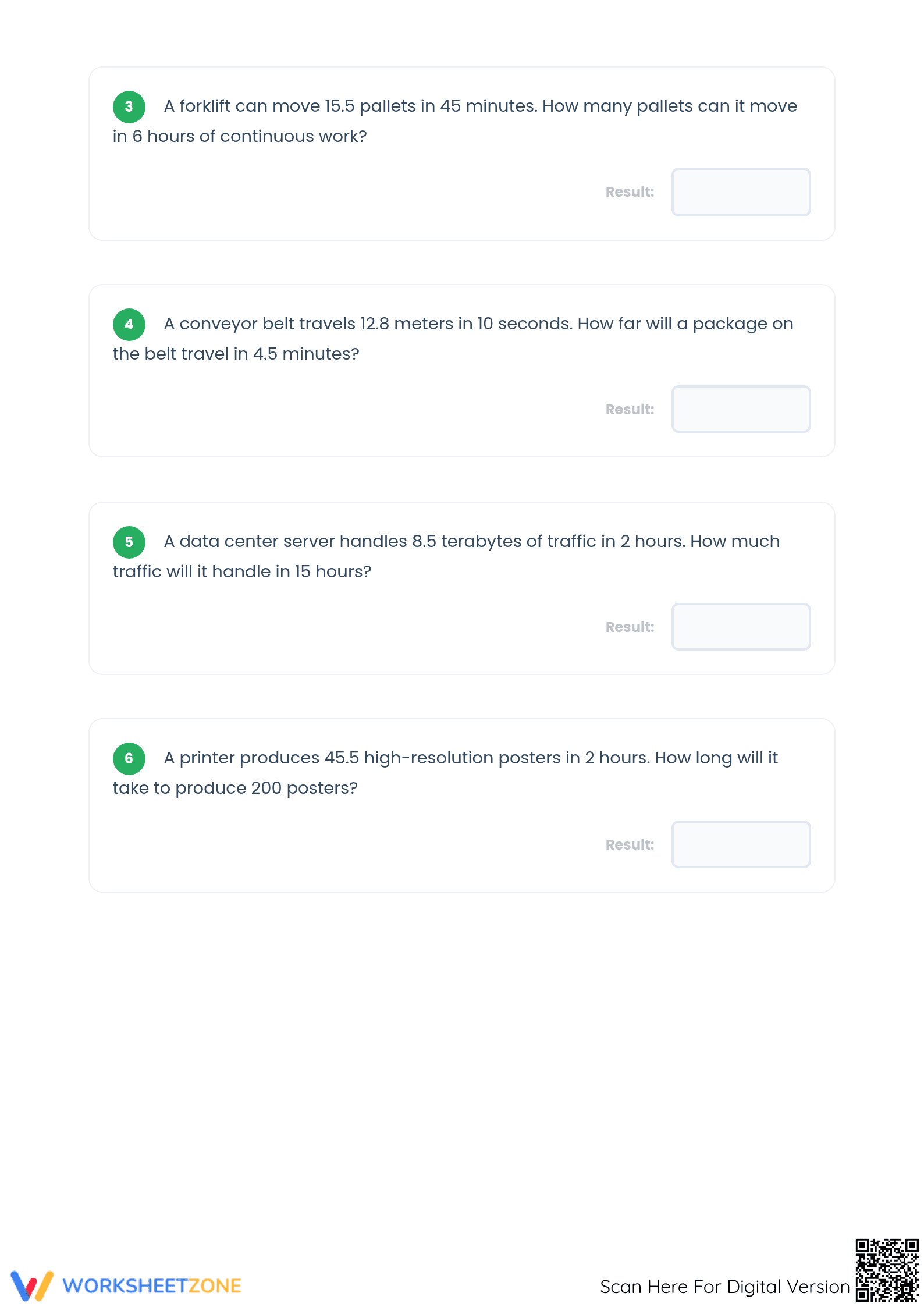
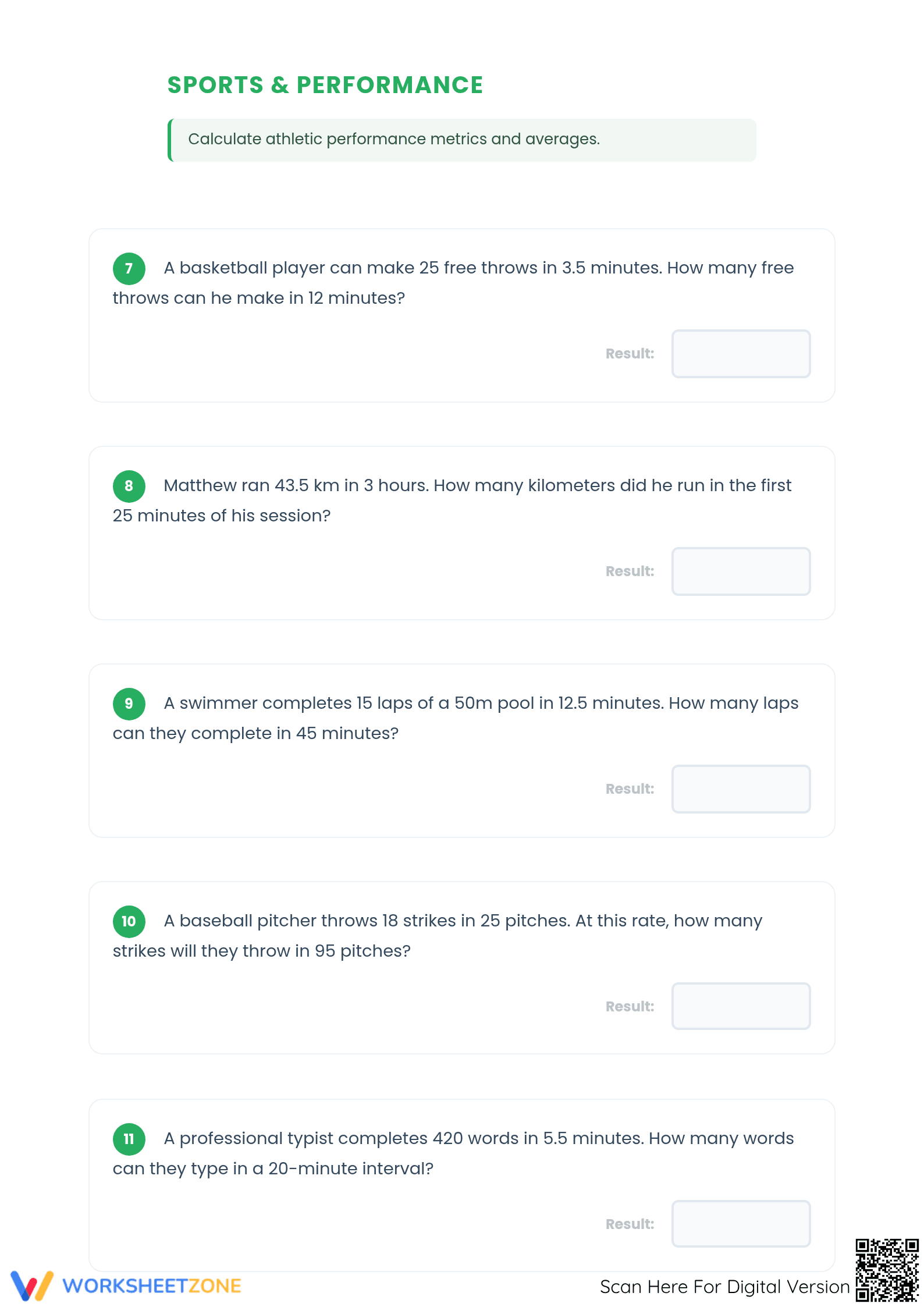
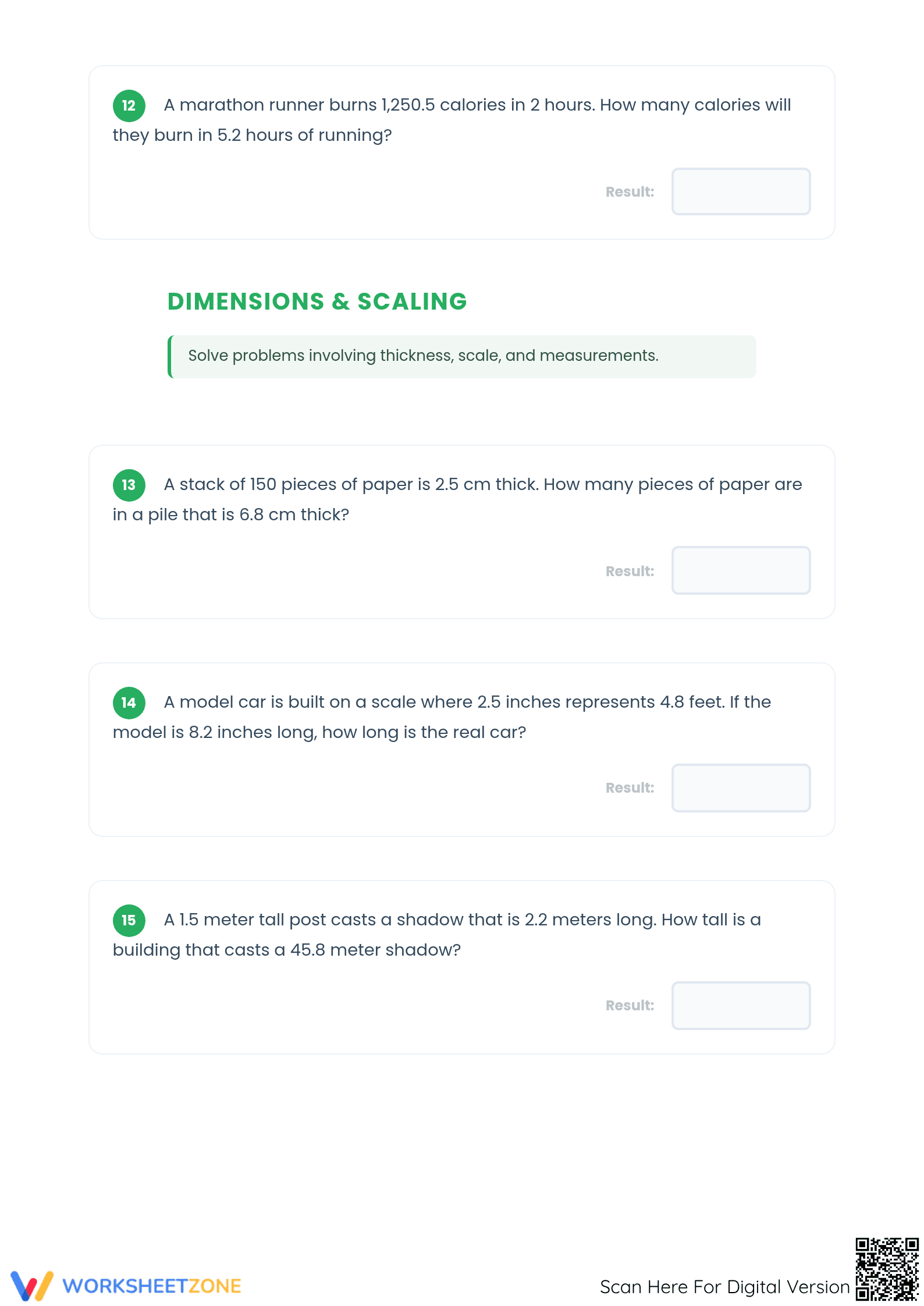
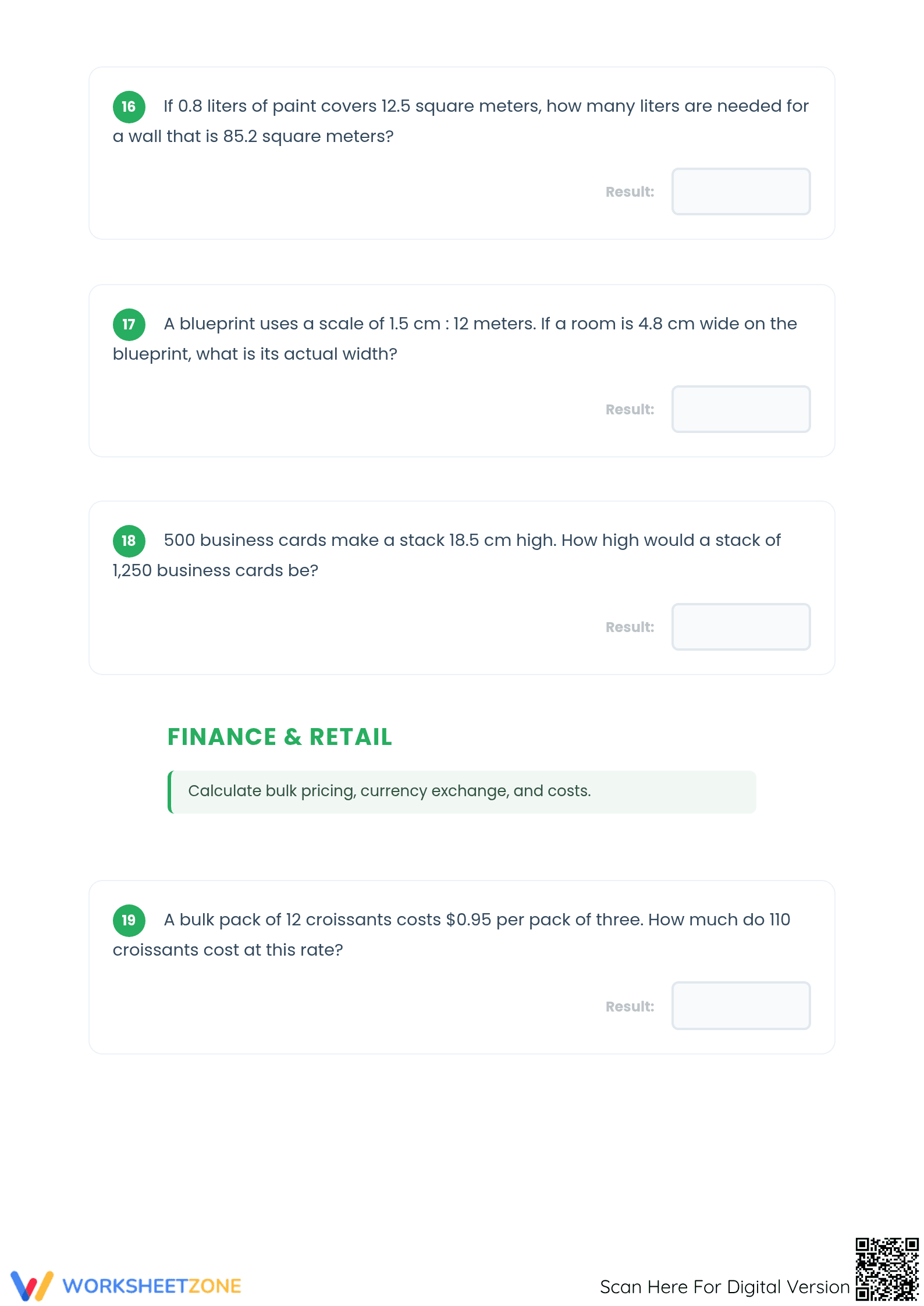
Inside this five-page collection, you will find 19 structured word problems categorized into thematic units including Logistics, Sports Performance, Dimensions & Scaling, and Finance. Each problem includes a dedicated "Result" box to encourage organized calculation. The set provides an intermediate level of difficulty, requiring students to handle multi-digit decimals and precise rounding. A complete answer key is provided for immediate feedback.
- Guided Practice: The initial problems involve straightforward rates, such as loading containers or processing packages, allowing students to establish a reliable cross-multiplication workflow.
- Supported Practice: Mid-range tasks introduce unit conversions (minutes to hours) and scaling challenges that require a two-step setup before calculating the final decimal result.
- Independent Practice: The concluding "Finance & Retail" section demands high-precision reasoning without scaffolds, forcing students to apply their rounding and ratio skills to complex pricing scenarios.
The primary standard for this resource is 7.RP.A.3, which requires students to use proportional relationships to solve multistep ratio and percent problems. It also supports 6.RP.A.3 by extending the application of ratio reasoning to real-world contexts. Both standard codes can be copied directly into lesson plans, IEP goals, or district curriculum mapping tools.
Use this worksheet as a summative assessment following a unit on ratios and proportions. During the instructional phase, observe if students are correctly aligning units in their cross-multiplication setup; a common error is inverting the second ratio. Most students will complete the full 19-problem set in 50 minutes, making it an ideal choice for a single-period mastery check or a multi-day homework assignment.
This resource is designed for middle school students in Grades 7 through 9 who have mastered basic fractions and are transitioning to complex decimal operations. It is particularly effective for students requiring extra practice with word problem interpretation. Pair this worksheet with a ratio anchor chart or a short reading passage on real-world engineering to provide additional context for the logistics problems.
According to the NAEP framework, the ability to apply proportional reasoning to real-world scenarios is a critical predictor of success in high school algebra and beyond. This worksheet targets the specific skill of solving multistep ratio problems using decimal values, which aligns with the rigorous demands of 7.RP.A.3. Research from ScienceDirect TpT Analysis suggests that high-volume practice with varied contexts—such as the logistics and finance themes used here—improves a student's ability to transfer mathematical concepts to unfamiliar situations. By requiring results to be rounded to two decimal places, the resource also reinforces computational precision and attention to detail. Educators can use the included answer key to quickly identify misconceptions in unit rate calculation or decimal placement. This set provides the structured, repetitive practice necessary to bridge the gap between abstract ratio theory and practical quantitative literacy.


