


























Views
Downloads




Essential Proportions Mastery: Grade 7 Math Printable
Paste this activity's link or code into your existing LMS (Google Classroom, Canvas, Teams, Schoology, Moodle, etc.).
Students can open and work on the activity right away, with no student login required.
You'll still be able to track student progress and results from your teacher account.
This comprehensive Grade 7 math resource provides a structured pathway for students to master solving proportions. By transitioning from simple integer ratios to complex decimal values and real-world applications, students build the conceptual fluency required for algebraic success. This multi-page packet ensures rigorous practice with immediate verification via the provided answer key.
At a Glance
- Grade: 7 · Subject: Math
- Standard:
CCSS.MATH.CONTENT.7.RP.A.2.C— Represent proportional relationships by equations to solve for unknown variables- Skill Focus: Cross-multiplication and algebraic isolation
- Format: 5 pages · 27 problems · Answer key included · PDF
- Best For: Independent practice or sub plans
- Time: 45–60 minutes
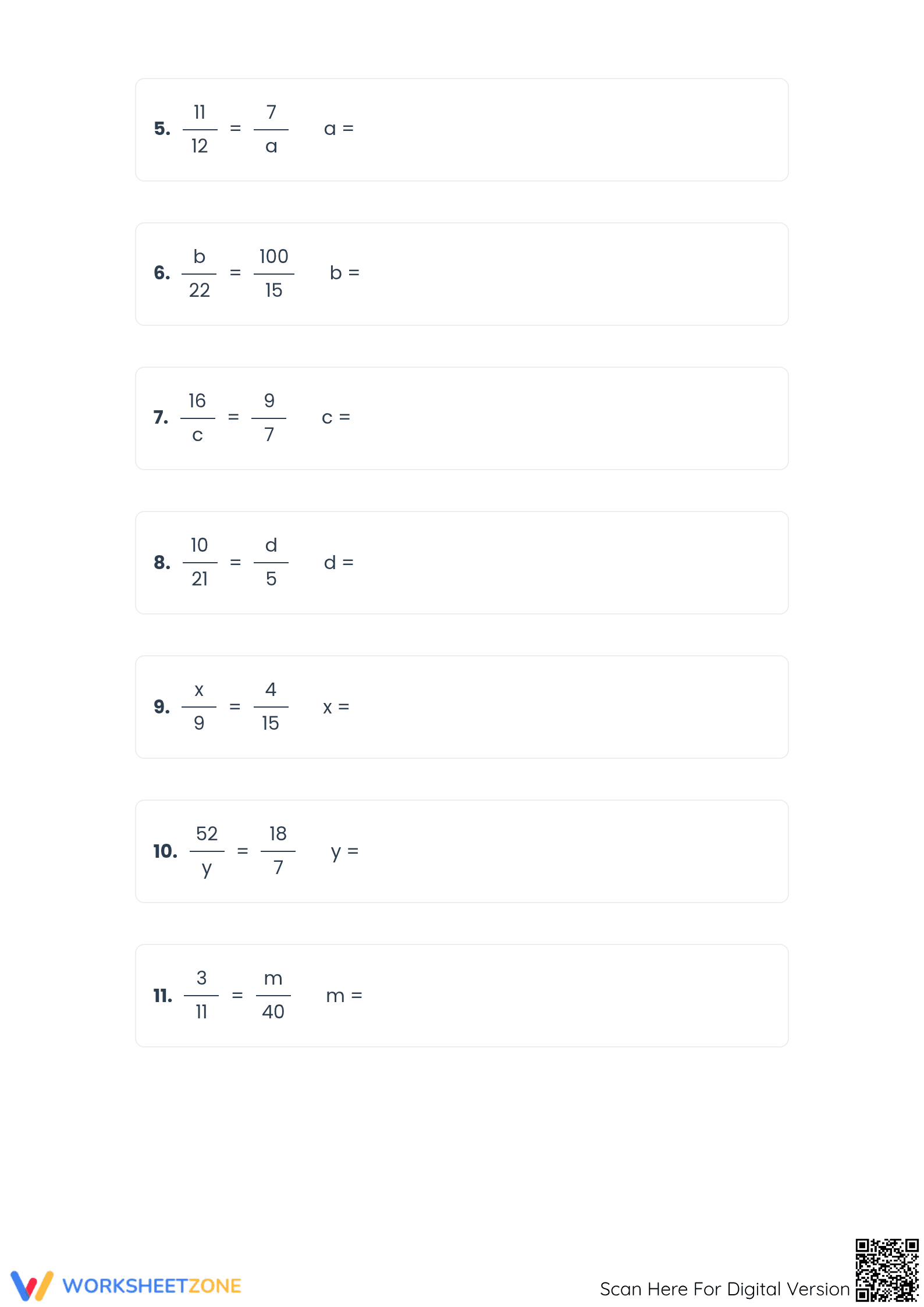
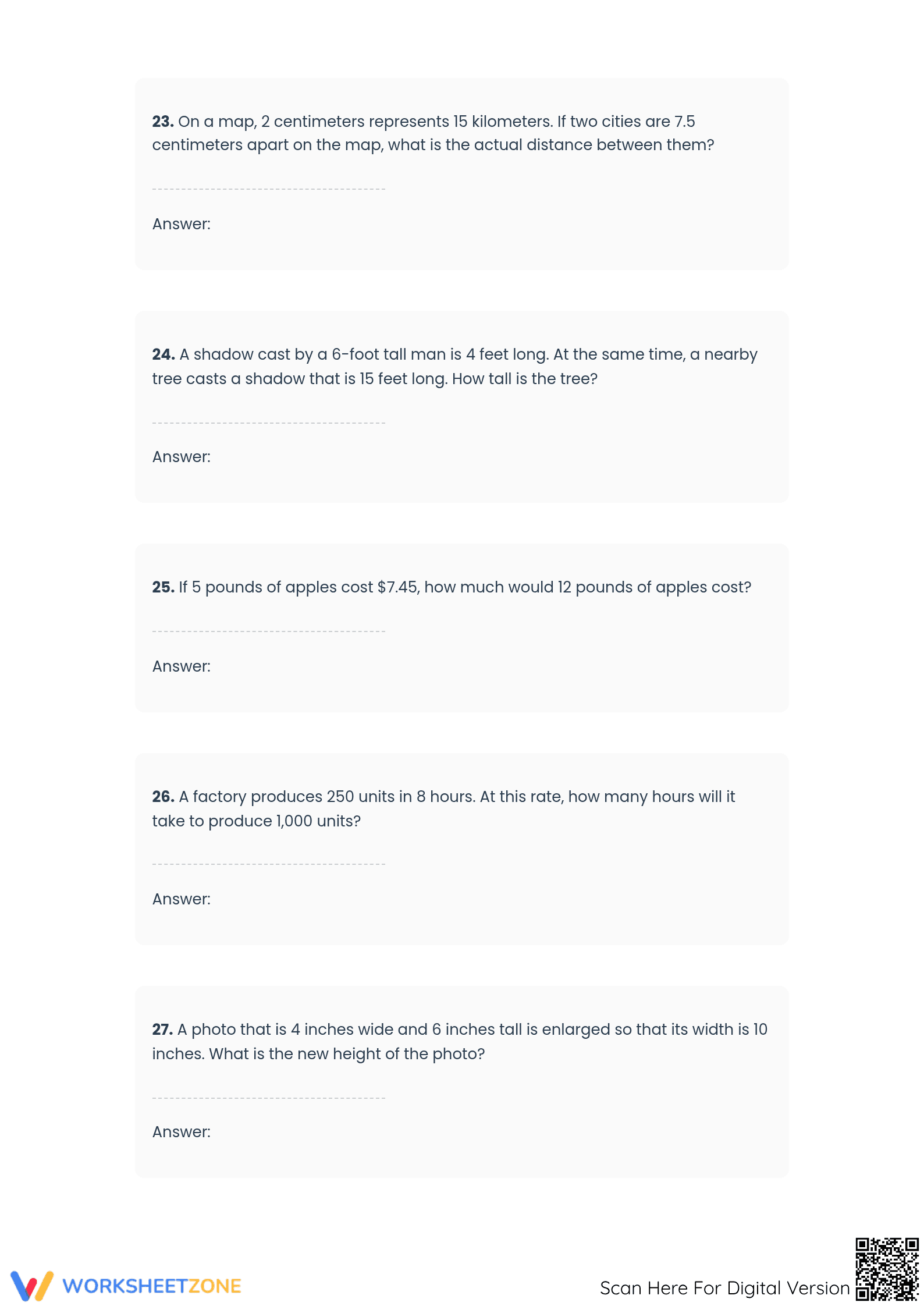
The What's Inside section highlights the deliberate scaffolding of this 5-page document. It begins with twelve fundamental proportion problems featuring whole numbers to solidify the cross-multiplication technique. The second section introduces eight problems with decimal terms, challenging students to maintain precision during calculation. Finally, seven real-world word problems require students to extract data and set up their own equations before solving, covering topics from recipe scaling to map distances.
This resource follows a Zero-Prep Workflow designed for the busy educator. First, print the five-page student packet and the corresponding answer key in under sixty seconds. Second, distribute the materials for an immediate independent work session or a structured sub plan. Third, use the provided answer key for a rapid five-minute whole-class review or individual grading. The total teacher preparation time remains under two minutes, making it an ideal choice for emergency lesson coverage.
Regarding Standards Alignment, the primary focus is CCSS.MATH.CONTENT.7.RP.A.2.C, which requires students to represent proportional relationships by equations. Additionally, the word problem section supports CCSS.MATH.CONTENT.7.RP.A.3 as students apply ratios to solve multi-step problems. Both standard codes can be copied directly into lesson plans, IEP goals, or district curriculum mapping tools to ensure documented instructional compliance.
There are two primary ways How to Use It effectively. Use it as a post-instruction reinforcement packet during the "You Do" phase of a gradual release model to ensure every student has attempted a variety of problem types. Alternatively, assign specific sections as formative assessment check-ins; observing how a student handles the transition to decimals in Section 2 can reveal hidden gaps in their multiplication or division fluency. Expect students to spend approximately fifty minutes on the full set.
This packet is specifically Who It's For: Grade 7 students learning new ratio concepts and Grade 8 or 9 students requiring an essential skills refresher. The clear spacing and sectioned headers support students with executive functioning needs. It pairs naturally with a direct instruction lesson on cross-multiplication or a classroom anchor chart detailing the steps to isolate a variable in a ratio equation.
The efficacy of scaffolded math practice is well-documented in Fisher & Frey (2014), which emphasizes the importance of moving from guided examples to independent application. This worksheet leverages that research by providing 27 structured opportunities to apply the CCSS.MATH.CONTENT.7.RP.A.2.C standard across varying contexts. By requiring students to solve proportions with both integers and decimals, the resource ensures they do not rely on simple mental math but instead master the procedural algorithm of cross-multiplication. The inclusion of seven real-world scenarios further bridges the gap between abstract calculation and functional numeracy. Such comprehensive task variety is essential for building the long-term retention needed for high-school algebra. Educators can rely on this tool as a verified method for assessing student readiness for more complex linear equations and slope-intercept forms in subsequent units.


