


























Views
Plays

Properties of Waves Worksheet | Grade 6 Essential
Paste this activity's link or code into your existing LMS (Google Classroom, Canvas, Teams, Schoology, Moodle, etc.).
Students can open and work on the activity right away, with no student login required.
You'll still be able to track student progress and results from your teacher account.
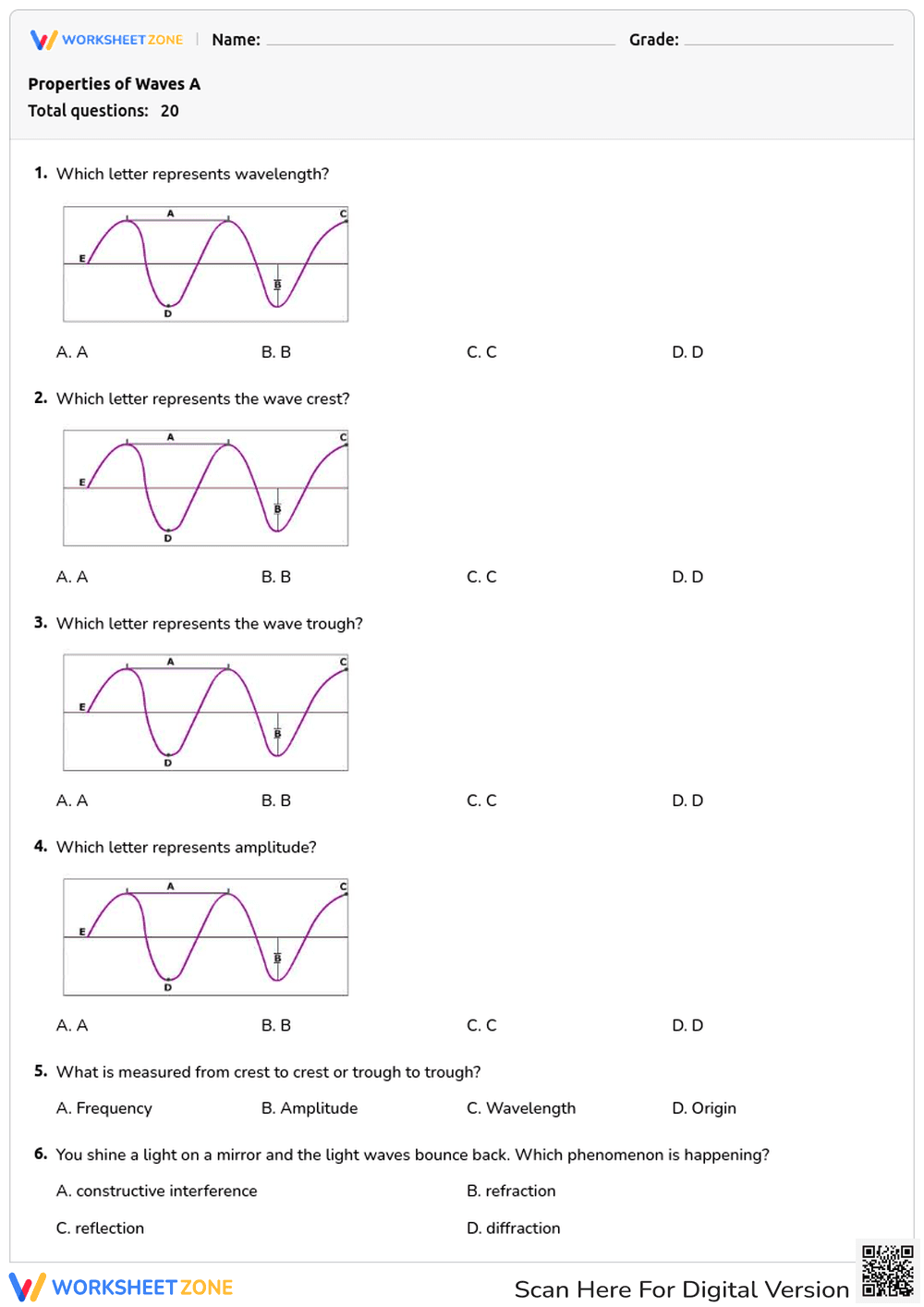
This comprehensive Grade 6 science worksheet provides students with 20 targeted multiple-choice questions to master the fundamental properties of waves. Students will identify wave anatomy, calculate wave speed, and distinguish between mechanical and electromagnetic waves. It is designed to ensure students can visualize and quantify wave behavior effectively.
At a Glance
- Grade: 6 · Subject: Science
- Standard:
MS-PS4-1— Use mathematical representations to describe a simple model for waves- Skill Focus: Wave Anatomy and Calculations
- Format: 3 pages · 20 problems · Answer key included · PDF
- Best For: Formative assessment or unit review
- Time: 25–35 minutes
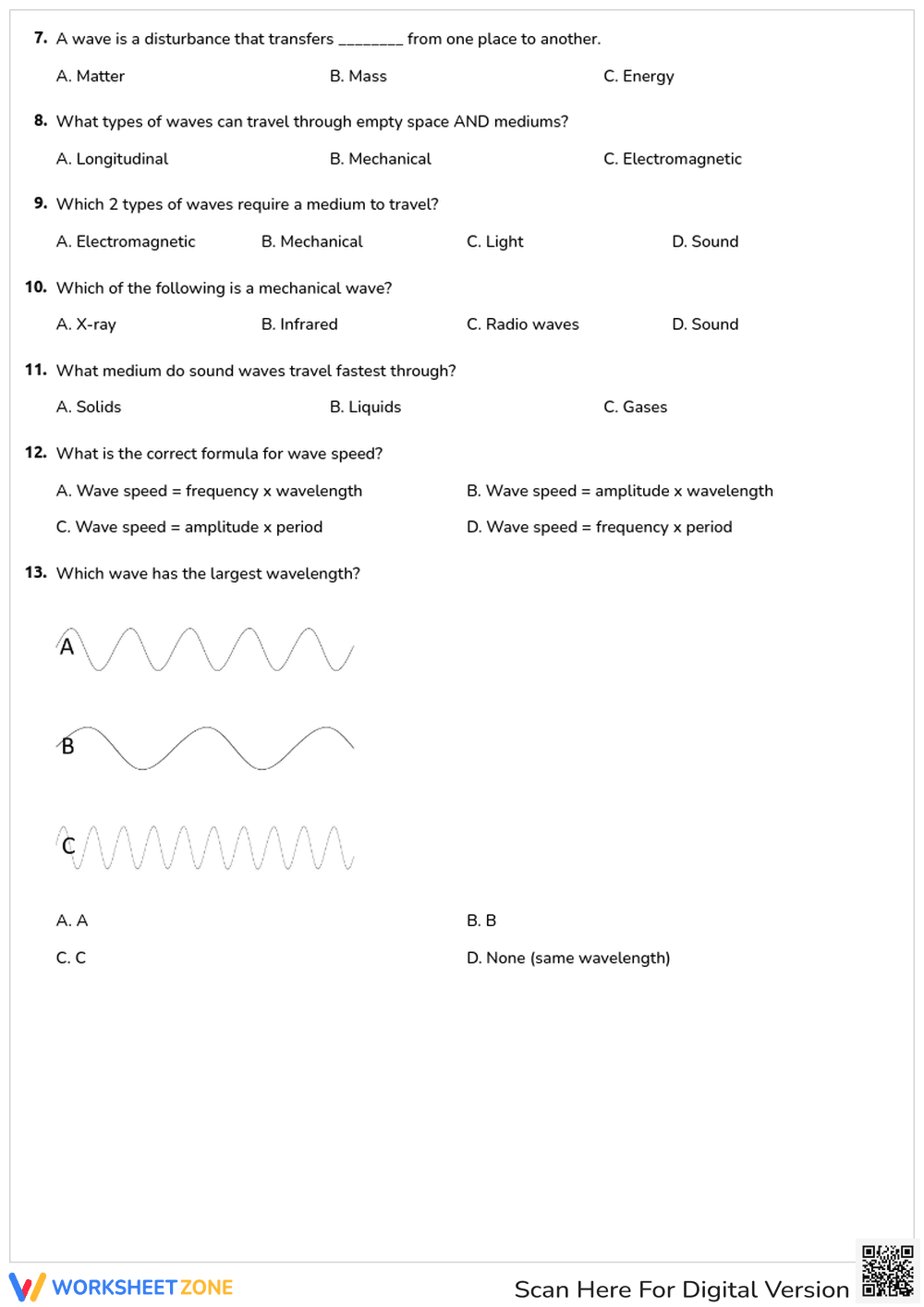
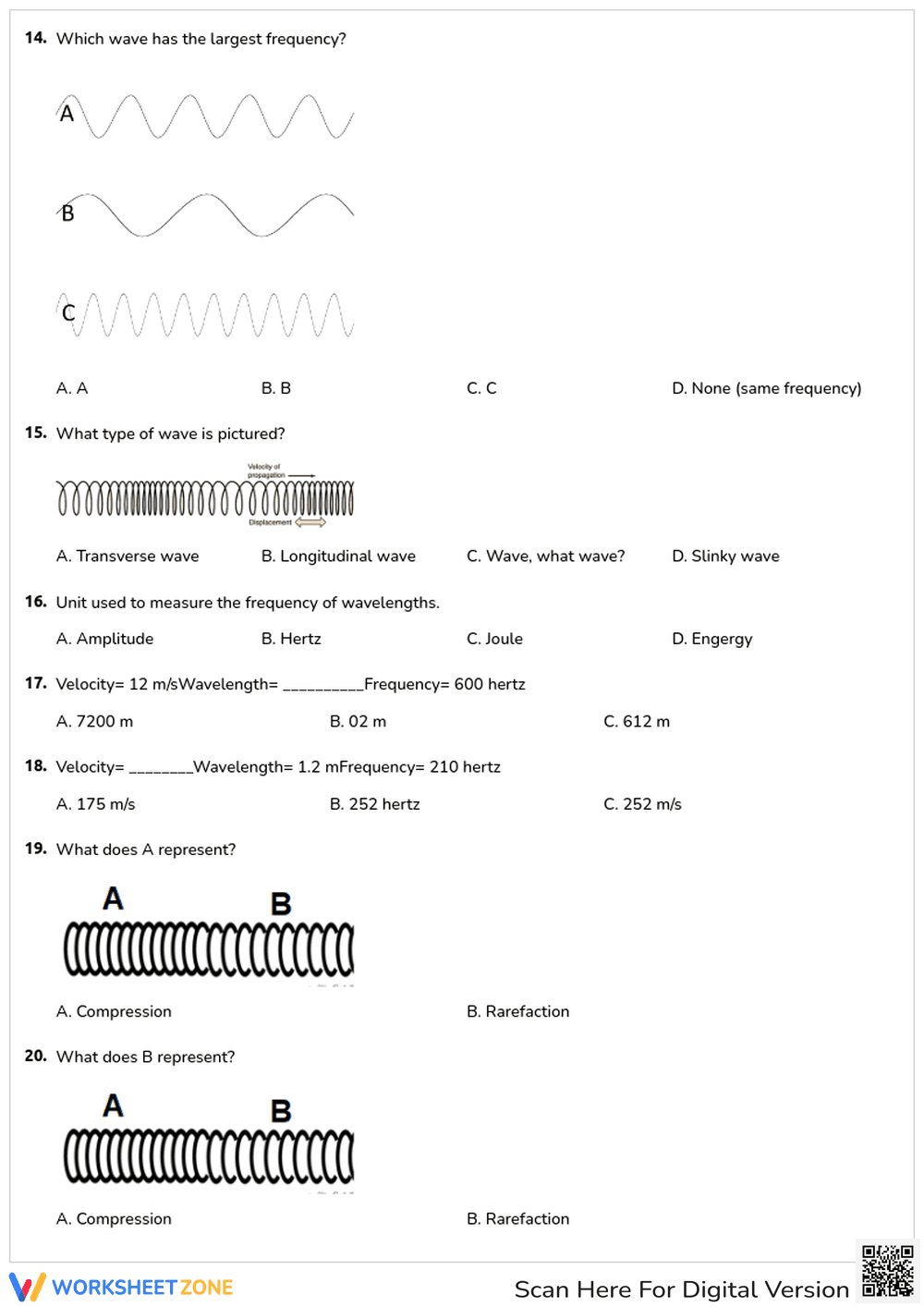
The 3-page PDF contains 20 multiple-choice questions featuring clear diagrams of transverse and longitudinal waves. Students must label parts like the crest, trough, and amplitude, while also applying the wave speed formula (velocity = frequency x wavelength). The layout includes visual aids for comparing wavelengths and frequencies across different wave patterns, ensuring students can differentiate between wave types by sight.
This resource is designed for immediate classroom implementation. Teachers can print the 3-page set in under 1 minute, distribute it to students for a 30-minute independent session, and use the included answer key for rapid grading. It serves as an ideal zero-prep sub plan or a quick check for understanding after a lecture on physics. The clear formatting allows for easy scanning and grading.
This worksheet is aligned to `MS-PS4-1`, requiring students to use mathematical representations to describe models of waves. It specifically addresses the relationship between frequency, wavelength, and speed. Both standard codes can be copied directly into lesson plans, IEP goals, or district curriculum mapping tools to ensure compliance with middle school physical science frameworks.
Use this worksheet as a mid-unit formative assessment to identify misconceptions about wave mediums and vacuum travel. During the activity, observe if students correctly identify the inverse relationship between frequency and wavelength in the visual comparison section. It typically takes students 25 to 35 minutes to complete, making it a perfect fit for a standard class period.
This resource is tailored for middle school students in Grades 6-7 studying physical science. It provides necessary scaffolding through visual diagrams, making it accessible for English Language Learners and students with IEPs who benefit from graphic representations. Pair this with a Slinky demonstration or a wave tank lab to reinforce the conceptual connections between the diagrams and physical reality.
According to the RAND AIRS 2024 report, high-quality science instructional materials that integrate visual models with mathematical application significantly improve student retention of abstract physics concepts. This worksheet addresses the MS-PS4-1 standard by requiring students to interpret wave diagrams and apply the wave speed formula across 20 distinct tasks. By bridging the gap between qualitative observation and quantitative analysis, the resource aligns with the Fisher & Frey (2014) gradual release of responsibility model. Research from EdReports 2024 emphasizes that structured practice with wave properties is essential for preparing students for high school physics. This 3-page PDF provides the necessary repetition and variety of question types to ensure mastery of wave behavior, reflection, and medium requirements in a classroom-ready format that minimizes teacher workload while maximizing student engagement with core scientific principles.


