


























Views
Plays
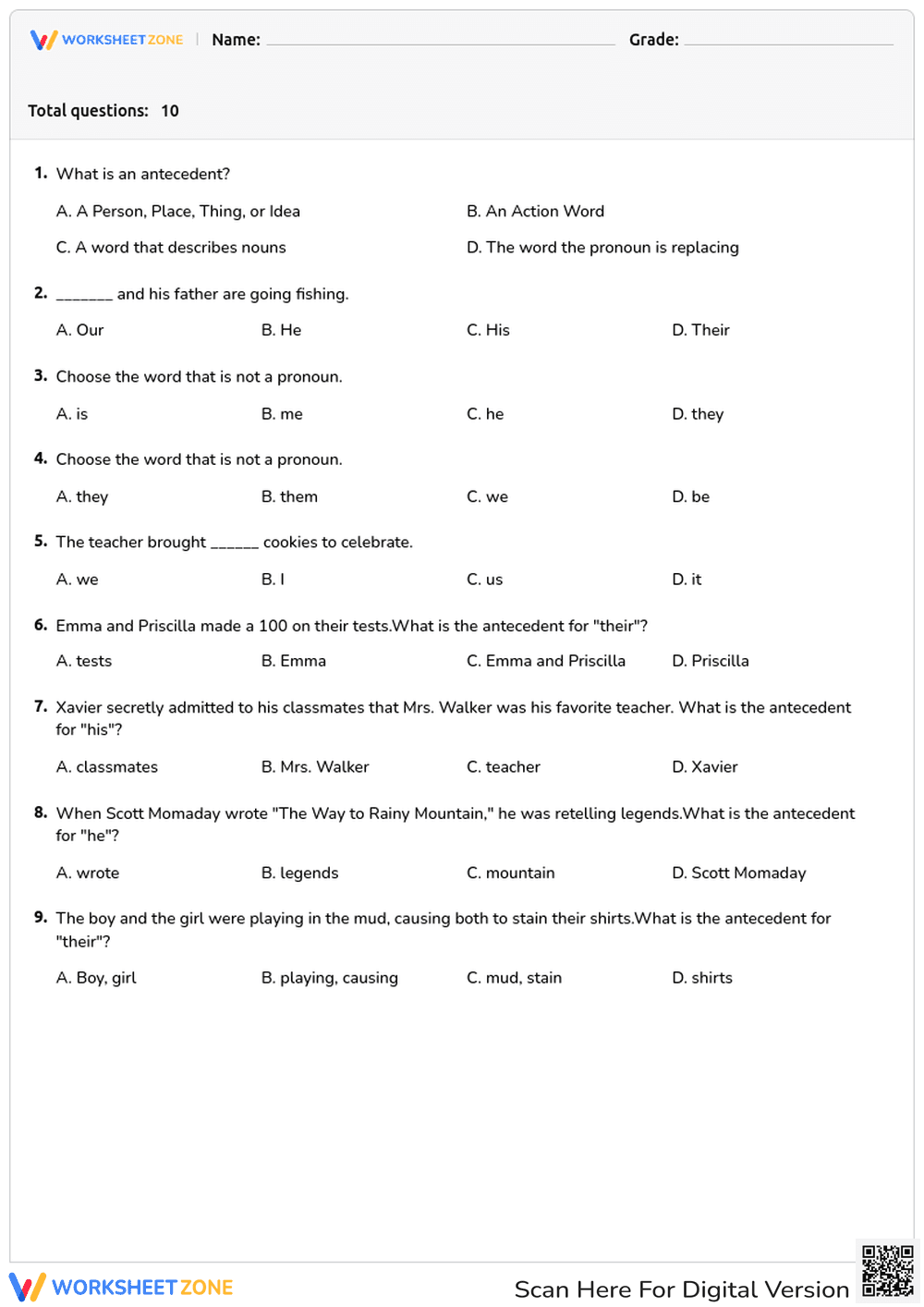


Printable Pronouns and Antecedents Quiz | Grade 3 ELA
Paste this activity's link or code into your existing LMS (Google Classroom, Canvas, Teams, Schoology, Moodle, etc.).
Students can open and work on the activity right away, with no student login required.
You'll still be able to track student progress and results from your teacher account.
This ready-to-use worksheet helps third-grade students master the relationship between pronouns and their antecedents. By completing these targeted multiple-choice questions, learners will practice identifying pronouns in context and accurately matching them to the nouns they replace, strengthening their foundational grammar and reading comprehension skills.
At a Glance
- Grade: 3 · Subject: ELA
- Standard:
CCSS.ELA-LITERACY.L.3.1.F— Identify pronouns and their matching antecedents- Skill Focus: Pronouns and Antecedents
- Format: 2 pages · 10 problems · Answer key included · PDF
- Best For: Independent practice or quick assessment
- Time: 10–15 minutes
This resource features a straightforward, two-page quiz format containing 10 multiple-choice questions. Students will encounter a mix of definition-based questions, sentence-level pronoun identification, and specific tasks requiring them to locate the exact antecedent for a given pronoun within a short text. A complete answer key is provided to ensure quick and accurate grading for educators.
Designed for maximum efficiency, this worksheet requires virtually zero teacher preparation:
- Print (1 minute): Simply download the PDF and print the two-page student assessment.
- Distribute (1 minute): Hand out the copies during your grammar block or as a quick warm-up activity.
- Review (3 minutes): Use the included answer key to grade submissions rapidly or review answers aloud as a whole class.
With a total prep time of under two minutes, this activity is an excellent addition to any emergency sub plan or last-minute lesson adjustment.
This activity is directly aligned with CCSS.ELA-LITERACY.L.3.1.F, which requires students to ensure subject-verb and pronoun-antecedent agreement. It also supports general language standards by reinforcing the basic function of pronouns in sentences. Both standard codes can be copied directly into lesson plans, IEP goals, or district curriculum mapping tools.
Deploy this worksheet as a formative assessment after concluding your direct instruction on pronouns and antecedents. It serves perfectly as an independent practice assignment or a Friday grammar quiz. While students work, teachers can circulate and observe which learners struggle to connect plural pronouns with compound antecedents, providing immediate targeted intervention. Expect most students to complete the 10 questions within 10 to 15 minutes.
This resource is primarily designed for third-grade students, though it serves as an excellent review tool for fourth graders or a challenge activity for advanced second graders. The clear, multiple-choice format provides built-in scaffolding for students who might struggle with open-ended grammar tasks. Pair this worksheet with a visual anchor chart displaying common pronouns to support English Language Learners and students needing extra visual cues.
Mastering grammar mechanics is essential for developing strong reading comprehension and writing fluency. This resource targets CCSS.ELA-LITERACY.L.3.1.F, helping students identify pronouns and their matching antecedents. According to Fisher & Frey (2014), providing students with clear, structured practice opportunities significantly improves their ability to transfer isolated grammar skills into their independent writing. When learners can reliably track how pronouns replace specific nouns across sentences, their overall reading comprehension improves because they no longer lose the thread of the narrative or informational text. By utilizing this targeted 10-question assessment, educators can quickly identify gaps in foundational language skills and adjust their instruction accordingly. Consistent, low-stakes practice with these specific grammatical structures builds the automaticity required for students to tackle more complex texts and produce coherent, well-structured writing as they progress through elementary school.


