


























Views
Plays
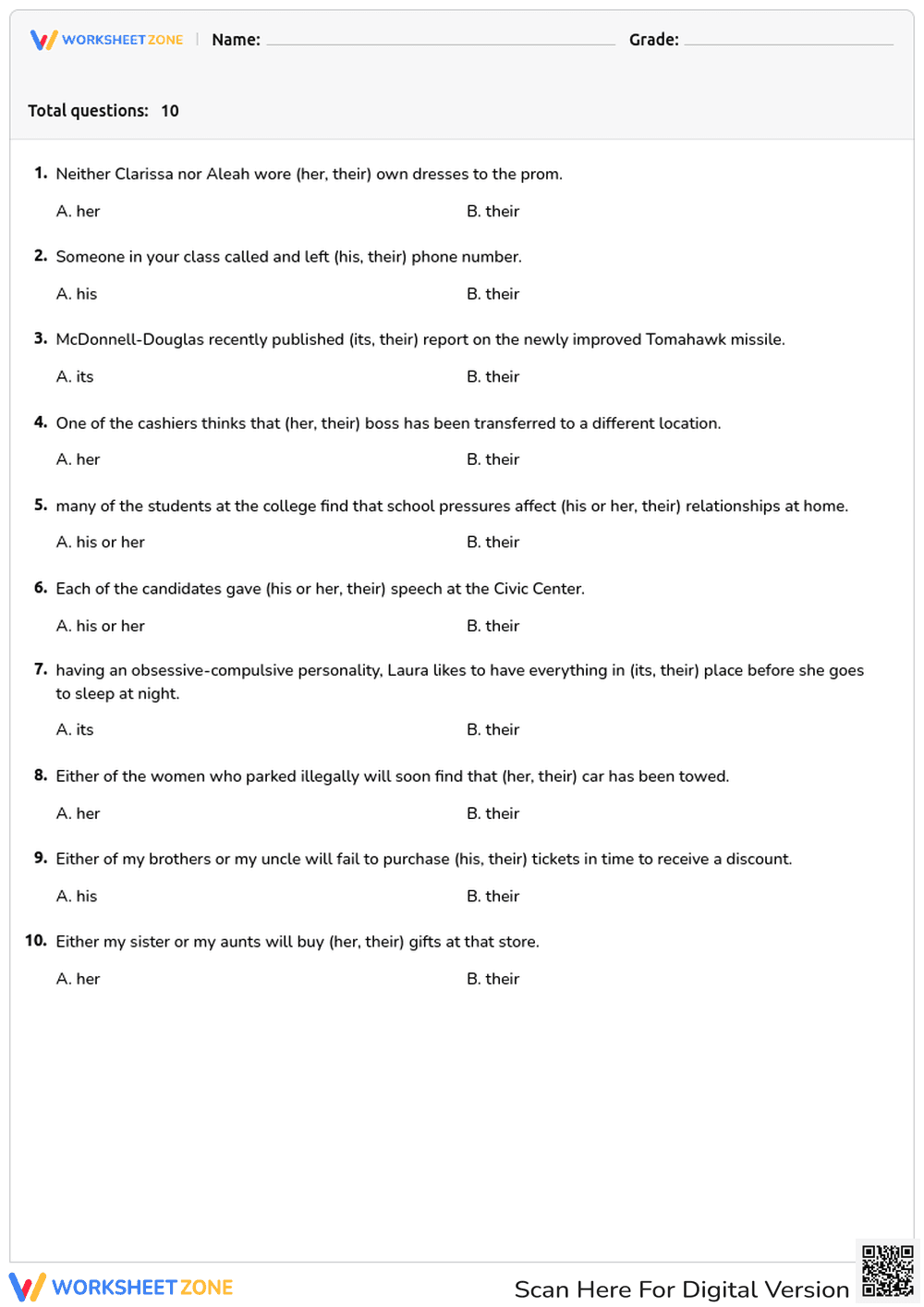

Printable Pronoun Agreement Worksheet | Grade 3 ELA
Paste this activity's link or code into your existing LMS (Google Classroom, Canvas, Teams, Schoology, Moodle, etc.).
Students can open and work on the activity right away, with no student login required.
You'll still be able to track student progress and results from your teacher account.
This Grade 3 grammar worksheet provides targeted practice to help students master pronoun-antecedent agreement. By completing these focused exercises, learners will correctly match pronouns to their antecedents in complex sentences, ensuring clear and accurate writing. The straightforward format allows students to immediately apply grammar rules in context.
At a Glance
- Grade: 3 · Subject: ELA
- Standard:
CCSS.ELA-LITERACY.L.3.1.F— Ensure pronoun-antecedent agreement in sentences- Skill Focus: Pronoun-Antecedent Agreement
- Format: 1 page · 10 problems · Answer key included · PDF
- Best For: Independent practice and review
- Time: 10–15 minutes
This single-page assessment features 10 multiple-choice questions. Each problem presents a sentence with a missing pronoun, requiring students to select the correct option from two choices. The worksheet includes challenging antecedent scenarios, such as indefinite pronouns and compound subjects, to test student comprehension. A complete answer key facilitates quick grading.
Zero-Prep Workflow
- Print (1 minute): Simply download the PDF and print copies for your class. The clean, black-and-white design ensures crisp reproduction without draining printer ink.
- Distribute (1 minute): Hand out the single-page worksheet. The instructions are self-explanatory, allowing students to begin working immediately without extensive teacher setup.
- Review (3 minutes): Use the included answer key to quickly check student responses or conduct a whole-class review session.
With total teacher prep under two minutes, it is perfect for sub plans or morning work.
Standards Alignment
This worksheet is directly aligned with CCSS.ELA-LITERACY.L.3.1.F, which requires students to ensure subject-verb and pronoun-antecedent agreement. It also supports CCSS.ELA-LITERACY.L.4.1 by reinforcing the use of standard English grammar and usage when writing or speaking. By practicing with sentences containing complex subjects, students demonstrate mastery of this foundational language skill. Both standard codes can be copied directly into lesson plans, IEP goals, or district curriculum mapping tools.
How to Use It
Use this worksheet as independent practice following direct instruction on pronoun rules, or as a quick formative assessment. Alternatively, it serves as an excellent homework assignment that reinforces classroom learning. As a formative assessment observation tip, monitor students as they work to see if they are actively identifying and underlining the antecedent before selecting their pronoun answer. Expected completion time ranges from 10 to 15 minutes.
Who It's For
Designed for third-grade students developing foundational grammar skills, this is also effective for fourth and fifth graders needing review. To differentiate, support struggling learners by pre-highlighting antecedents, while advanced students can write their own sentences using similar structures. This pairs naturally with an anchor chart detailing indefinite pronouns.
Mastering grammar mechanics like those found in CCSS.ELA-LITERACY.L.3.1.F is critical for developing proficient writers who can ensure pronoun-antecedent agreement in sentences. According to a comprehensive EdReports 2024 analysis, students who engage in frequent, targeted grammar practice within the context of complete sentences show significant improvements in their overall writing clarity and reading comprehension. Explicit instruction combined with immediate application helps solidify these abstract language concepts. When learners consistently practice matching pronouns to complex antecedents, they build the cognitive pathways necessary for fluent, error-free communication. This focused repetition reduces the cognitive load during independent writing tasks, allowing students to concentrate on higher-order skills like organization and idea development. Providing structured, multiple-choice formats offers a scaffolded approach that builds confidence and competence in young writers.


