


























Views
Plays
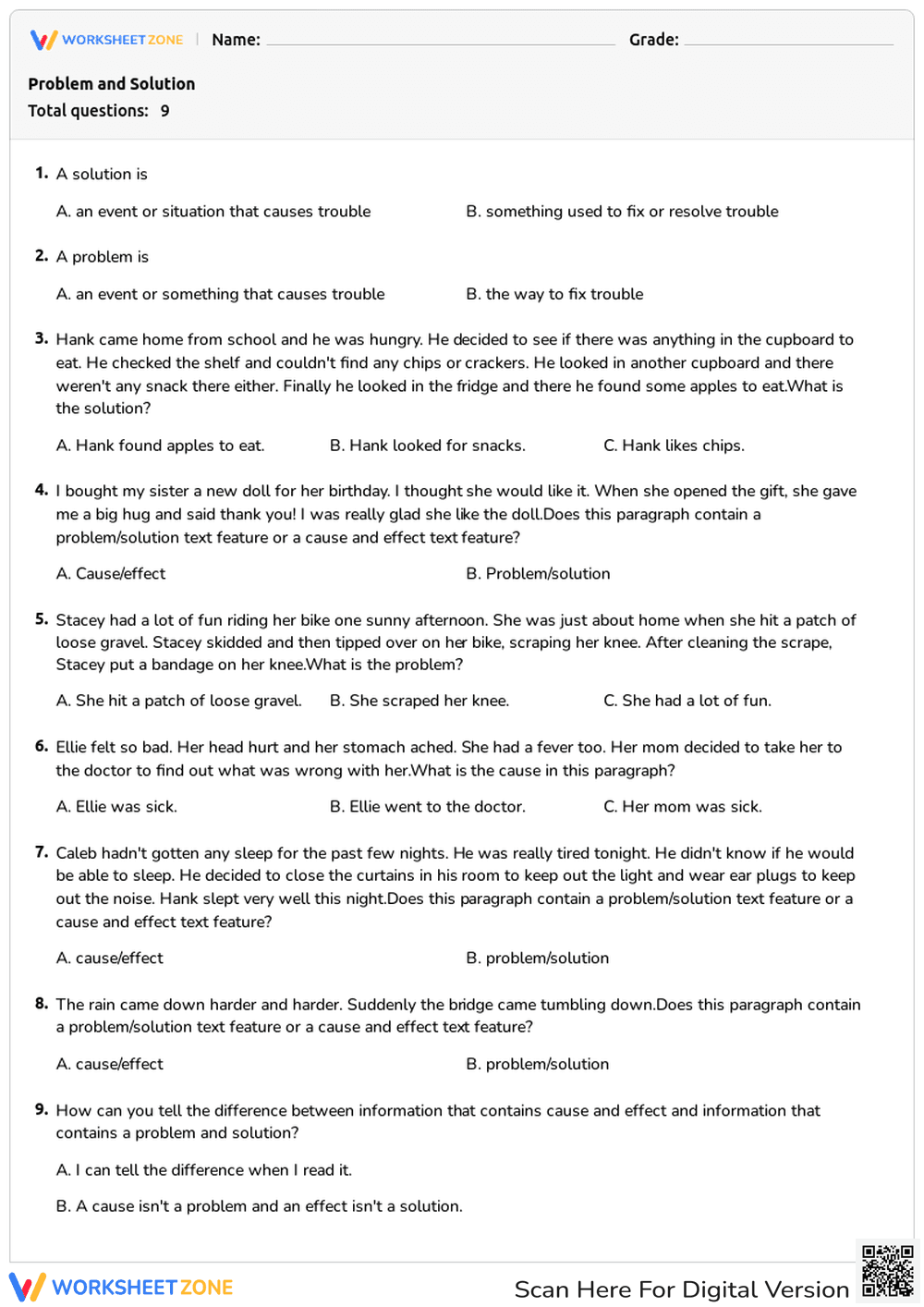


Problem and Solution Worksheet | Grade 3 Printable
Paste this activity's link or code into your existing LMS (Google Classroom, Canvas, Teams, Schoology, Moodle, etc.).
Students can open and work on the activity right away, with no student login required.
You'll still be able to track student progress and results from your teacher account.
This Grade 3 reading comprehension worksheet helps students identify and distinguish between problem and solution and cause and effect text structures. By analyzing short paragraphs and answering targeted multiple-choice questions, learners will develop the critical reading skills needed to understand logical connections within informational texts and stories.
At a Glance
- Grade: 3 · Subject: ELA
- Standard:
CCSS.ELA-LITERACY.RI.3.8— Describe logical connections between sentences and paragraphs.- Skill Focus: Problem and Solution, Cause and Effect
- Format: 2 pages · 9 problems · PDF
- Best For: Independent practice or quick assessment
- Time: 10–15 minutes
This resource features a straightforward, two-page layout containing nine multiple-choice questions. The first few items establish foundational definitions for "problem" and "solution." Subsequent questions present students with brief, relatable reading passages, asking them to identify specific causes, effects, problems, or solutions within the text. The clear formatting and multiple-choice structure make it highly accessible for young readers.
Zero-Prep Workflow
- Print (1 minute): Simply download the PDF and print a class set. The clean, black-and-white design is printer-friendly and requires no special formatting.
- Distribute (1 minute): Hand out the two-page assessment to students. The instructions are self-explanatory, allowing learners to begin immediately.
- Review (3 minutes): Use the multiple-choice format for rapid grading or whole-class review. Total teacher prep time is under two minutes, making this an excellent option for emergency sub plans or last-minute independent work.
Standards Alignment
This worksheet is directly aligned to CCSS.ELA-LITERACY.RI.3.8, requiring students to describe the logical connection between particular sentences and paragraphs in a text (e.g., comparison, cause/effect, first/second/third in a sequence). It also supports second-grade reading comprehension goals by reinforcing basic text structure identification. Both standard codes can be copied directly into lesson plans, IEP goals, or district curriculum mapping tools.
How to Use It
Formative Assessment: Assign this nine-question quiz after direct instruction on text structures. As students work, observe whether they struggle more with the definition questions or the passage-based application questions to guide your reteaching efforts. Expect completion in 10 to 15 minutes.
Independent Literacy Center: Place printed copies in a reading center for independent practice. Because the questions are self-contained and multiple-choice, students can complete the task quietly while the teacher works with small guided reading groups.
Who It's For
This worksheet is primarily designed for second and third-grade students developing their reading comprehension skills. The multiple-choice format provides built-in scaffolding for learners who might struggle with open-ended written responses, making it accessible for diverse classrooms. It pairs perfectly with an anchor chart detailing the differences between cause/effect and problem/solution text structures.
Mastering text structures like problem and solution is critical for early reading comprehension. Aligned with CCSS.ELA-LITERACY.RI.3.8, this resource requires students to describe logical connections between sentences and paragraphs. According to Fisher & Frey (2014), explicit instruction and targeted practice in identifying text structures significantly improve a student's ability to summarize information and retain key details from complex texts. When students can reliably distinguish between a cause-and-effect relationship and a problem-and-solution scenario, they transition from passive readers to active analytical thinkers. This nine-question worksheet provides the exact type of focused, repeated exposure necessary to solidify these cognitive connections. By evaluating short passages and selecting the correct structural label, learners build the automaticity required for advanced reading tasks in upper elementary grades, ensuring they are fully prepared for more rigorous academic demands.


