
































Printable Zoo Habitats Word Search | Grades 7–8 Science

Paste this activity's link or code into your existing LMS (Google Classroom, Canvas, Teams, Schoology, Moodle, etc.).
Students can open and work on the activity right away, with no student login required.
You'll still be able to track student progress and results from your teacher account.
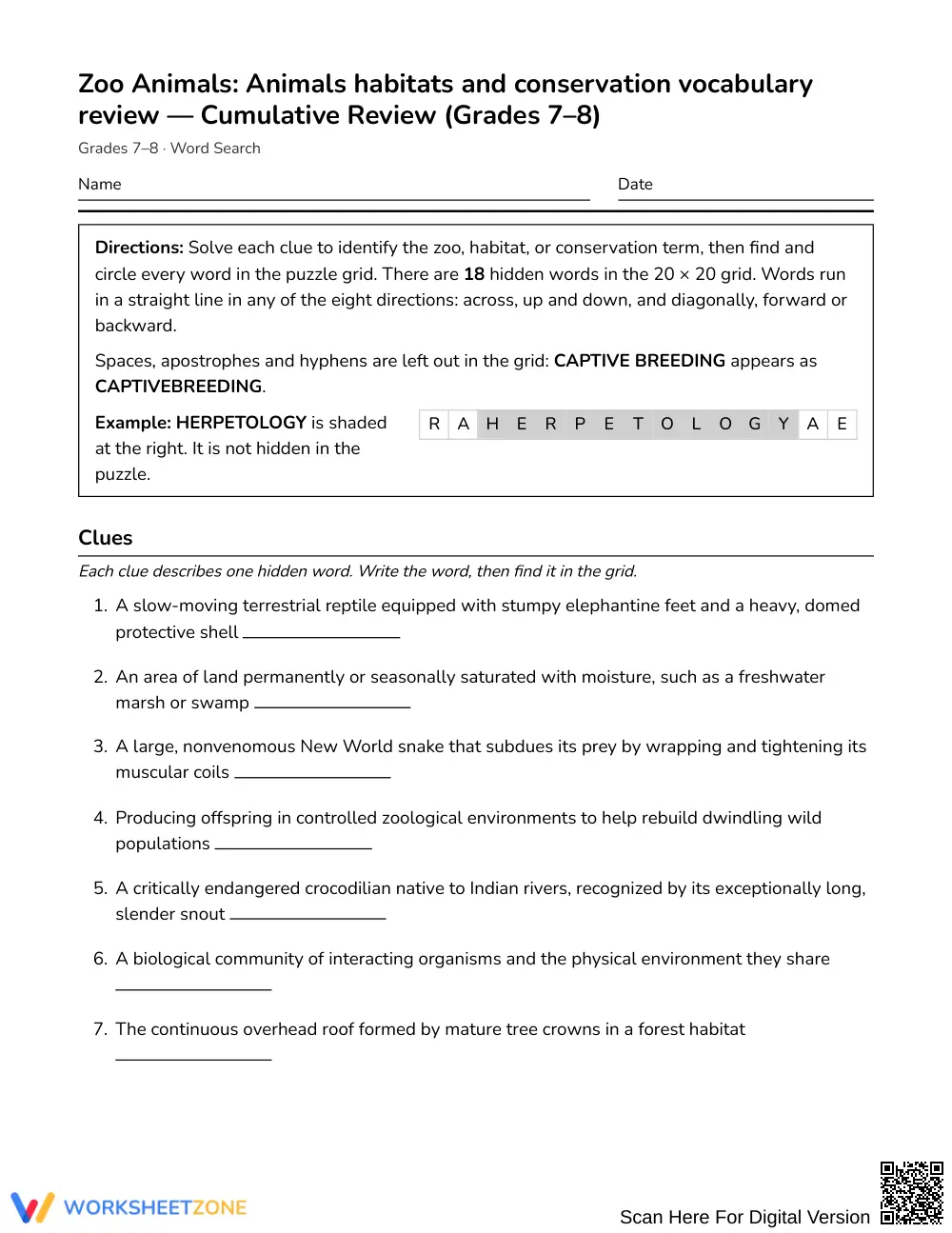
This science word search reinforces essential ecology and zoology vocabulary for middle school students. Designed for Grades 7–8, the activity challenges learners to read detailed scientific clues, identify corresponding species and environmental principles, and locate all 18 vocabulary terms hidden across the puzzle grid. It provides rigorous, engaging reinforcement for life science and ecology units.
At a Glance
- Grade: Grades 7–8 · Subject: Science
- Standard: Not standards-assessed — vocabulary enrichment
- Skill Focus: Animals, habitats, and conservation vocabulary review
- Format: 3 pages · 18 words · Answer key included · PDF
- Best For: Cumulative vocabulary review and sub plans
- Time: 25–35 minutes
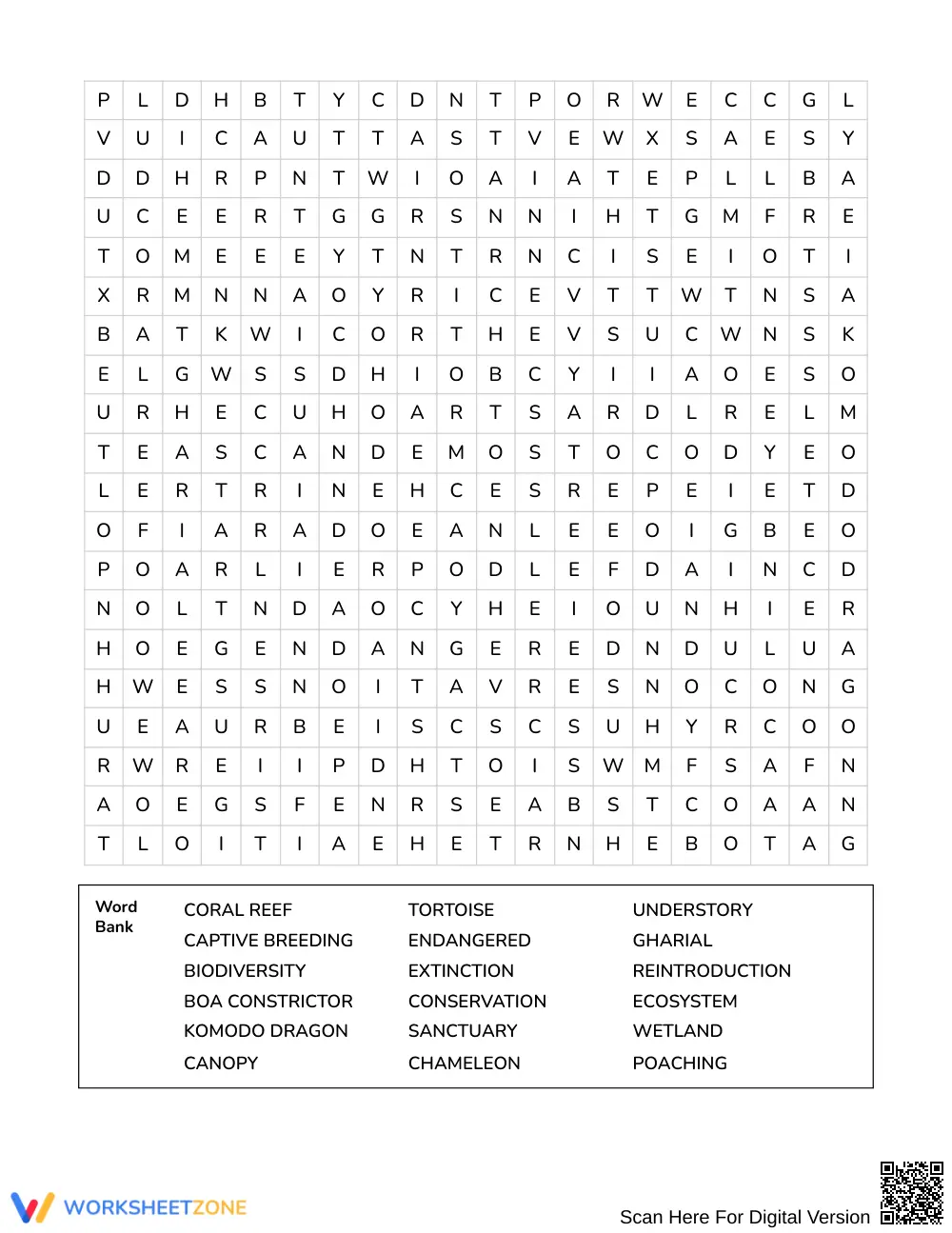
This 3-page printable science resource includes a comprehensive 18-word search puzzle accompanied by a complete definition-based clue sheet. Instead of a basic word list, students read thorough scientific descriptions—spanning ecological roles, habitat structures, and conservation actions—to determine each target term before searching. The packet also features a clear 4-page answer key showing exact word locations and completed solutions for rapid checking.
The puzzle features a dense 20 x 20 letter grid designed to provide an authentic challenge for middle schoolers. Words run in all 8 possible directions: north, northeast, east, southeast, south, southwest, west, and northwest. Students work from a shuffled word bank and matching scientific clues, requiring active recall of ecological concepts such as captive breeding, biodiversity, canopy layers, and endangered species before tracking each term.
This cumulative review activity serves as supplementary vocabulary enrichment and is not aligned to a specific state or national standard. It supports foundational scientific literacy by reinforcing precise terminology across ecosystem dynamics, biodiversity preservation, and wildlife management.
Use this word search as an engaging wrap-up activity after direct instruction on conservation biology, or assign it as a zero-prep emergency sub plan. During independent work, circulate to observe whether students use clue definitions to identify terms before locating them, rather than scanning the grid passively. Most students will complete the puzzle and clue matching within 25 to 35 minutes.
This resource is crafted for Grades 7–8 science classes, general life science courses, and environmental science clubs. It offers accessible terminology reinforcement for diverse learners, including multilingual students acquiring academic vocabulary. Pair this puzzle with an introductory reading passage on global biodiversity hotspots or a classroom lecture on wildlife conservation efforts.
Reinforcing domain-specific terminology is vital for scientific comprehension in the middle grades. This Grades 7–8 science word search targets 18 essential terms spanning animal adaptations, habitat tiers, and wildlife conservation practices. According to Fisher & Frey (2014), intentional exposure to academic vocabulary through diverse, low-stakes modalities strengthens conceptual retention and enables students to articulate complex relationships in content-area discussions. By linking rigorous definitional clues directly to active puzzle retrieval, this printable resource prompts learners to process ecological principles—such as biodiversity, reintroduction, and trophic ecosystems—rather than memorizing terms in isolation. The activity functions effectively as an introductory hook, a formative review checkpoint, or an independent vocabulary station. As middle school learners solidify their understanding of key environmental concepts, they build the foundational scientific literacy required for subsequent analytical reading, laboratory investigations, and evidence-based ecological discussions across secondary science coursework.


