





























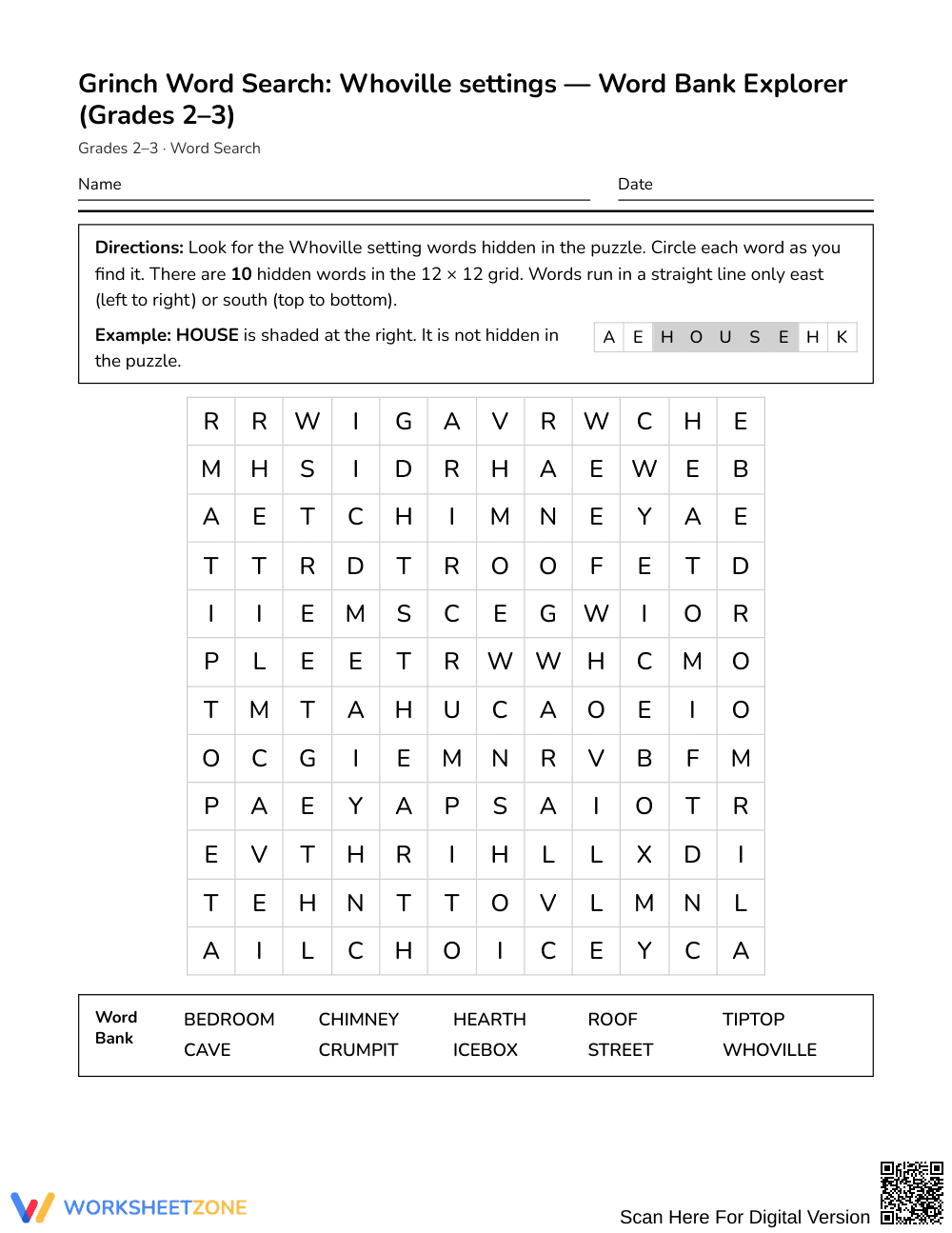


Printable Whoville Settings Word Search | Grades 2–3 ELA

Paste this activity's link or code into your existing LMS (Google Classroom, Canvas, Teams, Schoology, Moodle, etc.).
Students can open and work on the activity right away, with no student login required.
You'll still be able to track student progress and results from your teacher account.
This Grades 2–3 seasonal word search strengthens story setting vocabulary by guiding learners to locate 10 narrative terms from the classic Grinch tale. Students reinforce literary comprehension and spatial recognition as they search for key Whoville locations, boosting text engagement during seasonal holiday reading units.
At a Glance
- Grade: Grades 2–3 · Subject: English Language Arts (ELA)
- Standard: Not standards-assessed — vocabulary enrichment for seasonal reading units
- Skill Focus: Whoville story settings and descriptive vocabulary recognition
- Format: 1 page · 10 words · Answer key included · PDF
- Best For: Seasonal literacy centers, quiet independent work, and sub plans
- Time: 15–20 minutes
What's Inside
This 1-page printable activity features a clean puzzle grid paired with an alphabetical bank of 10 setting-themed vocabulary terms. Descriptive sentence clues define each featured location, helping students connect literary terms to narrative context. A complete 2-page answer key provides full visual solutions for effortless grading and student self-correction.
Puzzle Mechanics and Structure
The puzzle utilizes a clear 12 x 12 letter grid calibrated for early elementary students. Hidden words run strictly in two accessible directions: horizontally East (left to right) and vertically South (top to bottom). No backwards or diagonal placements appear, allowing second and third graders to build scanning confidence while referencing the alphabetical word bank.
Standards Alignment
This activity provides pure vocabulary enrichment and does not align to a formal academic standard code. It supports general English Language Arts proficiency by deepening familiarity with descriptive setting vocabulary, story elements, and narrative details during holiday book studies.
How to Use It
Incorporate this activity immediately after a whole-class reading of the Grinch story to consolidate setting comprehension, or assign it during independent literacy rotations. For formative assessment, observe whether students cross-reference the descriptive clues to identify settings before scanning the grid. Completing the full search typically takes between 15 and 20 minutes.
Who It's For
This resource serves second- and third-grade elementary classrooms, reading intervention groups, and homeschool environments seeking festive skill reinforcement. It offers accessible scanning practice for developing readers and pairs naturally with a winter setting anchor chart or holiday picture-book read-aloud.
According to research by Fisher & Frey (2014), purposeful word play and thematic vocabulary exploration provide essential support for reading comprehension by deepening students' mental models of narrative texts. Although this seasonal puzzle is not standards-assessed, identifying story setting vocabulary directly supports literacy development by connecting spatial search tasks with contextual setting definitions. When second and third graders locate high-interest words like hearth, chimney, and Crumpit, they actively retrieve key background concepts associated with narrative structures. Engaging with an organized 12 by 12 word grid reinforces visual scanning and spelling retention without creating cognitive overload. Research emphasizes that playful, low-stakes vocabulary activities strengthen orthographic memory, particularly when embedded in meaningful thematic literature units. Consequently, this targeted Whoville setting activity functions as an effective supplementary tool for developing early elementary language acquisition and reading confidence.


