


























Views
Downloads

Printable Weather Tools Word Search | Grades 4–5 Science
Paste this activity's link or code into your existing LMS (Google Classroom, Canvas, Teams, Schoology, Moodle, etc.).
Students can open and work on the activity right away, with no student login required.
You'll still be able to track student progress and results from your teacher account.
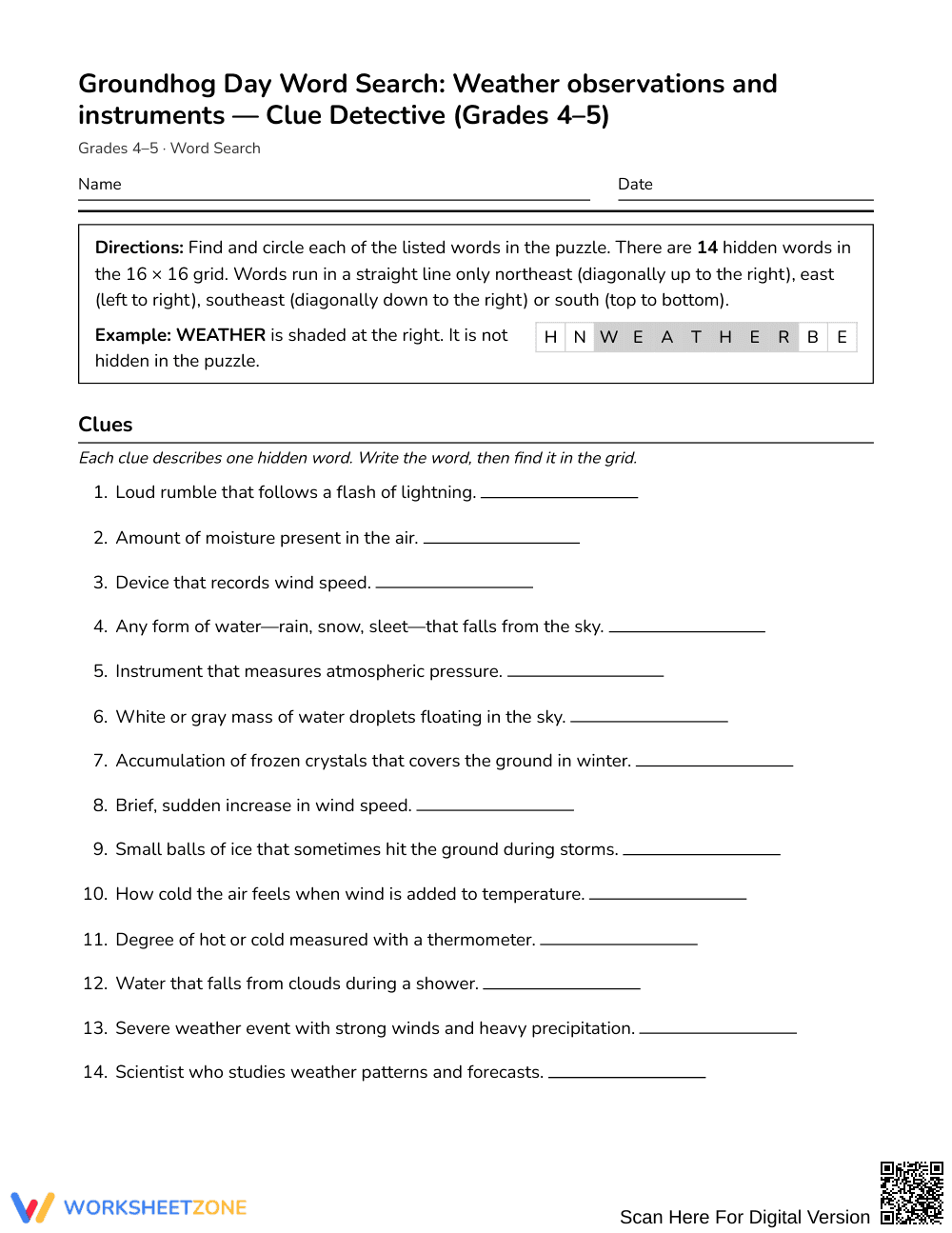
This weather observations and instruments word search strengthens science vocabulary for upper elementary learners. Students identify 14 atmospheric terms and measurement tools by connecting clues to target words. The puzzle reinforces earth science concepts while building term recognition and spelling.
At a Glance
- Grade: Grades 4–5 · Subject: Elementary Science
- Standard: Not standards-assessed — vocabulary enrichment
- Skill Focus: Weather observations and atmospheric measurement instruments
- Format: 2 printable student pages · 14 target vocabulary words · Full 3-page answer key included · Printable PDF
- Best For: Science vocabulary review and learning centers
- Time: 20–30 minutes
What's Inside
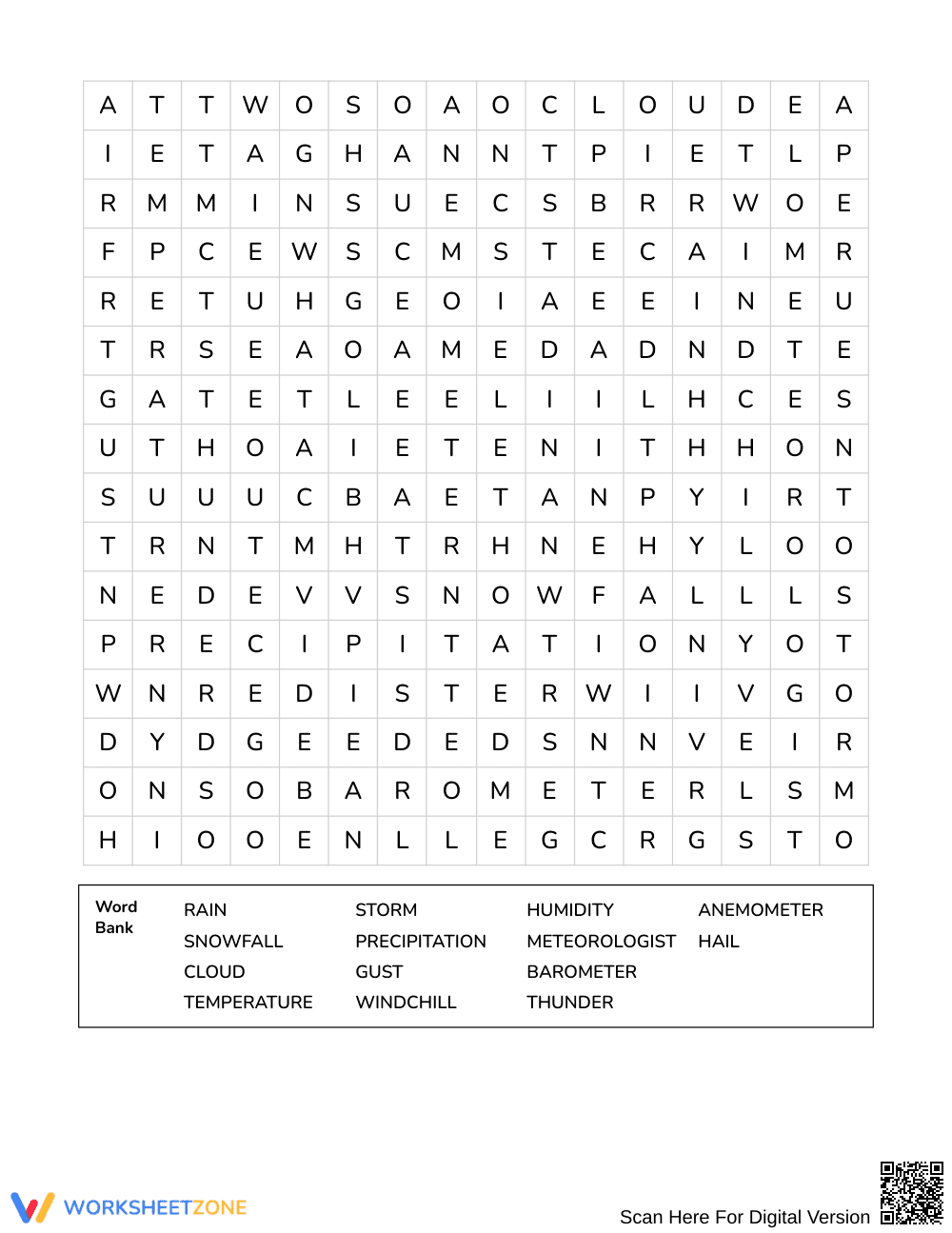
This 2-page science resource features a 16 by 16 letter grid alongside 14 clue-based vocabulary challenges. Students read scientific definitions to determine each target term before searching the puzzle. The file includes a shuffled word bank for spelling verification and a 3-page visual answer key showing word locations.
Puzzle Structure and Mechanics
The puzzle is built around specific search parameters designed for upper elementary learners:
- Grid Layout: A 16 by 16 grid contains all 14 hidden science terms.
- Word Directions: Terms run in four orientations: northeast, east, southeast, and south.
- Clue Detective Clues: Students solve 14 definitional clues with support from a shuffled word bank.
Standards Alignment
This word search provides vocabulary enrichment and is not aligned to a specific standard. Instead, it supports upper elementary earth science units by reinforcing domain-specific terms such as barometer, anemometer, precipitation, and humidity. The activity strengthens scientific literacy and spelling during weather tool investigations.
How to Use It
Use this activity across two distinct classroom moments:
- Pre-Teaching Vocabulary: Distribute the puzzle before direct instruction to introduce instrument names and weather terminology.
- Post-Lesson Practice: Assign the puzzle after lessons on weather measurement tools to consolidate concept recall.
For formative assessment, observe whether students deduce answers directly from the clues or depend on the shuffled bank to match instruments to their functions. Completion typically takes 20 to 30 minutes.
Who It's For
This resource serves Grades 4–5 students learning weather patterns, atmospheric conditions, and measurement instruments. It supports general science classes, English language learners acquiring specialized terminology, and early finishers. For an integrated science lesson, pair this puzzle with an illustrated weather instrument anchor chart.
Weather vocabulary acquisition provides upper elementary students with the foundation necessary to explain atmospheric phenomena and interpret scientific measurements. This 2-page educational word search focuses on weather observations and instruments across 14 specialized terms, including anemometer, barometer, and meteorologist. Rather than relying on rote memorization, the activity integrates descriptive clues that require students to connect precise operational definitions with scientific terminology before finding each word in a 16 by 16 grid. According to Fisher & Frey (2014), intentional exposure to domain-specific vocabulary through contextualized practice significantly enhances comprehension and content-area literacy. By orienting words across four non-reversed directions—northeast, east, southeast, and south—the puzzle fosters sustained visual attention and orthographic mapping. As a self-contained vocabulary enrichment resource complete with a 3-page answer key, this activity offers Grades 4–5 science teachers an effective tool for reinforcing meteorological concepts during independent practice, science stations, or seasonal Groundhog Day studies.


