































Printable Useful Linear Form Worksheet | Grade 9 Algebra I

Paste this activity's link or code into your existing LMS (Google Classroom, Canvas, Teams, Schoology, Moodle, etc.).
Students can open and work on the activity right away, with no student login required.
You'll still be able to track student progress and results from your teacher account.
This worksheet teaches Grade 9 Algebra I students to choose slope-intercept, point-slope, or standard form based on the information a situation gives, then build and use a linear model. Students finish able to justify their form choice and answer real-world questions with units.
At a Glance
- Grade: 9 · Subject: Algebra I
- Standard: Code not supplied — Choose a form of a linear equation and use it to model a situation
- Skill Focus: Select a useful form for a linear model
- Format: 5 pages · 10 problems · Answer key included · PDF
- Best For: Practice after teaching the three linear forms
- Time: 45–60 minutes
What's Inside
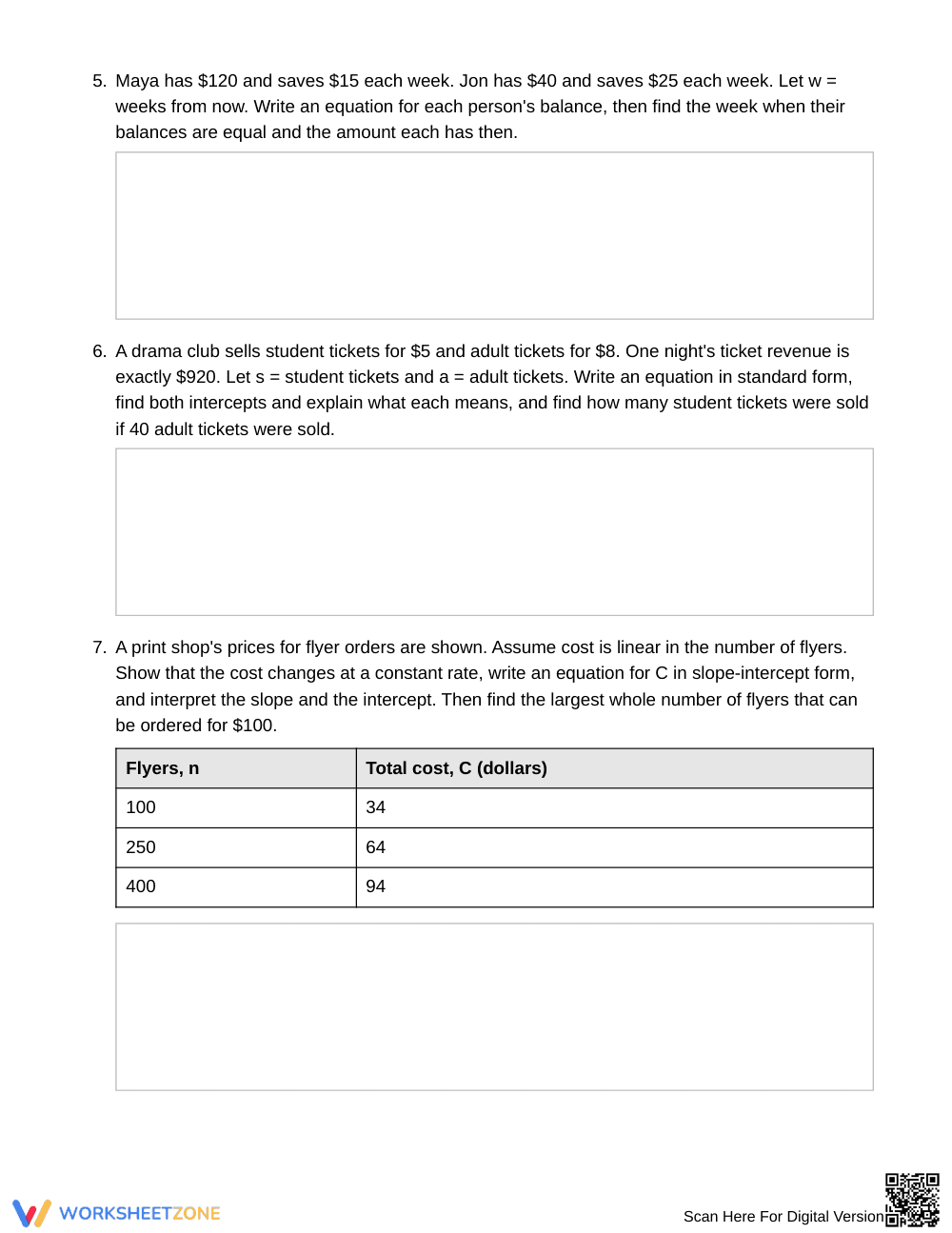
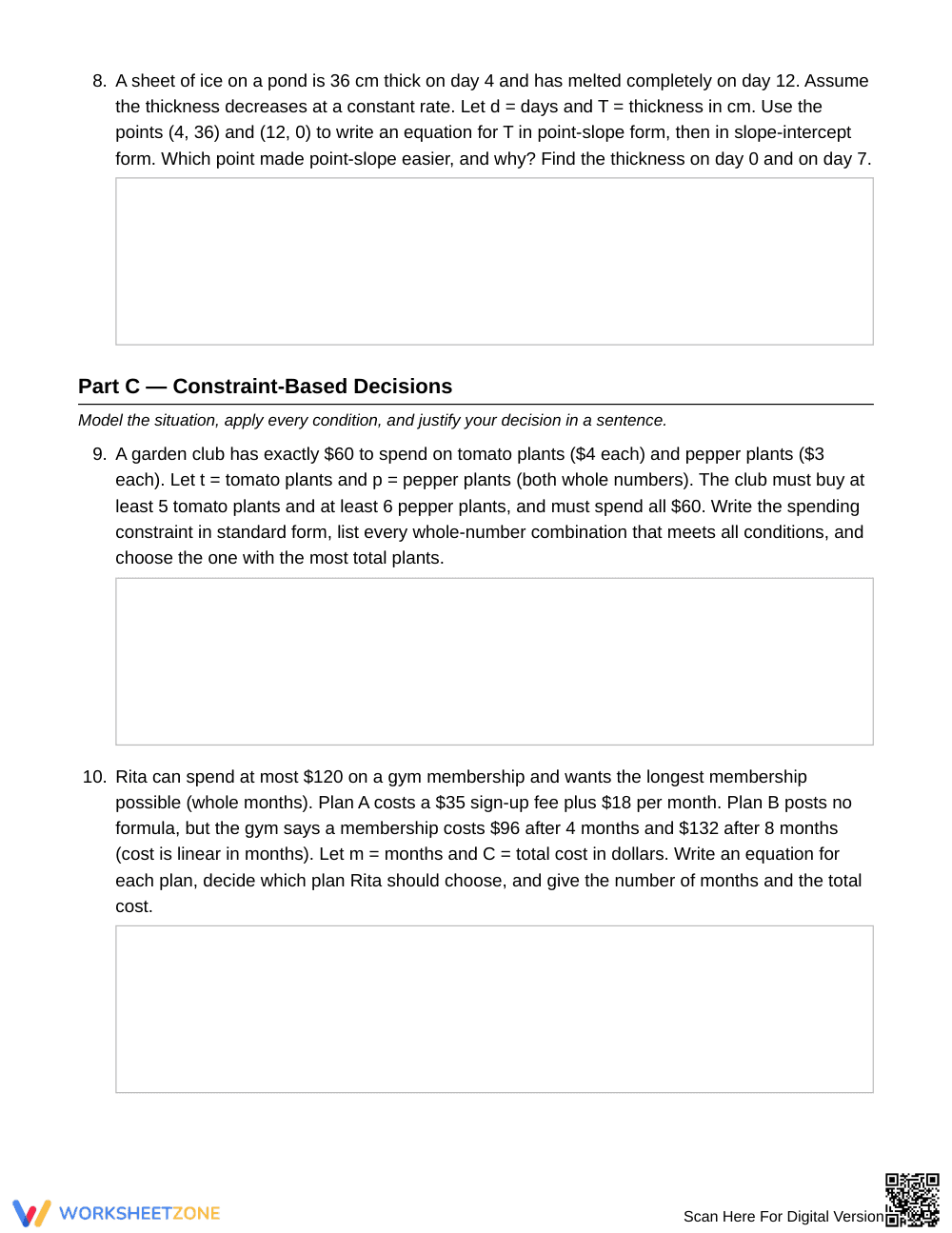
The 5-page student packet opens with a reference table comparing slope-intercept, point-slope, and standard form, followed by a short conventions box and a fully worked kayak-rental model. Ten tasks follow, including a graph, a data table, and word problems. A 2-page answer key shows the equation and the final answers for every task.
Skill Progression
- Guided practice (Part A, 2 problems): Students write a model from a fee-plus-rate situation or a rate-plus-point situation and name the form, with the worked model as a guide.
- Supported practice (Part B, 6 problems): Multi-step applications use a graph, a table, two-point data, a comparison of two savers, and a standard-form revenue model. Students convert between forms and interpret the slope and intercept.
- Independent practice (Part C, 2 problems): Students apply constraints, compare two plans, and justify a decision in a sentence.
The sequence follows a gradual-release pattern: I Do (model case), We Do (Parts A and B), You Do (Part C).
Standards Alignment
No standard code was supplied for this worksheet, so none is listed. The task set targets writing linear equations in different forms, converting between them, and interpreting slope and intercept in context. Add your district's standard code to lesson plans, IEP goals, or curriculum mapping tools.
How to Use It
- After direct instruction: Assign Parts A and B as classwork once students have seen all three forms. Allow 45–60 minutes.
- Review before a unit assessment: Assign Part C alone as a 15–20 minute check.
As students work, watch whether they name a form before writing an equation. Students who always default to slope-intercept may need another look at the reference table.
Who It's For
Grade 9 Algebra I students who can already write and graph linear equations and now need to decide which form fits a situation. Students who need support can lean on the worked model and the reference table. Pair it with a short lesson that compares the three forms side by side.
Choosing a Useful Form for a Linear Model is a Grade 9 Algebra I worksheet with 10 tasks over 5 pages, including a 2-page answer key. Students learn to match slope-intercept, point-slope, or standard form to the information in a situation, write the equation, convert between forms, and interpret slope and intercept in context. A worked kayak-rental model, two direct-model tasks, six multi-step applications, and two constraint-based decisions move students from guided to independent work. This structure follows the gradual release of responsibility described by Fisher & Frey (2014), in which teachers shift from modeling to guided practice to independent application. No standard code was supplied for this resource, so alignment is described by skill: selecting and justifying a useful form of a linear equation for a modeling situation. Teachers can use it for practice, review, or formative checks.


