































Printable Two-Stage Sample Space Worksheet | Grade 7 Math

Paste this activity's link or code into your existing LMS (Google Classroom, Canvas, Teams, Schoology, Moodle, etc.).
Students can open and work on the activity right away, with no student login required.
You'll still be able to track student progress and results from your teacher account.
This Grade 7 math worksheet develops student proficiency in organizing two-stage sample spaces to determine compound event probabilities. Through systematic lists, two-way tables, and tree diagrams, students build concrete models to identify favorable outcomes and calculate accurate theoretical probabilities for multi-step experiments.
At a Glance
- Grade: 7 · Subject: Math
- Standard:
7.SP.C.8— Find probabilities of compound events using organized lists, tables, and tree diagrams.- Skill Focus: Organize a Two-Stage Sample Space
- Format: 5 pages · 12 problems · Answer key included · PDF
- Best For: Guided practice and independent mastery
- Time: 40–50 minutes
This 5-page printable resource features 12 targeted mathematical tasks, concise concept definitions, and 2 fully worked visual examples demonstrating tree diagrams and grid models. Students encounter missing-step completions, multi-step construction exercises, and written error-analysis prompts. A 2-page detailed answer key provides complete sample spaces, intermediate calculation steps, and simplified fractional probabilities for efficient grading.
Skill Progression
- Guided Practice (Part A, Problems 1–4): Scaffolds learning with partially completed tables, structured lists, and fill-in blanks that reinforce systematic sample space generation.
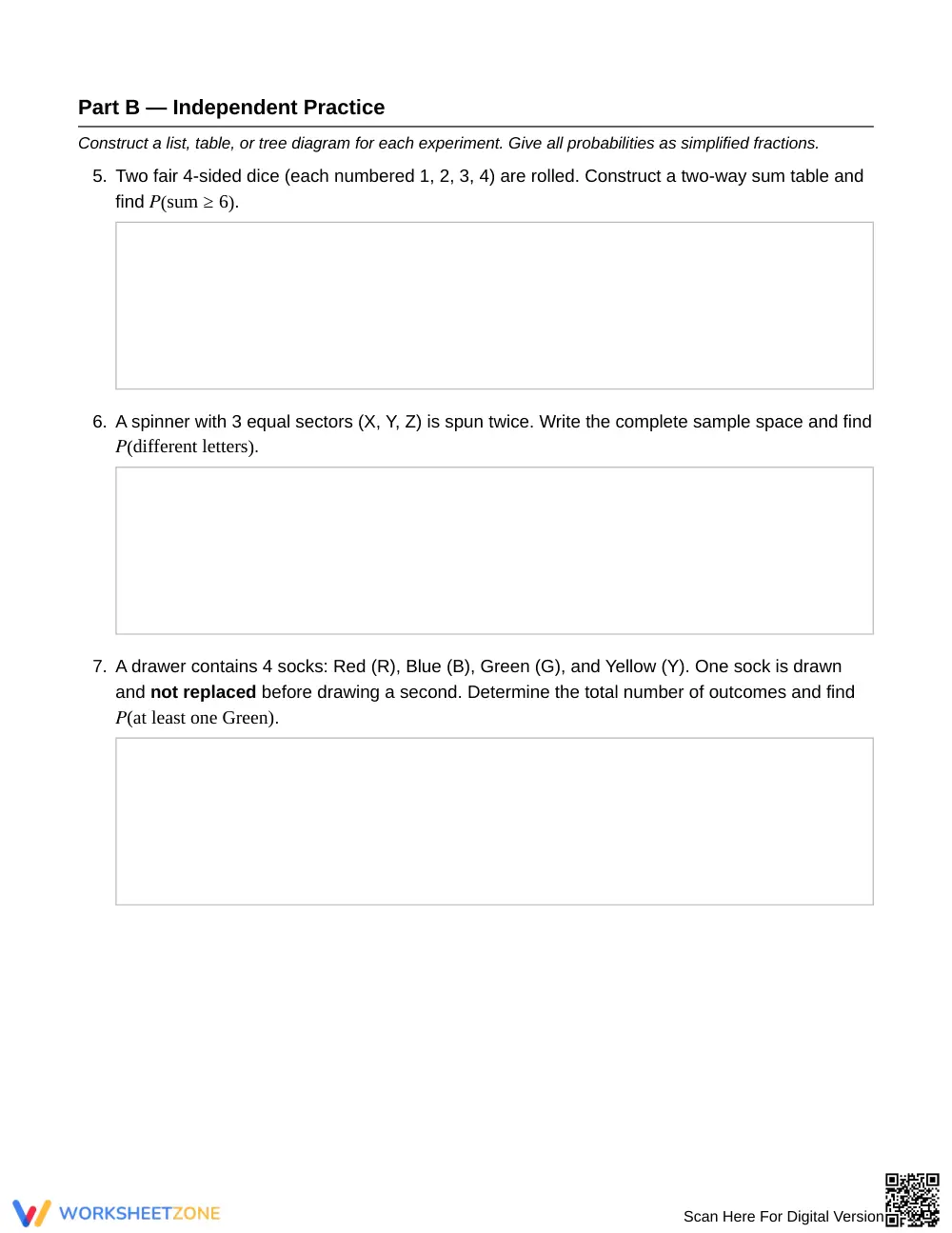
- Supported Practice (Part B, Problems 5–8): Directs students to construct independent two-way sum tables, tree diagrams, and compound event lists involving replacement scenarios.
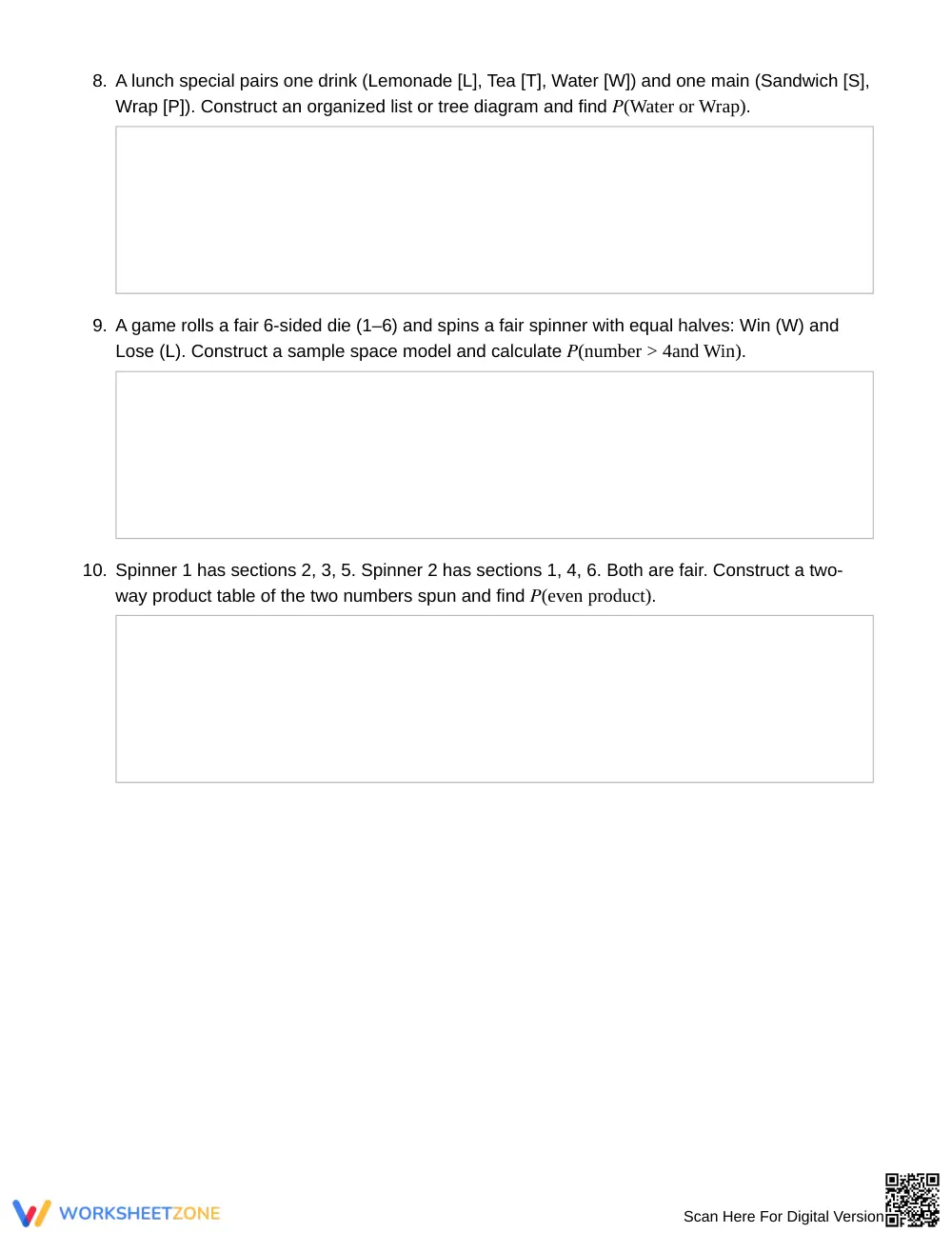
- Independent Practice (Part B & C, Problems 9–12): Challenges learners to generate product models, evaluate complex compound events, and diagnose misconceptions through written error analysis.
This sequence follows a gradual-release instructional model, transitioning students from structured graphic organizers to autonomous mathematical reasoning.
Standards Alignment
This worksheet directly aligns with Common Core standard 7.SP.C.8: Find probabilities of compound events using organized lists, tables, tree diagrams, and simulation. Both standard codes can be copied directly into lesson plans, IEP goals, or district curriculum mapping tools.
How to Use It
Administer this worksheet directly after introducing tree diagrams and sample spaces during whole-class direct instruction. Alternatively, assign Part A during small-group guided practice and reserve Parts B and C for partner collaboration or independent classwork. During completion, monitor how students organize their sample spaces; watch for students who omit repeated combinations or miscount total outcomes in replacement items. Completion typically requires 40 to 50 minutes.
Who It's For
This resource supports on-grade Grade 7 math classrooms, accelerated Grade 6 probability units, and Grade 8 intervention groups reinforcing foundational statistics. It pairs naturally with hands-on probability manipulatives such as standard dice, two-color counters, and spinner charts during initial concept exploration.
According to research on explicit mathematics instruction synthesized by Fisher & Frey (2014), structured instructional frameworks that incorporate visual modeling and gradual release significantly improve student mastery of complex mathematical structures. Common Core standard 7.SP.C.8 requires Grade 7 learners to organize two-stage sample spaces using systematic lists, two-way tables, and tree diagrams to compute compound theoretical probabilities. This 5-page worksheet provides 12 scaffolded tasks that operationalize these pedagogical principles, moving students from guided table completion to independent model construction and analytical error correction. By connecting visual grid representations to fractional probability calculations, the resource prevents common cognitive errors such as confounding ordered outcomes or misinterpreting replacement constraints. Educators can implement this standards-aligned asset during core probability units, small-group intervention, or formal progress monitoring to verify student proficiency in systematic counting methods and compound probability determination.


