


























Views
Downloads

Printable Shark Body Parts Word Search | Grades 2–3 Science
Paste this activity's link or code into your existing LMS (Google Classroom, Canvas, Teams, Schoology, Moodle, etc.).
Students can open and work on the activity right away, with no student login required.
You'll still be able to track student progress and results from your teacher account.
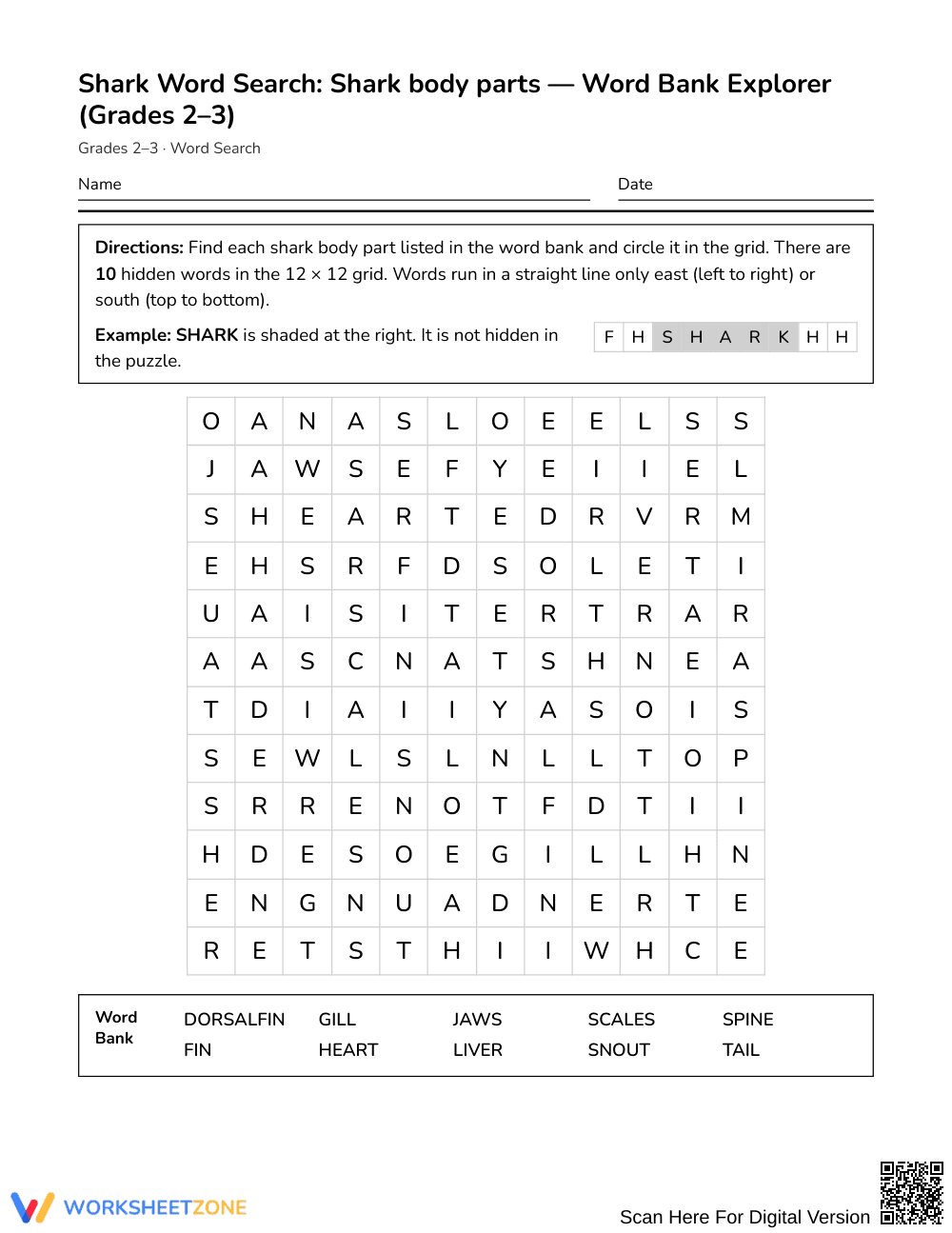
This printable science word search reinforces marine biology vocabulary by challenging elementary learners to locate key anatomical terms. Students build recognition of 10 essential shark body parts while strengthening visual discrimination and spelling skills. The clean format provides focused, independent science engagement without unnecessary visual distractions.
At a Glance
- Grade: Grades 2–3 · Subject: Science
- Standard: Not standards-assessed — vocabulary enrichment
- Skill Focus: Shark body parts
- Format: 1 page · 10 words · Answer key included · PDF
- Best For: Science centers or quick sub plans
- Time: 15–20 minutes
What's Inside
This single-page vocabulary activity presents an accessible 12 × 12 letter grid alongside an alphabetized word bank containing 10 target anatomy terms. Words include both external structures like fins and gills as well as vital internal organs. A complete 2-page answer key provides clear letter paths, making verification quick and painless.
Puzzle Mechanics and Structure
The puzzle is calibrated specifically for early elementary learners to prevent frustration while sustaining focus:
- Grid Dimensions: A compact 12 × 12 grid provides a targeted visual search area that does not overwhelm young readers.
- Search Directions: All 10 terms are hidden strictly in East (left-to-right) and South (top-to-bottom) orientations, mirroring conventional reading patterns.
- Vocabulary Bank: The alphabetical bank organizes key terms including dorsal fin, snout, liver, and scales, encouraging systematic cross-checking.
Standards Alignment
This resource serves as targeted vocabulary enrichment and is not aligned to a formal performance standard. It supplements life science units on animal structures, adaptations, and marine ecosystems by solidifying foundational domain-specific terminology.
How to Use It
Deploy this activity during or immediately after a direct instruction lesson on fish anatomy to reinforce anatomical vocabulary. It functions smoothly as a low-prep warm-up, early finisher choice, or science station rotation. For formative assessment, observe whether students read full terms systematically or spot isolated letters, noting which anatomical words require further review. Expected completion time is 15 to 20 minutes.
Who It's For
This resource is tailored for learners in Grades 2–3 exploring ocean life and vertebrate adaptations. It offers natural scaffolding for emerging readers through predictable word orientations and clearly defined letter spacing. Pair this word search directly with a labeled shark diagram or a non-fiction read-aloud about ocean predators.
Explicit vocabulary exposure within introductory life science units supports long-term reading comprehension and domain mastery. According to EdReports 2024 foundational literacy and content review guidelines, systematic reinforcement of topic-specific words helps young students anchor academic language before tackling complex informational texts. When early elementary learners identify and review marine biology terms like gills, scales, and fins through structured word searches, they build orthographic familiarity alongside scientific conceptual awareness. The predictable spatial layout minimizes cognitive overload, allowing second and third graders to focus on word patterns, letter sequences, and correct scientific spelling. This targeted repetition solidifies essential anatomical vocabulary, ensuring students can confidently recognize, decode, and apply domain-specific concepts during subsequent reading, diagramming, and classroom science discussions.


