


























Views
Downloads

Printable SEL Worksheet: Feelings Edition | Grades 2-5
Paste this activity's link or code into your existing LMS (Google Classroom, Canvas, Teams, Schoology, Moodle, etc.).
Students can open and work on the activity right away, with no student login required.
You'll still be able to track student progress and results from your teacher account.
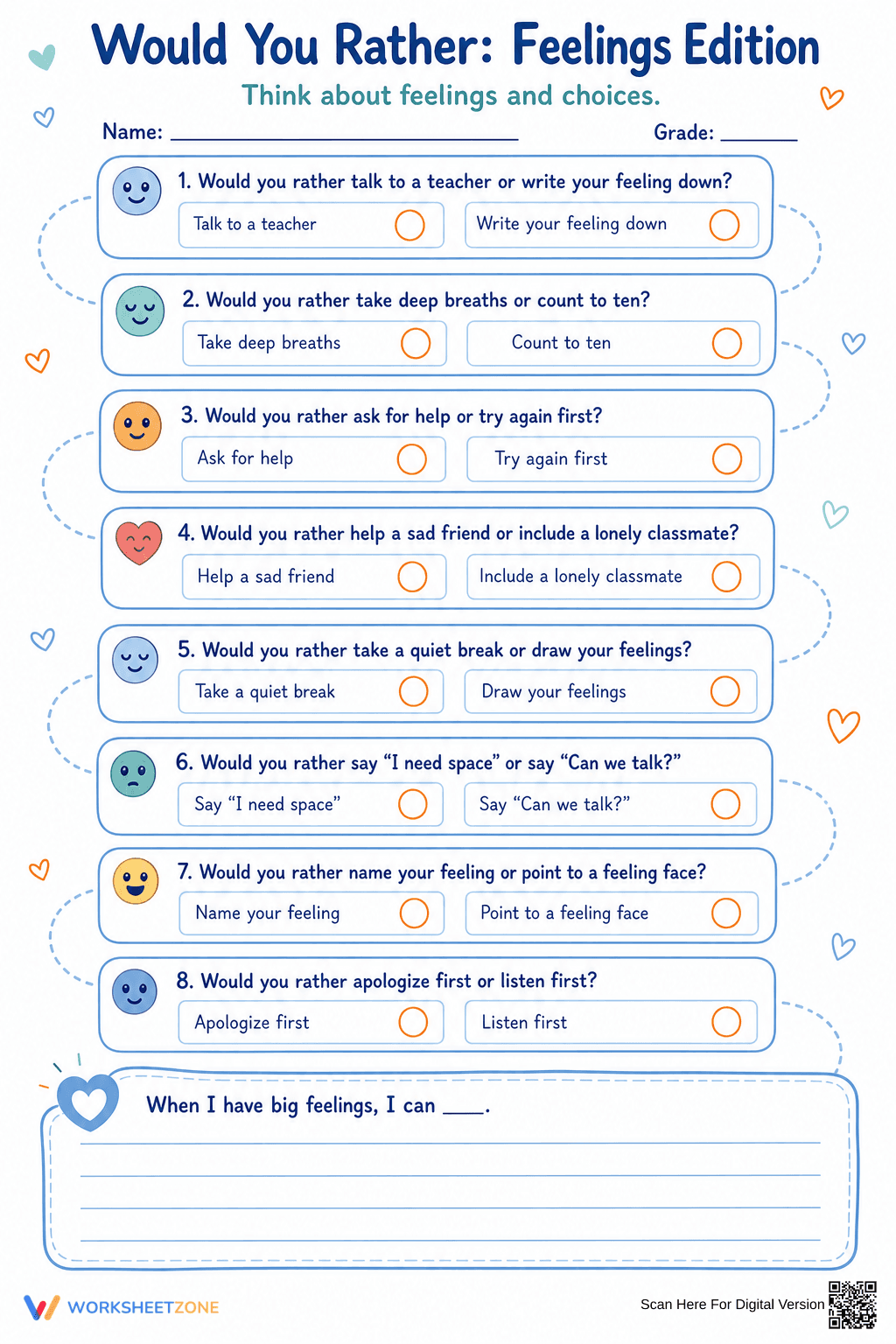
This Grade 2-5 SEL worksheet helps students identify personal coping strategies and social preferences through a series of "Would You Rather" prompts. By choosing between two positive actions, students build emotional literacy and self-awareness. The activity concludes with a written reflection to solidify their understanding of emotional regulation and proactive choice-making.
At a Glance
- Grade: 2-5 · Subject: Social Emotional Learning
- Standard:
CCSS.ELA-LITERACY.SL.3.1— Engage in collaborative discussions about feelings and choices- Skill Focus: Emotional regulation and social awareness
- Format: 1 page · 9 tasks · No answer key · PDF
- Best For: Morning meetings or small group SEL
- Time: 15–20 minutes
The worksheet features a visually engaging "feelings path" connecting eight distinct question cards. Each card presents a relatable scenario, such as choosing between deep breathing or counting to ten. The layout includes clear check circles for student responses and a dedicated reflection area at the bottom with a guided sentence starter for deeper processing and personal connection.
Zero-Prep Workflow
- Print: Generate the single-page PDF in under 30 seconds for your entire class.
- Distribute: Hand out the sheets during morning arrival or a transition period (1 minute).
- Review: Facilitate a 10-minute group discussion where students share their preferences and explain their reasoning.
This resource is an ideal "no-prep" solution for busy educators or substitute teachers looking for meaningful, low-stress activities.
Standards Alignment
Primary alignment is to `CCSS.ELA-LITERACY.SL.3.1`, which focuses on engaging effectively in a range of collaborative discussions. While the worksheet is a personal reflection tool, it serves as the primary scaffold for the Speaking and Listening strand by providing structured choices for students to share. Both standard codes can be copied directly into lesson plans, IEP goals, or district curriculum mapping tools.
How to Use It
Use this as a Morning Meeting icebreaker to set a calm and reflective tone for the school day. Alternatively, assign it as a formative assessment after a lesson on coping skills to observe which strategies students gravitate toward. During the activity, walk around and note which students struggle to choose, as this can indicate a need for further 1-on-1 support. Completion time ranges from 15 to 20 minutes.
Who It's For
This activity is perfect for general education students in grades 2 through 5, as well as small-group counseling sessions or speech therapy. It pairs naturally with an anchor chart on "Calm Down Choices" or a direct instruction lesson on identifying emotions. The clean design is also suitable for students who require minimal visual distraction.
According to Fisher & Frey (2014), providing students with structured choices and sentence frames is essential for developing the metacognitive skills required for emotional regulation. This worksheet aligns with `CCSS.ELA-LITERACY.SL.3.1` by facilitating the transition from individual reflection to collaborative peer discussion. By evaluating 8 specific social-emotional scenarios, students practice the plain-English skill of identifying and communicating personal needs during moments of stress. Research from the RAND AIRS 2024 report suggests that consistent, low-stakes SEL activities significantly improve classroom climate and student engagement. This resource provides a concrete tool for educators to integrate these practices without increasing administrative burden. The inclusion of a guided reflection box ensures that students move beyond simple selection to internalizing their chosen coping mechanisms, a key component of long-term behavioral success in elementary settings.


